5 PPC Ad Management Strategies That Drive Real ROI
Learn 5 expert PPC ad management strategies to lower costs, boost conversions, and maximize ROI for your business in 2026.

Key Takeaways
-
Build a tightly structured campaign hierarchy (campaigns → ad groups → ads → landing pages) with closely related keywords to improve Quality Scores and lower cost per click significantly.
-
Focus PPC bidding on high-intent, transactional keywords where users are actively ready to buy or hire, rather than broad informational searches that waste budget on unqualified clicks.
-
Ensure message match between ad copy and landing pages—users clicking an ad about a specific service must land on a dedicated page about that service, not your homepage, to maximize conversions.
-
Test and refine ad copy continuously by A/B testing headlines and descriptions to identify high-performing messages that resonate with your audience and compound into lower costs over time.
-
Review search term reports weekly, adjust bids by device/location/time, monitor Quality Scores, and analyze conversion data to continuously optimize campaigns instead of leaving them on autopilot.
-
Consider hiring a professional PPC manager if your cost per click keeps rising without conversion increases, competitors consistently outrank you, or you're unsure whether campaigns are actually profitable.
Running paid ads without a clear strategy is one of the fastest ways to drain your marketing budget. Many small business owners launch Google Ads campaigns with high hopes, only to watch their spend disappear with little to show for it. The difference between wasted ad spend and a profitable campaign almost always comes down to one thing: professional PPC ad management.
Pay-per-click advertising is one of the most powerful tools in digital marketing. When managed correctly, it puts your business in front of people who are actively searching for what you offer. But without proper oversight, targeting, and optimization, even a generous ad budget can produce disappointing results. In 2026, the stakes are higher than ever as competition for ad placements grows more intense.
This guide breaks down five proven PPC ad management strategies that help businesses of all sizes generate real, measurable returns. Whether you are a local service provider, an e-commerce retailer, or a growing startup, these strategies will help you get more from every dollar you spend on paid advertising.

What Is PPC Ad Management?
PPC ad management refers to the ongoing process of planning, launching, monitoring, and optimizing pay-per-click advertising campaigns. These campaigns typically run on platforms like Google Ads, where businesses bid on keywords and pay each time a user clicks their ad. Effective management goes well beyond just setting a budget and writing an ad headline.
A well-managed PPC campaign involves continuous refinement. It includes keyword research, audience targeting, bid strategy adjustments, ad copy testing, landing page optimization, and detailed performance reporting. Each of these elements works together to lower your cost per click and increase your return on investment. You can learn more about how this works by reading how to run Google Ads that actually drive results.

Why Most Businesses Struggle with PPC
PPC advertising sounds straightforward on the surface. You choose keywords, write an ad, set a budget, and let it run. In practice, however, most businesses run into the same common problems. Understanding these challenges is the first step toward overcoming them.
Here are the most frequent PPC pain points businesses face:
- Targeting keywords that are too broad, leading to irrelevant clicks
- Writing generic ad copy that does not speak to the customer’s specific need
- Sending traffic to a homepage instead of a dedicated landing page
- Ignoring negative keywords, which wastes budget on unqualified searches
- Failing to track conversions, making it impossible to measure ROI
- Setting bids once and never adjusting them based on performance data
These mistakes are incredibly common, and they are also very costly. If any of these sound familiar, you are not alone. For a deeper look at what goes wrong, read about the 7 pay-per-click advertising mistakes that drain your budget.

Strategy 1: Build a Tightly Structured Campaign from the Start
The foundation of every successful PPC ad management effort is a well-organized campaign structure. Many businesses make the mistake of dumping all their keywords into a single ad group. This approach makes it nearly impossible to write relevant ad copy and usually results in low Quality Scores, which drives up your cost per click.
A strong campaign structure follows a logical hierarchy:
- Campaign level: Organize by product category, service type, or geographic target
- Ad group level: Break each campaign into tightly themed groups of closely related keywords
- Ad level: Write specific ad copy that directly addresses the keywords in each ad group
- Landing page level: Match every ad group to a dedicated landing page that continues the message
- Negative keyword level: Add exclusions to prevent your ads from appearing in irrelevant searches
When your campaign structure is clean and logical, Google rewards you with higher Quality Scores. Higher scores mean lower costs and better ad placements. This single organizational step can dramatically improve the efficiency of your entire campaign.
Strategy 2: Master Keyword Intent Before Bidding
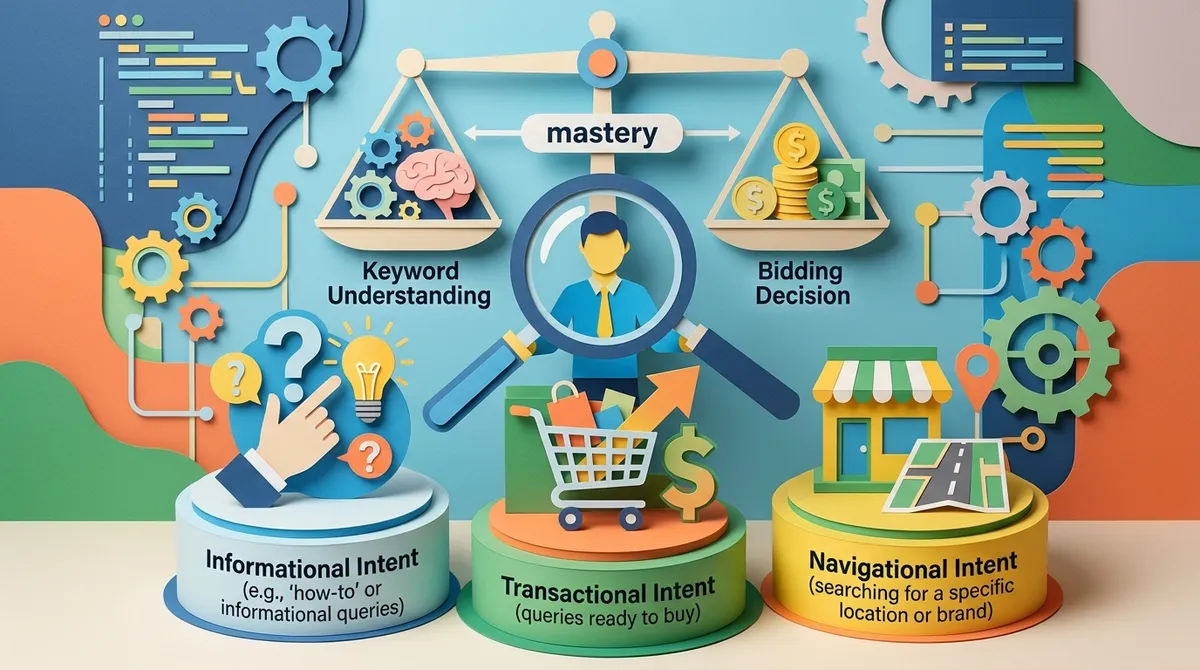
Not all keywords are created equal. A user searching for “best plumber near me” is ready to call. A user searching for “how does plumbing work” is just curious. Effective PPC ad management means understanding the intent behind every keyword before you decide to bid on it.
Keyword intent generally falls into three categories:
- Informational intent: The user is researching a topic and is unlikely to convert immediately
- Navigational intent: The user is looking for a specific brand or website
- Transactional intent: The user is ready to make a purchase or contact a business
For most businesses running paid ads, transactional keywords deliver the best return. These are the searches where someone is actively looking to buy, book, or hire. Bidding on high-intent keywords ensures your budget is spent on users who are most likely to become paying customers.
Understanding keyword intent also means using the difference between Google AdWords and PPC strategies to your advantage. Pairing intent-focused bidding with the right match types — exact, phrase, or broad match modified — gives you precise control over who sees your ads.
Strategy 3: Write Ad Copy That Converts
Your ad copy is the first impression a potential customer gets of your business. In a competitive search results page, you have a fraction of a second to earn a click. Weak, generic ad copy gets ignored. Specific, benefit-driven copy gets results.
Here is what strong PPC ad copy includes:
- A clear headline that matches what the user just searched for
- A specific benefit or offer, not just a description of your service
- Social proof elements such as ratings, years in business, or number of clients served
- A direct call to action that tells the user exactly what to do next
- Relevant ad extensions including sitelinks, callouts, and location details
Ad copy testing is also a critical component of professional PPC ad management. Running A/B tests on headlines and descriptions helps you identify which messages resonate most with your audience. Over time, small improvements in click-through rate compound into significantly lower costs and higher conversion rates.
For local businesses in the Tampa area, connecting your ad copy to local relevance — mentioning neighborhoods, service areas, or community-specific language — can meaningfully boost performance. Geo-targeting is a powerful lever that many businesses underutilize in their paid campaigns.
Strategy 4: Optimize Landing Pages for Conversions
Driving traffic to your website is only half the battle. Once a user clicks your ad, your landing page needs to convert that visitor into a lead or customer. A poorly designed landing page can nullify even the most well-crafted ad campaign.
The following table outlines the key differences between a high-converting and low-converting landing page:
| High-Converting Landing Page | Low-Converting Landing Page |
|---|---|
| Headline matches the ad copy exactly | Generic homepage content unrelated to the ad |
| Single, clear call to action above the fold | Multiple competing calls to action |
| Fast load speed (under 3 seconds) | Slow load speed that causes visitors to leave |
| Mobile-optimized layout | Desktop-only design that breaks on phones |
| Trust signals such as reviews and certifications | No social proof or credibility indicators |
| Minimal navigation to reduce distractions | Full site navigation that leads visitors away |
Your landing page and your ad are part of the same conversation. When a user clicks an ad about emergency HVAC repair, they expect to land on a page specifically about emergency HVAC repair — not your company’s general homepage. Message match between your ad and landing page is one of the highest-impact improvements you can make to any PPC campaign.
A professionally designed website built for conversion is essential. Having a professionally built website is critical for Google Ads success, and it directly affects your Quality Score, ad rank, and cost per conversion.
Strategy 5: Use Data to Continuously Optimize Campaigns
The most important difference between a mediocre PPC campaign and an exceptional one is ongoing optimization. PPC ad management is not a set-it-and-forget-it activity. Markets shift, competition changes, and user behavior evolves. Campaigns that are actively managed and refined consistently outperform those that are left on autopilot.
Effective data-driven optimization includes:
- Reviewing search term reports weekly to add profitable keywords and exclude irrelevant ones
- Adjusting bids based on device, location, time of day, and audience segment performance
- Monitoring Quality Scores and making improvements where they fall below benchmark
- Analyzing conversion data to identify which keywords and ads drive actual business outcomes
- Testing new ad formats, extensions, and creative approaches on a regular basis
Data transparency is a key reason businesses trust professional agencies to handle their campaigns. When you work with a team that provides clear analytics and reporting, you always know exactly how your ad spend is performing. This level of accountability is what separates results-driven management from guesswork.
According to Google E-E-A-T guidelines, experience and expertise matter not just in organic content but in how you demonstrate authority across all digital touchpoints — including your paid ad strategy and the landing pages behind them.
PPC vs. SEO: Understanding How They Work Together
A common question from business owners is whether to invest in PPC ads, SEO, or both. The honest answer is that both strategies serve different purposes, and the most effective digital marketing plans use them in combination.
| Factor | PPC Advertising | SEO |
|---|---|---|
| Speed of results | Immediate — ads appear same day | Long-term — typically 3–6 months |
| Cost structure | Pay per click | Investment in content and optimization |
| Visibility control | Precise and adjustable | Influenced by algorithm |
| Long-term value | Stops when budget stops | Builds compounding value over time |
| Best use case | Promotions, launches, fast leads | Brand authority, sustained traffic |
PPC is ideal when you need results quickly, such as for a new product launch, a seasonal promotion, or a competitive market where organic rankings take time to build. Meanwhile, organic SEO helps you grow rankings without relying solely on paid ads, creating a more sustainable long-term presence. Using both channels strategically creates a full-funnel marketing approach that captures customers at every stage of the buying journey.
When to Hire a Professional for PPC Ad Management
Many business owners start by managing their own PPC campaigns. This is completely understandable — it seems straightforward at first. However, as campaign complexity grows and competition intensifies, the gap between DIY management and professional management becomes significant.
Here are the signs it is time to bring in a professional:
- Your cost per click keeps rising without a corresponding increase in conversions
- You are spending time on campaign management instead of running your business
- You are not sure whether your campaigns are actually profitable
- Your competitors consistently appear above you in search results
Working with a certified, experienced agency removes the guesswork and ensures your campaigns are built on proven best practices. At Brain Buzz Marketing’s Google Ads services, every campaign is built with a strategic foundation and managed with the attention to detail that drives real results for small and medium-sized businesses. You can also view our certifications to see the expertise behind our approach.
Local businesses looking to grow in the Tampa area can visit Brain Buzz Marketing on Google to read real client reviews and see firsthand what professional PPC ad management can deliver. We are also active on Facebook and share digital marketing insights regularly.
It is also worth noting that a well-rounded digital strategy goes beyond just paid ads. Businesses like All Trusted Lawn Care and Charming Smiles of Ocoee are great examples of local service providers that benefit from pairing PPC with strong local digital presence. When your ads, website, and local SEO all work together, growth accelerates.
For more on building a complete paid advertising strategy, explore our guide on 13 Google advertising tips that drive real results in 2026. You can also learn about the broader context of what Google AdWords PPC is and how it grows your business.
Conclusion
Effective PPC ad management is not just about spending money on ads. It is about spending that money strategically, with a clear structure, the right keywords, compelling copy, optimized landing pages, and ongoing data-driven refinement. Each of the five strategies outlined above works together to reduce wasted spend and increase the quality of leads your campaigns generate.
In 2026, the businesses that win with paid advertising are those that treat their campaigns as ongoing projects, not one-time setups. Whether you manage your campaigns in-house or work with a trusted agency, applying these strategies consistently will help you achieve measurable, sustainable results.
If you are ready to take your paid advertising to the next level, our team is here to help. Reach out to our digital marketing specialists today and let us build a PPC strategy that works as hard as you do.
FAQs
Q: What does PPC ad management actually involve?
A: PPC ad management covers the full cycle of planning, launching, and optimizing pay-per-click campaigns. It includes keyword research, bid strategy, ad copywriting, landing page alignment, negative keyword management, and ongoing performance analysis to maximize return on ad spend.
Q: How much should a small business budget for PPC advertising?
A: Budget depends heavily on your industry, location, and competition level. A good starting point for most small businesses is between $500 and $1,500 per month in ad spend. A professional PPC manager can help you determine the right investment based on your specific goals and competitive landscape.
Q: How long does it take to see results from PPC campaigns?
A: Unlike SEO, PPC can generate traffic and leads almost immediately after a campaign launches. However, meaningful optimization and reliable ROI data typically emerge within the first 30 to 90 days as the campaign collects performance data and refinements are made.
Q: What is the difference between PPC and SEO for lead generation?
A: PPC delivers immediate visibility by placing paid ads at the top of search results, while SEO builds organic rankings over time through content and technical optimization. PPC is ideal for fast lead generation, while SEO provides compounding long-term value. Most high-growth businesses use both strategies together.
Q: Why do so many PPC campaigns fail to deliver results?
A: Most PPC campaigns underperform due to poor keyword targeting, weak ad copy, mismatched landing pages, and a lack of ongoing optimization. Without regular monitoring and data-driven adjustments, even well-funded campaigns can waste budget on clicks that never convert into customers.