8 Proven Ways to Appear in Google AI Overviews (2026)
Wondering how do I get featured in Google AI Overviews? Discover 8 proven SEO strategies to boost visibility in 2026.

Key Takeaways
-
Structure content with direct answers in first 1-2 sentences, short paragraphs, and clear subheadings to make it easy for AI models to extract and quote your information in summaries.
-
Build topical authority by creating multiple interconnected content pieces around your niche rather than single pages, signaling to Google's AI that you're a genuine expert worthy of being featured.
-
Optimize for E-E-A-T signals (Experience, Expertise, Authoritativeness, Trustworthiness) through case studies, detailed guides, backlinks from trusted sites, and author bios to increase chances of AI Overview inclusion.
-
Ensure technical fundamentals are solid with fast loading speeds under 3 seconds, mobile-friendly design, HTTPS security, and proper schema markup, as AI systems deprioritize slow or poorly-structured websites.
Ever type a question into Google and get a full answer before you even click a link? That’s a Google AI Overview, and it’s changing everything about online search. If your business isn’t showing up in these AI-generated summaries, you’re missing out on prime digital real estate. Small business owners, e-commerce retailers, and marketing managers alike are asking the same question: how do I appear in Google AI Overviews?
The good news? You’re not too late. AI Overviews are still new, and most businesses haven’t figured out how to optimize for them yet. That means there’s a real opportunity to get ahead. At Brain Buzz Marketing, we’ve been helping Tampa businesses adapt to search changes since long before AI was part of the conversation. Let’s walk through eight practical steps that can help your content earn a spot in these coveted AI summaries.

1. Understand What Google AI Overviews Actually Are
Google AI Overviews are short summaries that appear at the top of search results. They pull information from multiple websites to answer a user’s question quickly. Instead of clicking through five different links, searchers get a condensed answer right away.
For businesses, this means your content needs to be the source Google trusts enough to quote. Think of it like being the expert Google calls on for the answer. This shift is part of a bigger move toward generative engine optimization, which focuses on how AI models pull and present information.

2. Structure Your Content for Easy Extraction
AI models love clear, organized content. They scan pages looking for direct answers, not long rambling paragraphs. If your website buries the answer under fluff, the AI will likely skip it.
Here’s how to structure content the right way:
- Answer the main question in the first 1-2 sentences of a section
- Use short paragraphs (2-4 sentences max)
- Break down steps with numbered or bulleted lists
- Add clear subheadings that match common search questions
This approach isn’t just good for AI. It also improves readability for actual humans, which keeps them on your page longer. Our content writing services are built around this exact strategy.
3. Use Question-and-Answer Formatting
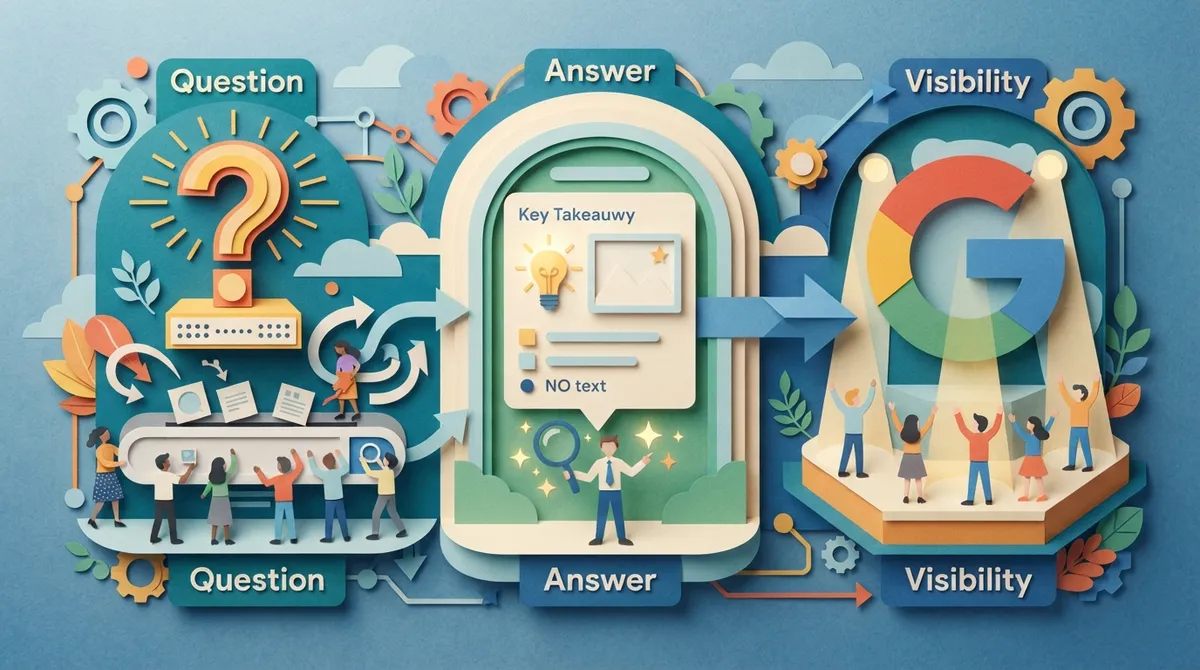
Google’s AI Overviews often pull directly from FAQ sections. When you format content as clear questions followed by direct answers, you make it easy for the AI to find and quote you.
Try this simple process:
- Research the exact questions your customers are typing into Google
- Write a clear, concise answer right after each question
- Keep answers between 40-60 words for the best chance of being featured
- Add supporting details after the direct answer
This method is a core part of answer engine optimization, which is quickly becoming just as important as traditional SEO.

4. Build Topical Authority Around Your Niche
Google doesn’t just look at one page. It looks at your entire website to see if you’re a real expert on a topic. This is called topical authority, and it matters a lot for AI Overviews.
If you’re a local service provider in Tampa, for example, you shouldn’t just write one blog post about your service. You need a whole cluster of content covering related questions, tips, and guides. This tells Google (and its AI) that you know your stuff. Learn more about how topical authority drives SEO success and why it’s the secret ingredient many businesses miss.
5. Optimize for E-E-A-T Signals
Google cares deeply about Experience, Expertise, Authoritativeness, and Trustworthiness. This framework, often called Google E-E-A-T, plays a huge role in which sources get pulled into AI Overviews.
| E-E-A-T Element | What It Means | How to Show It |
|---|---|---|
| Experience | First-hand knowledge of a topic | Share real case studies and client results |
| Expertise | Deep understanding of your field | Publish detailed, accurate guides |
| Authoritativeness | Recognition from others in your industry | Earn backlinks and mentions from trusted sites |
| Trustworthiness | Reliability and transparency | Use clear author bios and accurate info |
Small businesses often overlook this, but it’s one of the fastest ways to boost your chances of being featured. A strong SEO foundation supports all four of these pillars at once.
6. Keep Your Website Technically Sound
Even the best content won’t get noticed if your website is slow, broken, or hard to navigate. Google’s AI systems favor sites that load fast and work well on mobile devices.
Here are the technical basics you shouldn’t skip:
- Fast loading speeds (aim for under 3 seconds)
- Mobile-friendly design that adjusts to any screen
- Clean site structure with logical navigation
- Secure HTTPS connection
- Proper schema markup so search engines understand your content
A well-built site isn’t optional anymore. Our team’s website design process bakes these technical requirements into every project from day one.
7. Create Content That Solves Real Problems
AI Overviews reward content that genuinely helps people. Generic, thin content rarely gets pulled into these summaries. Instead, focus on answering the specific pain points your audience faces.
Ask yourself these questions before writing anything:
- What problem is my customer trying to solve right now?
- What questions do they ask before buying?
- What confuses them about my industry?
- How can I explain this in the simplest way possible?
Startups and e-commerce retailers especially benefit from this approach since they’re often competing against bigger, more established names. Detailed, useful content levels the playing field. This is also why we always recommend pairing strong content with digital marketing services that work together as one strategy.
8. Monitor, Test, and Adjust Your Strategy
AI Overviews are still evolving. What works today might shift next month. That’s why ongoing monitoring is so important. Track which of your pages show up in AI summaries and which don’t.
A simple monthly checklist can help:
- Search your target keywords and note if AI Overviews appear
- Check if your site is cited as a source
- Review which competitors (if any) are being featured instead
- Update older content with fresher data and clearer formatting
- Test new question-based headings on underperforming pages
This ongoing process is part of what we cover in our guide on adapting your SEO strategy for Google AI Search Overviews. Search is changing fast, and businesses that adjust quickly tend to win big.
Why This Matters More Than Ever in 2026
AI-driven search isn’t a passing trend. More searchers are relying on AI Overviews to get quick answers, which means fewer clicks are going to traditional listings. If your business isn’t optimized for this shift, you risk losing visibility to competitors who are paying attention.
Marketing managers and startups juggling limited resources often ask which comes first: SEO or AI optimization? The honest answer is that they work together. Traditional SEO builds the foundation, while AI search optimization builds on top of it. You can’t skip one and expect to succeed at the other.
For local service providers in Tampa, Brandon, Riverview, and surrounding areas, this shift also means local search matters more than ever. Google’s AI often pulls local business information directly into overviews for “near me” searches. Making sure your Google Business Profile is accurate and complete plays a big role here too. You can see how other local businesses have benefited by checking out reviews on our Brain Buzz Marketing Google Business Profile.
Common Mistakes That Keep Businesses Out of AI Overviews
Before wrapping up, let’s cover a few mistakes we see often. Avoiding these can save you a lot of wasted effort.
- Writing content that’s too promotional instead of informative
- Ignoring mobile page speed and design
- Skipping structured data and schema markup
- Failing to update old blog posts with current information
- Not answering the actual question users are searching for
Fixing these issues often requires a fresh set of eyes. That’s where working with an experienced team pays off. Our certifications and decades of combined experience mean we’ve seen these search shifts before and know how to adapt quickly.
Ready to Get Your Business Featured in AI Search Results
Appearing in Google AI Overviews takes a mix of smart content strategy, solid technical SEO, and ongoing optimization. It’s not a one-time fix. It’s an evolving process that rewards businesses willing to stay ahead of the curve.
Brain Buzz Marketing has been serving Tampa area businesses since 1998, and we’ve adapted through every major search algorithm shift along the way. Whether you’re a small business owner in Brandon, an e-commerce retailer shipping products nationwide, or a startup trying to make your mark, we can help you build a content strategy designed for today’s AI-driven search landscape. Follow our team’s insights on LinkedIn with Eric and LinkedIn with Nicole for more search marketing tips, or check us out on Instagram and Facebook for daily marketing updates.
Ready to get your business showing up where it matters most? Reach out to our team today and let’s build a strategy that gets you noticed by both search engines and real customers.
FAQs
Q: How do I appear in Google AI Overviews?
A: You appear in Google AI Overviews by creating clear, well-organized content that directly answers common search questions. Focus on strong topical authority, technical SEO, and E-E-A-T signals to boost your chances. It also helps to keep your content fresh and structured in a question-and-answer format.
Q: Do I need traditional SEO if I want to show up in AI Overviews?
A: Yes, traditional SEO is still the foundation for AI visibility. Google’s AI models pull from well-optimized, trustworthy pages, so skipping SEO basics will hurt your chances. Think of AI optimization as building on top of solid SEO work, not replacing it.
Q: How long does it take to start appearing in AI Overviews?
A: It varies, but many businesses see changes within a few months of consistent optimization. Factors like your site’s existing authority, content quality, and technical health all play a role. Patience and regular content updates tend to pay off over time.
Q: Can small businesses compete with big brands for AI Overview visibility?
A: Absolutely, and this is actually good news for smaller businesses. AI Overviews often favor specific, helpful answers over generic corporate content, which gives local and niche businesses a real chance to shine.
Q: What’s the difference between SEO, GEO, and AEO?
A: SEO focuses on ranking in traditional search results, while GEO (Generative Engine Optimization) targets AI-generated content like Google’s AI Overviews. AEO (Answer Engine Optimization) is about structuring content so it directly answers specific questions. All three work together to boost your overall search visibility.
Our Service Area