ChatGPT Text Ad Format: What It Is and How to Use It
Understand the ChatGPT text ad format: headline, description, context hint, and tips to write ads that convert in 2026.

Key Takeaways
-
ChatGPT text ads are short, clearly labeled sponsored messages (headline, description, link) that appear near a ChatGPT answer and match the full conversation rather than typed keywords.
-
The context hint replaces long keyword lists: describe the real situation your ideal customer is in, such as homeowners comparing roof repair options, so the platform can match your ad.
-
Write benefit-first headlines that solve a problem (e.g., 'Fast Leak Repair, Same-Day Visits') instead of naming your business, and avoid hype words that feel out of place in chat.
-
Ensure your landing page delivers exactly what the ad promises, since a slow or confusing page wastes budget even when the ad performs well.
-
Expect a more helpful, conversational tone than search ads, because chat users are exploring and asking follow-up questions rather than scanning results.
-
Treat ChatGPT ads as one channel alongside SEO and Google Ads, and verify current OpenAI eligibility rules and specs before launch since placement and options are changing quickly.
Have you heard that ads are showing up inside ChatGPT? If so, you are probably wondering what they actually look like. More importantly, you might be wondering whether your business can use them. Good news: you are in the right place, and we are going to keep this simple and friendly.
The ChatGPT text ad format is the way a paid message appears inside a ChatGPT conversation. It is mostly text, it sits near the answer a user is reading, and it is built to feel helpful instead of pushy. For small business owners, e-commerce shops, startups, and local service providers, this is a brand new way to get seen at the exact moment someone is asking a question.
In this guide, we will break down what the format looks like, what each part does, how to write strong copy, and how it compares to ads you may already run. Think of this as a friendly walkthrough, not a lecture. Let’s dive in!

What Is the ChatGPT Text Ad Format?
The ChatGPT text ad format is a clearly labeled sponsored message that shows up in or near a ChatGPT answer. It uses a short headline, a brief description, and a link to your website. There are no flashy banners or auto-playing videos. The goal is a clean, useful experience for the person chatting.
Here is the big idea. Instead of targeting people by keywords alone, these ads match the conversation. If someone asks about the best way to fix a leaky roof, a roofing company’s ad could appear alongside the answer. The ad fits the moment because the person already told ChatGPT what they need.
Because this platform is new and changing fast, details like placement and options can shift. Always check the latest rules from OpenAI before you launch. At Brain Buzz Marketing, we manage ChatGPT ads and keep up with these changes so you do not have to.
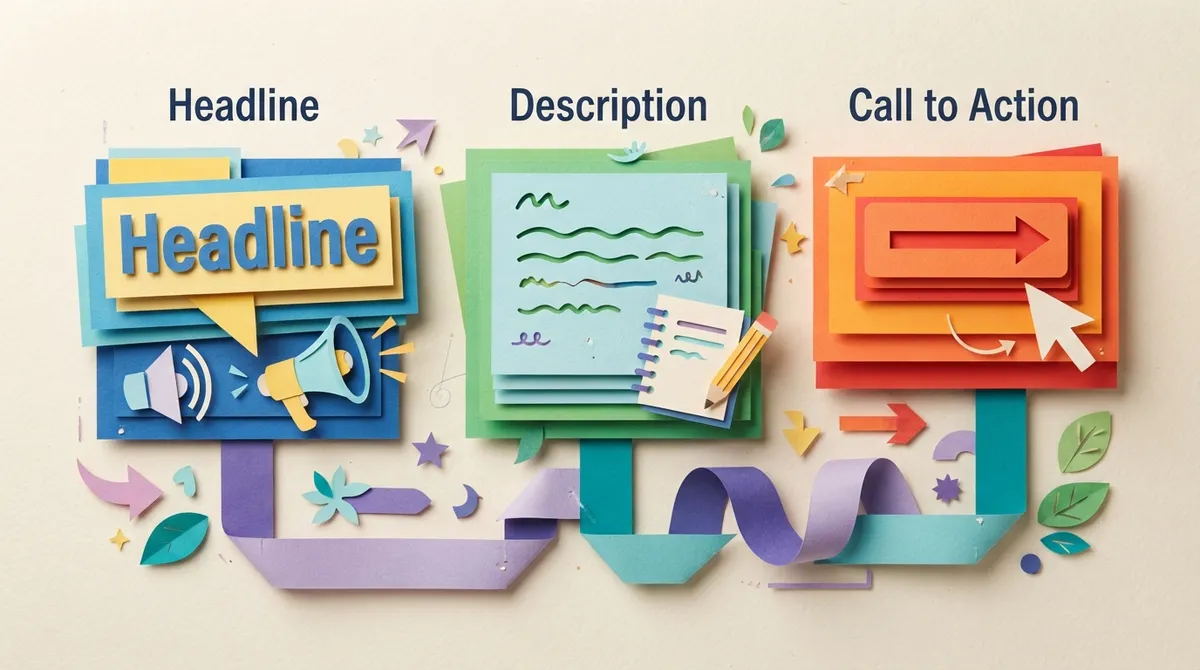
The Core Parts of a ChatGPT Text Ad
Every text ad is built from a few simple pieces. Knowing each one helps you write copy that works. Here are the main parts you will work with:
- Headline: The first thing people read. It should name the problem you solve or the benefit you offer.
- Description: A short line or two that adds proof, detail, or a reason to click.
- Destination link: The page on your website where people land after clicking.
- Sponsored label: A clear tag that tells users this is an ad, not part of the answer.
- Context hint: A short note you write that tells the platform what kinds of conversations fit your ad.
The context hint is the piece that feels new to most marketers. It replaces the old habit of stuffing in long keyword lists. You describe the situation your ideal customer is in, and the platform uses that to decide when your ad is a good match.
Why the Sponsored Label Matters
Trust is everything in a chat setting. People use ChatGPT because they want honest, helpful answers. A clear sponsored label keeps that trust intact. It also means your ad needs to earn the click by being genuinely useful, not sneaky.

ChatGPT Text Ad Format at a Glance
Here is a quick cheat sheet to help you picture how each element works. Remember, exact character limits can change, so confirm current specs before you build your ads.
| Ad Element | What It Does | Best Practice |
|---|---|---|
| Headline | Grabs attention and names the benefit | Keep it short, clear, and specific |
| Description | Adds detail, proof, or an offer | Lead with value, not hype |
| Destination URL | Sends the click to your page | Match the page to the promise |
| Sponsored Label | Shows the message is paid | Added by the platform automatically |
| Context Hint | Guides when the ad may appear | Describe your customer’s real question |
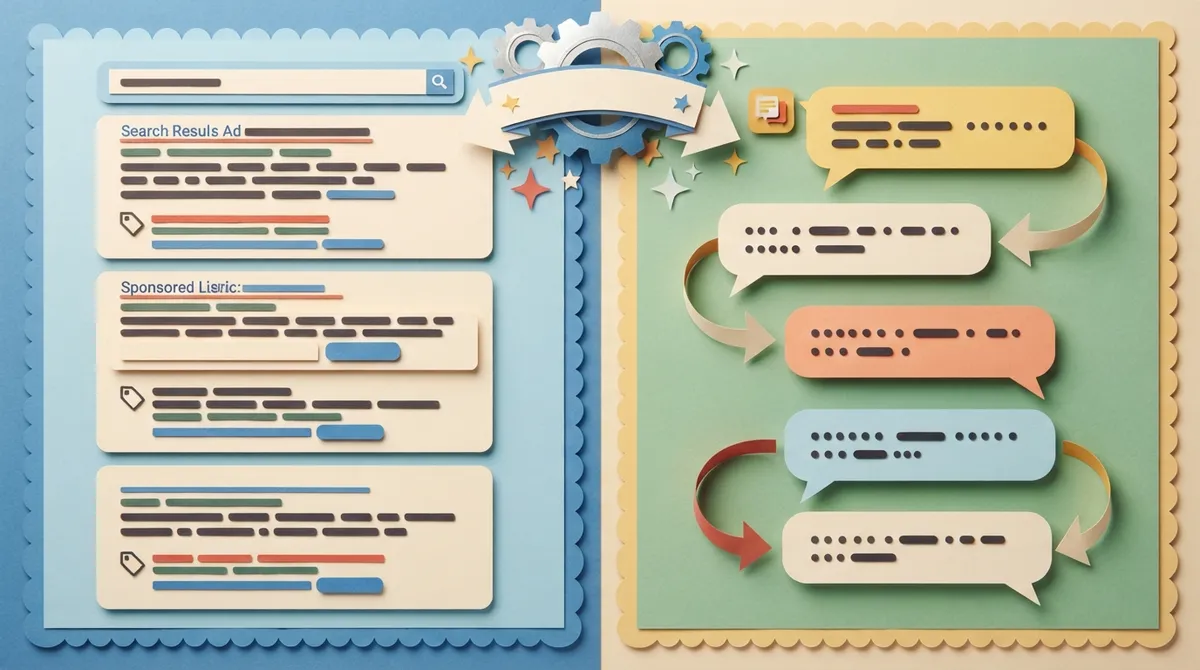
How the Text Ad Format Differs From Search Ads
If you have ever run Google Ads, the ChatGPT text ad format will feel a little familiar. But there are some important differences worth knowing. Here is a simple side-by-side look:
| Feature | Traditional Search Ads | ChatGPT Text Ads |
|---|---|---|
| Trigger | Typed keywords | Full conversation and intent |
| User mindset | Quick search, scanning results | Deep question, wants a clear answer |
| Targeting focus | Keyword lists and match types | Context hints and customer intent |
| Ad style | Short and punchy | Helpful and conversational |
The biggest shift is the mindset. People on a search results page are scanning. People in a chat are exploring and asking follow-up questions. That means your ad can be a little more thoughtful and a little less shouty.
If you want to understand the foundation behind paid search, check out our guide on how Google Ads work. It helps you see where the two platforms overlap and where they split.
How to Write Copy for a ChatGPT Text Ad
Writing for this format is a bit like giving a friend a helpful tip. You want to be useful, clear, and kind. Follow these steps to write copy that earns clicks:
- Start with the customer’s question. Think about what someone would type into ChatGPT right before they need your service.
- Write a benefit-first headline. Say what they get, not just who you are.
- Add one proof point in the description. This could be years in business, a guarantee, or a clear result.
- Keep the tone helpful. Avoid hype words like “amazing” or “best ever.”
- End with a gentle next step. Invite people to learn more, get a quote, or see options.
- Match your landing page. The page should deliver exactly what the ad promised.
Let’s say you run a local plumbing company. A weak headline would be “Joe’s Plumbing Services.” A stronger one would be “Fast Leak Repair, Same-Day Visits.” See the difference? One names a business. The other solves a problem.
Tips for Writing Great Context Hints
Your context hint is your chance to tell the platform who your ad is for. Here are a few simple tips:
- Describe the situation, such as “homeowners comparing roof repair options.”
- Focus on intent, not on stuffing in lots of keywords.
- Be honest about what you offer so the match feels natural.
- Test different hints to see which conversations bring the best leads.
Who Should Use the ChatGPT Text Ad Format?
This new format can be a great fit for several types of businesses. Here is who may benefit the most:
- Small business owners who want to reach people asking detailed questions about their services.
- E-commerce retailers who want to appear when shoppers compare products.
- Startups that need to get in front of new customers quickly.
- Local service providers who want to catch people right when they need help nearby.
- Growing companies looking to add one more lead source to a mix of SEO and paid search.
It is also worth noting that traffic from AI tools can be very valuable. People who arrive after a detailed chat often know what they want. We shared more on this in our post about why LLM-referred traffic converts so well.
Common Mistakes to Avoid
Every new ad platform comes with a learning curve. Here are mistakes we see often, and how to dodge them:
- Writing like a billboard. Chat users want help, not hype.
- Sending clicks to a weak page. A slow or confusing page wastes your budget.
- Ignoring policies. Ads must follow platform rules, so check eligibility first.
- Skipping testing. Run a few versions of your headline and description to see what wins.
- Forgetting to track results. Without tracking, you cannot tell what is working.
A strong landing page matters just as much as the ad itself. If your site feels outdated, a fresh design can lift results across every channel. Learn more about our website design services.
How to Get Started With ChatGPT Ads
Ready to try it out? Here is a simple roadmap to launch your first campaign:
- Check eligibility. Make sure your business and offer meet OpenAI’s ad policies.
- Define your customer intent. List the real questions your ideal customer asks before buying.
- Plan ad groups around those intents. Group similar questions together.
- Write your headlines, descriptions, and context hints.
- Set your targeting. Choose location and device options that fit your business.
- Add tracking. Connect Google Analytics so you can see visitors from ChatGPT.
- Launch, test, and refine. Review results each month and adjust.
Keep your budget in mind too. Our approach pairs well with a bigger plan, and you can use our marketing spend calculator to see how ChatGPT ads fit alongside your other channels.
How ChatGPT Ads Fit Into Your Bigger Marketing Plan
Here is something we tell every client: no single channel does it all. ChatGPT ads work best as one piece of a bigger puzzle. SEO builds long-term visibility. Google Ads captures people ready to buy right now. ChatGPT ads add a fresh way to reach people during research.
Content also plays a big role. The same helpful answers that earn organic rankings can help your ads convert, because they build trust. If you want to go deeper on this, read our article on answer engine optimization. It explains how to get your brand cited in AI answers, which pairs nicely with paid placement.
Since 1998, Brain Buzz Marketing has helped businesses grow online. We are a small but mighty, husband-and-wife-owned agency, and we work 100% virtually with clients across Florida and the entire United States. Want to see what our customers say? Visit us on Google — Brain Buzz Marketing to read their reviews, and follow along on Instagram for more marketing tips.
What Does It Cost?
Costs have two parts. First, ChatGPT requires its own monthly ad spend, paid directly to them. Second, you may want help managing the campaigns. Our ChatGPT Ads Management is $250 per month plus a one-time $250 setup fee, and ChatGPT asks for a $750 monthly ad spend paid straight to them.
Setup includes checking your eligibility, planning ad groups around customer intent, writing context hints, drafting headlines and descriptions, setting location and device targeting, and adding Google Analytics tracking. Ongoing management includes refining hints, testing ad versions, watching budgets, suggesting landing page tweaks, checking policy compliance, and sending detailed monthly reports.
Final Thoughts
The ChatGPT text ad format is simple on the surface: a clear headline, a short description, a link, and a smart context hint. But the real magic is in the approach. Write like a helpful friend, match the customer’s question, and send them to a page that delivers. Do that, and you give your business a fresh way to be found.
Not sure where to begin? We would love to help you set it up the right way. Contact Us today, and let’s talk about how ChatGPT ads can work alongside your SEO, Google Ads, and website to grow your business.
FAQs
Q: What does a ChatGPT text ad look like?
A: It is a short, clearly labeled sponsored message made of a headline, a brief description, and a link to your website. It appears near a ChatGPT answer and is designed to feel helpful rather than pushy. Exact placement can change, so always check the latest platform details.
Q: How is the ChatGPT text ad format different from Google search ads?
A: Search ads trigger from typed keywords, while ChatGPT ads match the full conversation and the user’s intent. You also guide targeting with a context hint instead of long keyword lists. The tone is more helpful and conversational, too.
Q: How much does it cost to run ChatGPT text ads?
A: ChatGPT requires a $750 monthly ad spend paid directly to them. If you want expert help, Brain Buzz Marketing manages ChatGPT ads for $250 per month plus a one-time $250 setup fee. That covers planning, copywriting, tracking, testing, and monthly reporting.
Q: What is a context hint in a ChatGPT ad?
A: A context hint is a short note you write that describes the kind of conversation your ad fits. Think of it as telling the platform who your ideal customer is and what they are asking. A clear, honest hint helps your ad show up in the right moments.
Our Service Area