How to Win Customers with Answer Engine Optimization
Expert guidance on "answer engine optimization"s with practical tips, proven strategies, and actionable insights for better.

Key Takeaways
-
AI tools now answer questions directly without sending users to websites, making answer engine optimization critical for visibility in 2026 as ChatGPT, Perplexity, and Google AI Overviews replace traditional search.
-
LLM-referred traffic converts at 30-40% compared to typical search traffic, making AEO a high-ROI opportunity most businesses currently ignore.
-
AEO prioritizes clear structure, direct answers in opening sentences, authoritative sourcing, and schema markup—fundamentally different from traditional SEO's focus on keywords and backlinks.
-
Structure content with headings, bullet points, and numbered lists; put answers in the first 2-3 sentences; and add FAQ and business schema markup to help AI tools understand and cite your pages.
-
Build topical authority by covering topics from multiple angles across your website and keep your Google Business Profile updated, as local AI results heavily pull from these profiles.
-
Start small with five key customer questions, rewrite answers clearly, add basic schema markup, and update business listings—this foundation helps you capture AI-driven search traffic before competitors adapt.
Picture this: someone in Tampa types a question into ChatGPT instead of Google. They ask which local business can fix their problem right now. If your website isn’t set up the right way, you won’t even be in the running. That’s the new reality of search, and it’s exactly why answer engine optimization matters so much in 2026.
Here at Brain Buzz Marketing, we’ve watched search change faster in the last two years than in the previous two decades combined. AI tools like ChatGPT, Perplexity, and Google’s AI Overviews are answering questions directly. Sometimes they never send the searcher to a website at all. That’s a scary thought for small business owners who depend on web traffic. But it’s also a huge opportunity if you know how to adapt.
This guide will walk you through what answer engine optimization actually means, why it matters for your business, and simple steps you can take today. Whether you run a local shop, manage an online store, or handle marketing for a growing company, this article is for you. Let’s get started.

What Is Answer Engine Optimization?
Answer engine optimization, often called AEO, is the practice of shaping your content so AI tools and answer engines can find it, understand it, and use it. Think of tools like ChatGPT, Google’s AI Overviews, Perplexity, and voice assistants like Siri or Alexa.
Traditional SEO focuses on ranking your website on a search results page. AEO focuses on something different. It aims to get your business mentioned as the actual answer. Instead of clicking through ten blue links, users get one direct response. If your content isn’t structured properly, that response won’t include you.
We covered this shift in detail in our article on what answer engine optimization is and how to do it. It’s worth a read if you want to go deeper into the mechanics.
Why AEO Is Different From Traditional SEO
Traditional SEO cares about keywords, backlinks, and page rankings. AEO cares about clarity, structure, and trustworthiness. AI models scan the web looking for content that answers a specific question clearly and completely.
Here’s a simple way to think about it:
- SEO asks: “Does this page rank on page one of Google?”
- AEO asks: “Would an AI tool quote this page as the answer?”
- SEO rewards keyword placement and technical site health.
- AEO rewards clear formatting, direct answers, and factual accuracy.
Both strategies matter. But if you only focus on old-school SEO, you may miss out on a growing slice of search traffic that never touches a traditional results page.

Why Your Business Needs Answer Engine Optimization in 2026
More people are turning to AI chat tools for quick answers. Instead of typing a search and scrolling through results, they ask a question and get a direct response. This changes how customers find local services, products, and information.
Consider a few real numbers. Research shows that traffic referred by large language models converts at a much higher rate than typical search traffic. We dug into this trend in our post about LLM-referred traffic converting at 30-40%. That’s a massive opportunity most businesses are ignoring right now.
Here’s why this matters for different types of businesses:
- Small business owners can get found by nearby customers asking AI tools for recommendations, even without a huge marketing budget.
- E-commerce retailers can appear in AI-generated product comparisons and buying guides.
- Marketing managers can add a forward-looking strategy that keeps their brand ahead of competitors still stuck on old SEO tactics.
- Startups can build visibility quickly without years of backlink building.
- Local service providers can capture “near me” style questions asked through voice assistants and chat tools.

How Answer Engines Actually Choose Content
AI tools don’t randomly pick websites to quote. They look for signals that show your content is accurate, well-organized, and trustworthy. Understanding these signals helps you shape your strategy.
| Signal | Why It Matters | How to Improve It |
|---|---|---|
| Clear structure | AI tools scan headings and lists faster than dense paragraphs | Use short paragraphs, bullet points, and numbered steps |
| Direct answers | AI models prefer content that answers the question in the first few sentences | Put the answer near the top, then explain further below |
| Authoritative sourcing | Answer engines favor content backed by expertise and trust signals | Show credentials, certifications, and real experience |
| Structured data | Schema markup helps machines understand your content type | Add FAQ schema, business schema, and article schema |
| Freshness | Updated content signals relevance | Review and refresh key pages regularly |
We explored this topic further in our piece about how AI search algorithms actually work. It breaks down the technical side in plain language.
Step-by-Step: How to Do Answer Engine Optimization
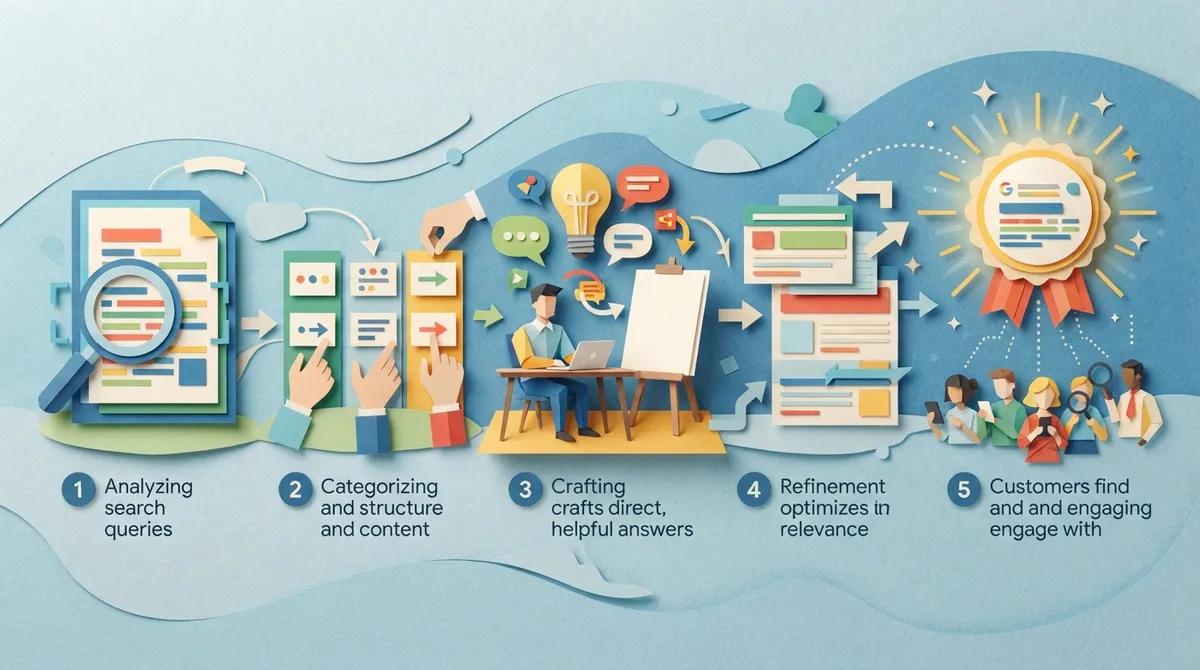
Ready to get started? Here’s a simple process you can follow, whether you’re doing this yourself or working with a team.
Step 1: Identify the Questions Your Customers Ask
Start by making a list of common questions your customers ask before they buy. Think about what they type into Google or ask Siri. These questions become the foundation of your content strategy.
Step 2: Write Clear, Direct Answers
Once you know the questions, write short, clear answers. Aim for two to three sentences that fully answer the question. Follow up with more detail if needed, but make sure the core answer stands on its own.
Step 3: Structure Your Content for Scanning
AI tools favor content that’s easy to scan. Use headings, bullet points, and numbered lists. Avoid long blocks of text without breaks. This makes it easier for both humans and machines to find what they need.
Step 4: Add Structured Data (Schema Markup)
Schema markup is code added to your website that tells search engines and AI tools exactly what your content means. FAQ schema, business schema, and review schema all help answer engines understand your page faster.
Step 5: Build Topical Authority
Don’t just write one article and stop. Cover a topic from multiple angles across your website. This builds what we call topical authority, which signals to AI tools that your business truly understands the subject.
Step 6: Keep Your Google Business Profile Updated
Local answer engine results often pull from Google Business Profiles. Make sure your hours, services, and reviews are current. You can visit us on Google — Brain Buzz Marketing to see how we keep our own profile fresh and complete.
Step 7: Monitor and Adjust
AI search is still evolving fast. Check how your content performs, test new formats, and adjust based on what’s working. This isn’t a one-time task. It’s an ongoing part of your marketing strategy.
AEO vs. SEO vs. GEO: What’s the Difference?
You may have heard terms like GEO (Generative Engine Optimization) alongside AEO and SEO. These strategies overlap but aren’t identical. We break this down fully in our article on how to use GEO vs AEO vs AI to dominate search.
Here’s a quick breakdown:
- SEO focuses on ranking in traditional search results pages.
- AEO focuses on becoming the direct answer inside AI tools and voice assistants.
- GEO focuses on how your content appears within AI-generated summaries and overviews.
The good news? These strategies work together. Strong SEO fundamentals give AEO and GEO a solid foundation to build on. You don’t need to choose one over the other. For a deeper comparison, check our post on SEO vs. AEO: which strategy wins for your business.
Common Mistakes That Hurt Your AEO Results
Many businesses make simple mistakes that keep them out of AI-generated answers. Here are the most common ones we see:
- Writing vague content that never directly answers a question
- Ignoring structured data and schema markup entirely
- Publishing outdated information and never updating it
- Skipping local business listings and Google Business Profile management
- Using overly complex language instead of clear, simple explanations
- Failing to build authority across related topics on your site
We cover more of these pitfalls in our article about 13 AEO mistakes hurting your search visibility. Avoiding these errors puts you ahead of most competitors who haven’t caught up yet.
How This Fits Into Your Bigger Marketing Strategy
Answer engine optimization shouldn’t live in isolation. It works best alongside SEO, quality content writing services, and a well-built website design. Think of it as one more tool in your digital marketing toolbox.
For small business owners and startups, this might feel overwhelming. That’s completely normal. You don’t have to master every piece overnight. Start with one or two changes, like adding FAQ schema or rewriting your top pages with clearer answers. Small steps add up over time.
If you’re a marketing manager juggling multiple channels, consider how AEO fits into your existing content calendar. You don’t need to reinvent everything. You just need to adjust your approach so AI tools can understand and trust your content.
Why Local Businesses Especially Need This Now
If you serve customers in Tampa, Brandon, Riverview, or anywhere in the Tampa Bay area, local search behavior is shifting fast. People ask their phones for recommendations instead of typing searches. Voice assistants and AI chat tools are becoming the new front door to local businesses.
This is where local SEO services and AEO strategies come together. A well-optimized Google Business Profile, consistent business information, and clear service descriptions all help AI tools recommend you when someone nearby asks for help.
We’ve seen this firsthand working with clients across Florida and beyond. Businesses that adapt early tend to capture more of this new AI-driven traffic before their competitors even realize what’s happening.
Getting Started With Answer Engine Optimization
You don’t need a massive budget to begin. Start small:
- Pick your five most important customer questions
- Rewrite the answers on your website in clear, simple language
- Add basic schema markup to those pages
- Update your Google Business Profile with accurate details
- Track your progress and adjust as you learn more
This process takes time, but every step moves you closer to showing up in AI-generated answers. And remember, this isn’t about replacing your current marketing. It’s about adding a new layer that keeps you visible as search continues to change.
For more on how AI is reshaping search overall, take a look at our post on how to get cited on Google’s AI Mode. It’s packed with practical tips you can use right away.
Ready to Get Found by AI Search?
Answer engine optimization isn’t a passing trend. It’s becoming a core part of how people find businesses like yours. The sooner you adapt, the more ground you’ll gain over competitors who are still stuck in old habits.
At Brain Buzz Marketing, we’ve spent decades helping businesses grow their online presence, and we’re excited about this new chapter in search. If you want a team that understands both traditional SEO and the future of AI-driven search, we’d love to help. Learn more about Brain Buzz Marketing and how we approach digital growth.
You can also follow our team’s insights on Instagram, or connect with our founders directly. Follow Eric on LinkedIn and follow Nicole on LinkedIn for regular updates on digital marketing trends.
Ready to make sure your business shows up when customers ask AI tools for help? Reach out to our team today and let’s build a strategy that works for the future of search.
FAQs
Q: What is answer engine optimization in simple terms?
A: It’s the practice of writing and structuring your content so AI tools like ChatGPT or Google AI Overviews can find it and use it as a direct answer. Think of it as making your website easy for a robot assistant to understand and trust!
Q: Is answer engine optimization the same as SEO?
A: Not exactly, though they work well together. SEO helps you rank on a search results page, while AEO helps you become the actual answer inside AI chat tools and voice assistants. Both matter, and neither one replaces the other.
Q: How long does it take to see results from AEO?
A: It varies, but many businesses start seeing small wins within a few months of consistent effort. Just like traditional SEO, patience and steady updates pay off over time, so don’t get discouraged if it feels slow at first!
Q: Do small businesses really need to worry about AEO right now?
A: Yes, especially since local searches are shifting toward voice assistants and AI chat tools. The earlier you adapt, the more likely you are to show up before your competitors catch on to this shift.
Q: Can Brain Buzz Marketing help with answer engine optimization?
A: Absolutely! We combine decades of SEO experience with fresh AEO and GEO strategies to help your business get found in this new era of AI-driven search. We’d love to chat about your goals and build a plan together.
Our Service Area