9 Schema Types That Boost AI Search Visibility in 2026
Discover what schema helps AI search find your site, from Organization to FAQPage, with easy steps to add each one in 2026.

Key Takeaways
-
Organization, LocalBusiness, and FAQPage schema provide the strongest AI visibility signals; start with these three before expanding to other schema types based on your business model.
-
Schema markup removes confusion by clearly labeling business details, which helps AI tools accurately understand and cite your content without guessing or opening every piece of content.
-
Product, Review, and Service schema are essential for e-commerce and service businesses respectively, as AI shopping assistants and search tools skip listings with missing pricing, stock, or service details.
-
Always test schema markup using Google's Rich Results Test before publishing, since broken schema can perform worse than no schema at all and confuse both AI and customers.
-
Keep schema data current by updating hours, prices, addresses, and review markup quarterly, as outdated structured data actively harms AI understanding and customer trust.
-
Pair schema markup with genuinely helpful, accurate content since schema only clarifies existing information; it cannot rescue thin or false content and works best as a supporting tool.
Have you ever asked ChatGPT, Perplexity, or Google’s AI Overviews a question and wondered how it picked its answer? Here’s a little secret: those tools lean on clean, structured data to figure out who you are and what you do. That’s where schema markup comes in.
So, what schema helps AI search visibility? The short answer is that Organization, LocalBusiness, FAQPage, Article, Product, Review, Service, Person, and BreadcrumbList schema give AI systems the clearest signals about your business. Each one acts like a friendly name tag that tells machines exactly what your content means.
If you run a small business, an online store, or a growing company, this guide is for you. We’ll walk through nine schema types in plain language, show you where each one fits, and share simple tips to get started. No coding degree required. Grab a coffee and let’s dive in!

Why Schema Matters for AI Search in 2026
Schema markup is a small piece of code, usually JSON-LD, that you add to your pages. It labels your content so search engines and AI tools can read it without guessing.
Think of it like labeling the boxes in your garage. Without labels, you have to open every box to find the holiday lights. With labels, you grab the right one in seconds. AI tools work the same way. They scan for clear labels so they can pull accurate facts and cite trusted sources.
This matters more every year. As we covered in 10 Ways to Optimize for AI Search Results in 2026, AI-driven search rewards content that is easy to understand and easy to verify. Schema helps on both counts.
What Schema Does and Doesn’t Do
Let’s keep expectations honest. Schema is not a magic button. It will not rescue thin or inaccurate content. What it does is remove confusion, which gives your good content a better shot at being understood and cited.
- It clarifies meaning: AI can tell your business name from a random phrase on the page.
- It supports trust: Verified details like addresses, reviews, and authors build credibility.
- It improves eligibility: Structured data can unlock rich results in traditional search too.
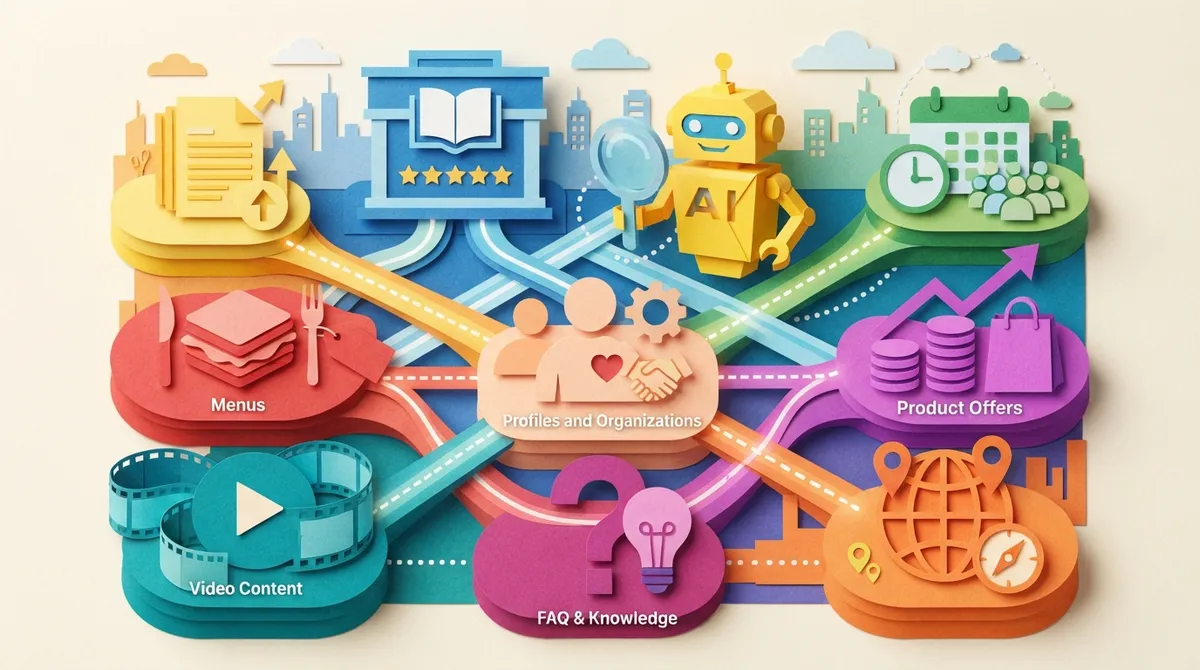
The 9 Schema Types That Help AI Search Visibility
Here is a quick snapshot before we explore each one.
| Schema Type | Best For | AI Visibility Benefit |
|---|---|---|
| Organization | Every business | Confirms brand identity and entity details |
| LocalBusiness | Local service providers | Connects you to a place and service area |
| FAQPage | Help and service pages | Feeds direct answers to AI tools |
| Article | Blogs and guides | Shows authorship and freshness |
| Product | E-commerce stores | Shares price, stock, and specs |
| Review / AggregateRating | Any reviewed business | Adds social proof and trust |
| Service | Service businesses | Defines what you offer clearly |
| Person | Authors and experts | Builds expertise signals (E-E-A-T) |
| BreadcrumbList | Larger websites | Shows site structure and topic hierarchy |
1. Organization Schema
This is your foundation. Organization schema tells AI who you are, including your name, logo, website, contact details, and social profiles.
Use the sameAs property to link your official profiles, like Instagram or LinkedIn. This helps AI connect the dots between your website and your online presence. It is one of the strongest ways to build what experts call entity recognition, meaning AI knows you are a real, distinct business.
2. LocalBusiness Schema
If you serve customers in a specific area, this one is a must. LocalBusiness schema shares your address, hours, phone number, and service area.
For local service providers, this is gold. When someone asks an AI tool for “the best plumber near me,” structured location data helps the tool match you to the right neighborhood. It pairs beautifully with the tips in How to Do Local SEO Step by Step in 2026.
3. FAQPage Schema
AI search loves questions and answers. FAQPage schema wraps your questions and answers in a format machines can lift directly.
Here is a simple way to use it well:
- Pick real questions your customers ask.
- Write short, clear answers of two to three sentences.
- Add the FAQ markup to the page that actually shows those questions.
- Make sure the visible text matches the markup exactly.
This pairs naturally with the strategy in What Is Answer Engine Optimization? And How to Do It, since AEO is all about giving direct, trustworthy answers.
4. Article Schema
Every blog post should use Article (or BlogPosting) schema. It tells AI the headline, author, publish date, and last-updated date.
Freshness matters. When AI tools weigh two similar sources, a clearly dated and recently updated article often looks more reliable. Keep the dateModified field honest and update it only when you truly refresh the content.
5. Product Schema
E-commerce retailers, this one is for you! Product schema shares the name, image, description, price, availability, and brand of each item.
AI shopping assistants rely on this data to compare products and recommend them. If your pricing or stock status is missing, the tool may skip you entirely. Keep it accurate and updated, especially when prices change.
6. Review and AggregateRating Schema
Customer reviews are powerful trust signals. Review and AggregateRating schema share your star ratings and review counts in a structured way.
A quick word of caution: only mark up genuine reviews that appear on your page. Google has strict rules about review markup, and misusing it can hurt you. If you want to understand how reviews affect rankings, take a peek at Do Google Reviews Help SEO.
7. Service Schema
Service schema spells out exactly what you offer, who it is for, and where you provide it. For a business that sells services instead of products, this is the equivalent of Product schema.
- Name each service clearly, like “Local SEO” or “Custom Website Design.”
- Describe what is included in plain words.
- Link the service to your Organization or LocalBusiness entity.
- List the areas you serve.
This helps AI match your services to what people are really asking for.
8. Person Schema
AI tools want to know a real human stands behind the content. Person schema highlights authors and experts, including their job title, credentials, and profile links.
This supports E-E-A-T, which stands for Experience, Expertise, Authoritativeness, and Trustworthiness. If you want a deeper dive, check out Google E-E-A-T. Pair your author bios with Person schema, and you give AI a strong reason to trust what you publish.
9. BreadcrumbList Schema
Breadcrumbs show how your pages fit together, like Home, then Services, then SEO. BreadcrumbList schema shares that structure with machines.
For larger sites, this helps AI understand which topics you cover in depth. It supports the idea of topical authority, where a site shows deep knowledge across a subject.

How to Add Schema Without Losing Your Mind
Good news! You do not have to hand-code everything. Most people use one of three simple paths.
Choose Your Method
- Plugin or built-in tool: Many website platforms offer schema plugins that handle the basics.
- Manual JSON-LD: You paste a small code snippet into your page header or body. This gives you the most control.
- Professional setup: A team builds and tests it for you so nothing breaks.
If your site is outdated or hard to edit, schema may be easier during a rebuild. A custom website design can bake structured data in from day one, so you never have to bolt it on later.
Test Before You Celebrate
Always test your markup. Google’s Rich Results Test and the Schema.org validator will flag errors in seconds. Fix any warnings, then recheck. A broken schema block can be worse than none at all, so this step is worth a few minutes.

Common Schema Mistakes to Avoid
Even smart marketers trip up here. Watch out for these common slips.
- Marking up hidden content: Schema should match what visitors can actually see.
- Copying the same markup everywhere: Each page needs details that fit that page.
- Using fake or inflated reviews: This can bring penalties and kill trust.
- Letting data go stale: Old hours, prices, or addresses confuse AI and customers.
- Skipping the basics: Fancy schema means little if Organization and LocalBusiness are missing.
If your search traffic has felt strange lately, it might be bigger than schema. Our post on The New SEO Game: How to Get Cited on Google’s AI Mode explains how the whole picture is shifting.
Where to Start Based on Your Business Type
Not sure which schema to tackle first? Here is a friendly cheat sheet.
- Small business owners: Start with Organization, LocalBusiness, and FAQPage.
- E-commerce retailers: Lead with Product, Review, and Organization.
- Startups: Focus on Organization, Service, and Person to build trust fast.
- Local service providers: Prioritize LocalBusiness, Service, and Review.
- Growing companies: Layer in Article, BreadcrumbList, and Person across your content.
Pick two or three, do them well, and expand from there. Slow and steady wins this race.
Schema Plus Great Content: The Winning Combo
Here is the honest truth. Schema works best when it supports strong, helpful content. AI tools still need real answers worth citing. That means clear writing, accurate facts, and pages that solve real problems.
Brain Buzz Marketing has been helping businesses with this kind of work since 1998. As a small but mighty, fully virtual agency, we combine SEO, GEO, and AEO content strategy so your brand shows up in both classic search and AI-driven answers. You can see what clients say on our testimonials page or visit us on Google — Brain Buzz Marketing to read reviews from businesses we have helped.
If you want to stay current on search trends, you can also follow Eric on LinkedIn for regular tips. And if you are curious about automating your own content workflow, tools like SEO Rocket are worth a look.
Final Thoughts: Make Your Business Easy for AI to Understand
Schema is really about being clear. When you label your business, services, products, authors, and answers, you make it easy for AI to understand you and trust you. That is the heart of AI search visibility.
Start small with Organization and LocalBusiness, add FAQPage and Article, and grow from there. Test your work, keep it fresh, and pair it with helpful content. Your future customers, and the AI tools they ask, will thank you.
Ready for a hand? Our team would love to help you set up schema the right way. Contact Us today and let’s get your business ready for the future of search.
FAQs
Q: What schema helps AI search visibility the most?
A: Organization, LocalBusiness, and FAQPage schema tend to give the biggest boost for most businesses. They clearly tell AI who you are, where you operate, and what questions you answer. Start there, then add Article, Product, or Service schema based on your site.
Q: Does schema markup guarantee I’ll show up in AI answers?
A: Nope, there is no guarantee, and anyone who promises one is overselling! Schema makes your content easier for AI to understand and trust, but you still need helpful, accurate content. Think of it as a strong helper, not a magic wand.
Q: What format should I use for schema markup?
A: JSON-LD is the format most search engines recommend. It sits in a separate block of code, so it is easy to add and update without messing up your page design. Always test it with a validator before publishing.
Q: Can I add schema myself, or do I need a developer?
A: You can absolutely do the basics yourself using a plugin or a simple JSON-LD snippet. For bigger sites or more advanced setups, a pro can save you time and prevent errors. Either way, test your markup every time.
Q: How often should I update my schema?
A: Update it whenever your real business details change, like hours, prices, services, or addresses. A quick quarterly check is a smart habit. Outdated schema can confuse both AI tools and your customers.
Our Service Area