AI Discovery: How to Get Found by AI Search in 2026
AI discovery explained: learn how AI tools find and recommend businesses, plus 10 simple steps to show up in AI search in 2026.

Key Takeaways
-
AI tools often name only three to five businesses per answer, so being on that short list matters more than ranking on page one of traditional results.
-
Clear, well-organized pages with question-style headings and direct answers placed right below each heading make it easier for AI to match your content to customer questions.
-
Trust signals drive AI recommendations: collect honest reviews, keep your name, address, and phone number consistent everywhere online, and use schema markup to label your business details.
-
Polish your Google Business Profile with complete information, photos, and current hours, and build location pages for the cities you serve to win near-me AI questions.
-
Treat SEO as the foundation and layer AEO and GEO on top, since AI tools often pull from the same trusted sources that rank well in traditional search.
-
Track progress by regularly asking AI tools your customers’ questions, watching for traffic from AI platforms in analytics, and fixing gaps in how your business is described.
Picture this: a customer opens an AI assistant and types, “Who is the best plumber near me?” or “Which marketing agency can help my small business?” The AI gives a short list of answers. If your business is not on that list, you just lost a customer you never even knew about. That is the new reality, and it is why AI discovery matters so much in 2026.
AI discovery is how people find businesses, products, and answers through AI tools like ChatGPT, Google AI Overviews, Perplexity, and other AI-powered assistants. It is a big shift from the old way of searching. Instead of scrolling through ten blue links, people now get direct answers and quick recommendations.
The good news? You do not need to be a tech expert to win here. In this friendly guide, we will break down what AI discovery means, how it works, and the simple steps your business can take to show up. Let’s dive in!

What Is AI Discovery?
In digital marketing, AI discovery means the way AI systems find, understand, and recommend your business to people. It covers every moment an AI tool looks at your website, your content, and your online reputation, then decides whether to mention you in an answer.
Think of it like word-of-mouth, but with a super-smart helper. When someone asks an AI tool for a recommendation, the AI pulls from what it knows and what it can find online. Your job is to make sure it finds you, understands what you do, and trusts you enough to share your name.
This is different from traditional search in a few key ways:
-
Answers over links: AI tools give direct answers instead of a long list of websites.
-
Fewer winners: An AI may only mention three to five businesses, not ten.
-
Trust matters more: AI leans on clear facts, reviews, and signs that you are the real deal.
-
Questions are longer: People ask full, natural questions instead of short keywords.

Why AI Discovery Matters for Your Business
More and more people are using AI to research before they buy. They ask for advice, compare options, and decide who to call, all inside a chat window. If your business is invisible to these tools, you are missing a growing stream of ready-to-buy customers.
Industry data has shown that visitors who arrive from AI tools often convert at higher rates than regular search visitors. That makes sense. Someone who got a direct recommendation already trusts the answer. You can learn more about this trend in our post on LLM-referred traffic and why it converts so well.
Here is who benefits most from getting AI discovery right:
-
Small business owners who want to be the name an AI recommends in their area.
-
E-commerce retailers who want products to show up in AI shopping answers.
-
Startups that need to build trust and visibility fast.
-
Local service providers who rely on “near me” style questions.
-
Growing companies that want steady lead growth from every channel.

How AI Tools Discover Businesses
AI tools do not pick businesses at random. They use a mix of signals to decide who to trust. Understanding these signals gives you a big head start.
They Read and Understand Your Content
AI systems scan your website to figure out what you offer, who you serve, and where you operate. Clear, well-organized pages make this job easy. Confusing or thin pages make it hard, and the AI may simply skip you.
They Look for Trust Signals
Reviews, mentions on other sites, years in business, and expert credentials all help. This lines up with Google’s E-E-A-T idea: Experience, Expertise, Authoritativeness, and Trustworthiness. The more real proof you show, the more confident an AI feels about naming you.
They Use Structured Data
Schema markup is a type of code that labels your information, like your business name, services, hours, and reviews. It acts like a name tag for your website. AI tools can read these tags quickly and accurately.
They Check for Consistency
If your business name, address, and phone number are different across the web, an AI may get confused. Consistent details build confidence. This is a big part of local SEO services and it matters just as much for AI.
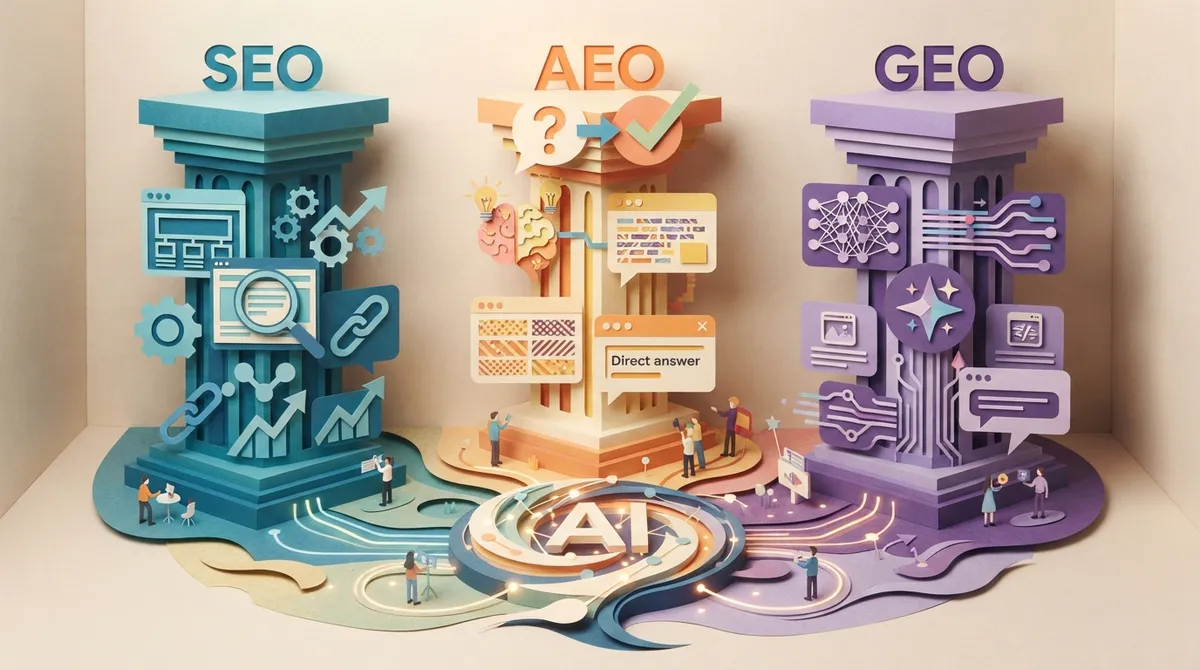
The Three Pillars: SEO, AEO, and GEO
To win at AI discovery, it helps to know three related terms. They work together, and you need all three in 2026.
|
Strategy |
What It Means |
Main Goal |
|---|---|---|
|
SEO (Search Engine Optimization) |
Improving your site so it ranks in search engines like Google |
Show up in traditional search results |
|
AEO (Answer Engine Optimization) |
Writing content that gives clear, direct answers to questions |
Be the source for featured answers and voice results |
|
GEO (Generative Engine Optimization) |
Shaping your content so AI tools cite and recommend you |
Get named inside AI-generated responses |
Think of SEO as the foundation. AEO and GEO build on top of it. If you want a deeper look, check out our guide on answer engine optimization and our explainer on whether GEO is replacing SEO. The short answer? They are partners, not rivals.
10 Practical Steps to Improve Your AI Discovery
Ready to get started? Here is a simple, step-by-step plan you can follow. You do not have to do everything at once. Even small steps add up.
-
Make your website clear and fast. A clean, mobile-friendly site is easy for both people and AI to read. A strong website design is the base of everything.
-
Answer real customer questions. Write pages and blog posts that answer the exact questions your customers ask. Use plain, friendly language.
-
Use question-style headings. Headings like “How much does it cost?” help AI match your content to what people type.
-
Lead with the answer. Put a short, direct answer right below each heading, then add more detail after it.
-
Add schema markup. Label your business details, services, FAQs, and reviews so AI can read them with ease.
-
Claim and polish your Google Business Profile. Fill out every section, add photos, and keep your hours current.
-
Collect more reviews. Ask happy customers to share their experience. Fresh, honest reviews are a strong trust signal.
-
Keep your details consistent. Use the same name, address, and phone number everywhere online.
-
Build topical authority. Cover your main topics in depth with several connected articles instead of one-off posts.
-
Track and adjust. Test how AI tools respond to questions about your business, then improve the gaps you find.
Content That AI Loves to Cite
Not all content is equal in the eyes of AI. The best content is clear, helpful, and easy to pull a quote from. Here is what works well.
-
Short, direct answers placed near the top of each section.
-
Simple language that avoids buzzwords and fluff.
-
Fresh facts and dates so the AI knows your info is current.
-
Lists and tables that organize information neatly.
-
Real expertise shown through examples, case studies, and credentials.
Writing like this is a skill. That is why many businesses lean on content writing services that blend SEO, GEO, and AEO into every page. If you want to see how to set up your pages for AI answers, our post on 10 ways to optimize for AI search results is a great next read.
Local AI Discovery: Winning Near-Me Questions
If you serve a specific area, local AI discovery is a big opportunity. People often ask AI things like “best marketing agency in Tampa” or “who can build a website for my small business in Brandon?” The AI then looks for businesses with strong local signals.
To boost your local presence, focus on these basics:
-
A fully optimized Google Business Profile that shows you in the Map Pack.
-
Location pages that name the cities and neighborhoods you serve.
-
Local reviews that mention your services and your area.
-
Consistent listings across trusted directories.
Want to go deeper? Our guide on how to do local SEO step by step in 2026 walks through each move. And if you want to see what real customers think of working with us, you can visit Brain Buzz Marketing on Google and read the reviews.
Common AI Discovery Mistakes to Avoid
Even smart business owners trip up here. The good news is that these mistakes are easy to fix once you spot them.
-
Ignoring AI completely. Waiting on the sidelines lets others take the spots you could earn.
-
Writing for robots only. Stuffing keywords makes content worse. Write for people first.
-
Hiding key facts. If your services, prices, or location are hard to find, AI cannot share them.
-
Skipping reviews. No reviews means fewer trust signals.
-
Letting content go stale. Old pages with outdated info can hurt your credibility.
-
Blocking AI crawlers by accident. Check your site settings so helpful AI tools can actually read your pages.
The last point is worth a quick note. Big infrastructure companies and AI developers are now working together to make AI discovery work better for everyone. As of October 2026, there is growing industry attention on how AI agents find and read websites, which shows just how important it is to keep your site open, clear, and well organized.
How to Measure Your AI Discovery Progress
You cannot fix what you do not measure. Tracking AI discovery is still new, but there are simple ways to check how you are doing.
Ask the AI Yourself
Open a few AI tools and ask questions your customers would ask. Does your business come up? Is the info correct? Write down what you find and check again each month.
Watch Your Traffic Sources
In Google Analytics, look for visits that come from AI tools. Even small numbers are a good sign, and they often convert well.
Monitor Reviews and Mentions
Count new reviews and brand mentions across the web. More mentions usually mean stronger discovery over time.
Review Your Reports
Good reporting turns raw data into clear next steps. Learn how to build a smart reporting habit in our post on analytics and reporting for data-driven marketing.
Where Paid AI Ads Fit In
Organic AI discovery takes time, and that is okay. Many businesses also want faster visibility. Paid options are starting to appear inside AI tools, and they can work alongside your organic efforts.
Think of it as a one-two punch. Organic work builds long-term trust, while paid ads can put you in front of customers right now. If you are curious, you can read about ChatGPT ads versus Google Ads to see where each one makes sense. Pairing smart ads with strong content gives you the best of both worlds.
Why Work With a Team That Knows AI Discovery
AI search changes fast. Keeping up while running your business is a lot. That is where a trusted partner helps. Brain Buzz Marketing has been helping businesses grow online since 1998. As a small but mighty, husband-and-wife-led agency, we pair decades of know-how with a hands-on approach and fair pricing.
We are a 100% virtual agency, so we can help businesses across Tampa, Brandon, Riverview, and all over Florida and the United States. Our team blends traditional SEO with GEO and AEO, so your brand shows up in Google and in AI answers. You can also follow our updates on Instagram or connect with Eric on LinkedIn for fresh marketing tips.
If you want to see how we put these ideas to work, take a look at our digital marketing services and our approach to SEO. You can also see how SEO Rocket automates blog posts built to rank.
Your Next Step Toward Being Found by AI
AI discovery is not a passing trend. It is a new front door to your business, and the companies that prepare now will be the ones customers meet first. The steps are simple: build a clear website, answer real questions, earn trust, and keep your details consistent.
You do not have to figure it all out alone. Start small, stay steady, and keep improving a little each week. Your future customers are already asking AI for help, so let’s make sure your name is part of the answer.
Ready to get found by AI search? Contact Us today and let’s build a plan that fits your goals and your budget.
FAQs
Q: What is AI discovery in digital marketing?
A: AI discovery is how AI tools like ChatGPT, Google AI Overviews, and Perplexity find, understand, and recommend your business to people. It is all about making your website and online presence easy for AI to read and trust. The better your content and reputation, the more likely an AI is to mention you.
Q: How is AI discovery different from regular SEO?
A: Regular SEO helps you rank in a list of search results, while AI discovery helps you get named inside a direct AI answer. They work hand in hand, though. Strong SEO is the foundation, and AEO and GEO add the extra layer that helps AI tools cite you.
Q: How can a small business improve its AI discovery?
A: Start with a clear, fast website and content that answers real customer questions in simple language. Then add schema markup, polish your Google Business Profile, and collect honest reviews. Keeping your name, address, and phone number consistent online also builds trust with AI tools.
Q: How long does it take to show up in AI search results?
A: It varies, but most businesses see early progress within a few months of steady work. AI tools lean on trust and fresh content, so consistency pays off over time. The sooner you start, the sooner you can build the authority AI looks for.
Q: Do I still need SEO if I focus on AI discovery?
A: Yes, you do! AI tools often pull from the same trusted sources that rank well in search, so strong SEO supports your AI visibility. Think of SEO, AEO, and GEO as a team that works best together.