Google’s Top 4 Ranking Factors for 2026 Explained
Climb the search results with Google's Top 4 ranking factors for 2026: content, links, user experience, and trust.

Key Takeaways
-
Content quality is the foundation: pages should answer the searcher’s main question quickly, use simple language, include real examples or data, and stay updated.
-
Backlinks act as votes of trust; one link from a respected local or industry site can outweigh dozens of low-quality links, so earn links by creating link-worthy resources.
-
Core Web Vitals and mobile-friendliness matter: aim for main content loading in under three seconds, a responsive mobile design, HTTPS everywhere, and no broken pages.
-
Match search intent (informational, navigational, commercial, or transactional) to your page’s purpose, since a mismatch will prevent ranking regardless of quality.
-
Demonstrate E-E-A-T by adding author bios, case studies, testimonials, credentials, and consistent business details, with reviews and a Google Business Profile as key local trust signals.
-
The four factors reinforce each other, so a balanced strategy beats quick tricks; start with a 30-day plan: audit top pages, fix speed and mobile issues, add trust signals, then promote one asset.
If you have ever wondered why one website lands on page one while another gets buried on page six, you are not alone. Google uses hundreds of signals to decide who ranks where, and that can feel like a giant mystery. The good news? You do not need to master every single signal to see real progress.
In this guide, we break down Google’s top 4 ranking factors in plain, friendly language. We will cover what each one means, why it matters in 2026, and what you can do about it this week. Whether you run a local service business, an online store, or a fast-growing startup, these four pillars are where your time and money will pay off most.
At Brain Buzz Marketing, we have helped businesses climb the search results since 1998. We have seen algorithms come and go, but these core ideas keep showing up again and again. Let’s dive in!
What Are Google’s Top 4 Ranking Factors?
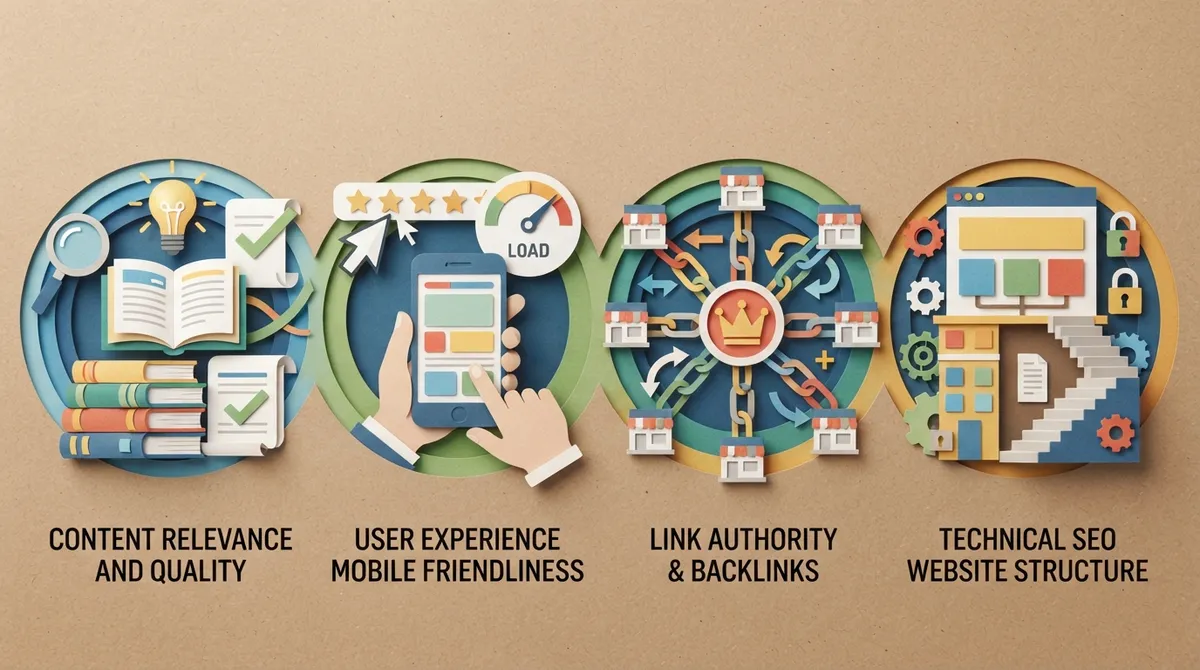
Google has never published an official, ranked list of its signals. Still, years of testing, public statements from Google, and real-world results point to four big pillars that drive most rankings. Think of them as the four legs of a table. If one leg is short, the whole thing wobbles.
Here are the four pillars we will cover:
-
Content quality and relevance
-
Backlinks and authority
-
User experience and technical health
-
Search intent match and E-E-A-T (trust)
Quick note: Google’s AI-driven search features, like AI Overviews, now pull from pages that score well on all four. So these pillars matter for classic blue links and for getting cited in AI answers too.
|
Ranking Factor |
What It Means |
Main Goal |
|---|---|---|
|
Content quality |
Helpful, complete, original pages |
Answer the searcher’s question |
|
Backlinks |
Other sites linking to you |
Prove you are trusted |
|
User experience |
Fast, mobile-friendly, easy to use |
Keep visitors happy |
|
Intent and E-E-A-T |
Matching the search and showing expertise |
Earn trust and relevance |

Ranking Factor #1: Content Quality and Relevance
Content is still the heart of SEO. Google wants to show pages that truly help people. If your page answers the question better than anyone else’s, you have a big edge.
What Google Means by Quality
Quality content is not about being long for the sake of it. It is about being useful. Google’s own guidance points to “helpful, reliable, people-first content.” That means your page should be original, clear, and complete.
Strong content usually has these traits:
-
It answers the main question quickly, then goes deeper
-
It uses simple words and short sentences
-
It includes real examples, data, or first-hand experience
-
It stays fresh with updates when facts change
-
It uses your target keyword and related terms naturally
How to Improve Your Content This Week
Start with your most important pages. Read them out loud. Do they sound like a real person talking to a real customer? If not, rewrite them.
Next, add the questions your customers actually ask. Short, direct answers help you win featured snippets and show up in AI answers. If writing is not your thing, our content writing services can create keyword-targeted pages that read well and rank well.
Want to understand why content carries so much weight? Check out 15 Reasons Content Is the Backbone of SEO in 2026 for a deeper look.

Ranking Factor #2: Backlinks and Authority
A backlink is simply a link from another website to yours. Google treats these links like votes of confidence. When trusted sites link to you, Google takes that as a sign you are worth listening to.
Quality Beats Quantity
One link from a respected local news site can beat fifty links from random, low-quality pages. Google’s systems have gotten very good at spotting spammy link tricks, and those shortcuts can hurt you.
Good backlinks often come from:
-
Local chambers of commerce and business groups
-
Industry blogs and trade publications
-
Partner and supplier websites
-
Local news stories and community sponsorships
-
Helpful resources that others want to share
How to Earn Links the Right Way
The best strategy is simple: create something worth linking to. That could be a helpful guide, a free tool, original research, or a great local resource page. Then tell the right people about it.
Many small business owners ask if links are truly required. We cover that honestly in Do You Really Need Backlinks to Get Organic Traffic? The short answer: they help a lot, especially in competitive markets.

Ranking Factor #3: User Experience and Technical Health
You can have the best content in the world, but if your site loads slowly or breaks on a phone, visitors will leave. Google notices that. Page experience signals tell Google whether people enjoy using your site.
The Technical Basics That Matter
Google measures several things under the hood. The big ones are called Core Web Vitals, which track loading speed, how fast a page responds to taps and clicks, and whether the layout jumps around while loading.
Here is a simple checklist to review:
-
Speed: Your main content should load in under three seconds
-
Mobile-friendly design: Most searches happen on phones, so your site must look great on small screens
-
Secure connection: Use HTTPS on every page
-
Clean structure: Clear menus, headings, and internal links help people and Google
-
No broken pages: Fix 404 errors and slow redirects
Why Design and SEO Work Together
A site that is built well from the start is easier to rank. That is why smart businesses plan SEO into their website design instead of bolting it on later. A clean, fast, custom-built site gives Google fewer reasons to doubt you and gives visitors more reasons to call.
If your current site feels outdated, slow, or hard to use, it may be time for a refresh. See 7 Signs It’s Time for a Website Redesign in 2026 to find out.
Ranking Factor #4: Search Intent and E-E-A-T
This final pillar is the one many people skip, and it is a big miss. It combines two ideas: matching what the searcher actually wants, and proving you are a trustworthy source.
Understanding Search Intent
Every search has a goal behind it. Someone typing “how to fix a leaky faucet” wants a how-to guide. Someone typing “plumber near me” wants to hire a local pro. If your page does not match the goal, it will not rank, no matter how good it is.
Most searches fall into four types:
-
Informational: The person wants to learn something
-
Navigational: The person wants a specific website
-
Commercial: The person is comparing options
-
Transactional: The person is ready to buy or book
What Is E-E-A-T?
E-E-A-T stands for Experience, Expertise, Authoritativeness, and Trustworthiness. It comes from Google’s quality rater guidelines. It is not a single score, but it shapes how Google judges your content, especially on topics that affect money or health.
You can show E-E-A-T by:
-
Adding author names and short bios to your articles
-
Sharing real case studies and customer stories
-
Displaying testimonials and reviews
-
Listing credentials, such as certifications
-
Keeping your contact details and business info clear and consistent
For local businesses, reviews and a well-built Google Business Profile are huge trust signals. You can see how customers talk about us on Visit us on Google — Brain Buzz Marketing.
How the Four Factors Work Together
Here is the secret most guides leave out: these four pillars feed each other. Great content earns backlinks. A fast site keeps people reading that content. Strong E-E-A-T makes other sites more willing to link to you. It is a loop, and each turn makes you stronger.
That is also why quick fixes rarely last. A single trick might bump you up for a week, but a balanced strategy builds rankings that stick. If you want to see how this fits into the bigger picture, take a look at 12 Ways to Rank Higher Than Competitors in Organic SEO.
A Simple 30-Day Action Plan
Not sure where to begin? Try this:
-
Week 1: Audit your top five pages for quality and search intent
-
Week 2: Run a speed and mobile test, then fix the biggest issues
-
Week 3: Add author bios, reviews, and trust signals to key pages
-
Week 4: Pick one link-worthy asset and share it with local partners
Doing this consistently will move you further than chasing every new SEO trend. If you would like a pro to check your site first, our SEO audit breakdown shows exactly what a good review uncovers.
Common Mistakes to Avoid
Even well-meaning business owners trip over the same issues. Watch out for these:
-
Keyword stuffing: Writing for robots instead of people
-
Ignoring mobile: Designing only for desktop screens
-
Buying cheap links: This can trigger penalties
-
Thin pages: Posting short, copied, or generic content
-
Skipping local signals: Forgetting your Google Business Profile and local citations
If you serve a local area, pair these four factors with a smart local strategy. Our guide on how to do local SEO step by step in 2026 shows you how.
Ready to Put the Top 4 Ranking Factors to Work?
Google’s top 4 ranking factors come down to this: create helpful content, earn trusted links, give visitors a smooth experience, and prove you are the real deal. Nail those four, and you are ahead of most of your competition.
You do not have to do it alone. Brain Buzz Marketing is a small but mighty, husband-and-wife-led team that has been helping businesses grow online since 1998. We work 100% virtually, so we can support you anywhere in Florida and across the country. Explore our SEO and digital marketing services, or follow along on Instagram for daily tips and updates.
Curious how Google sees your site right now? Get in touch with our team and let’s build a plan that fits your goals and your budget. We would love to help you climb!
FAQs
Q: What are Google’s top 4 ranking factors?
A: Google does not publish an official ranked list, but the four biggest pillars are content quality and relevance, backlinks and authority, user experience and technical health, and search intent paired with E-E-A-T. Focus on all four and you will build a strong, lasting foundation.
Q: Which Google ranking factor matters the most?
A: Helpful, relevant content is usually the best place to start because everything else builds on it. That said, no single factor works alone, so the best results come from balancing all four.
Q: How long does it take to see results from improving ranking factors?
A: Most businesses start seeing movement in about three to six months, though competitive topics can take longer. Steady, consistent improvements beat quick tricks every time.
Q: Do small businesses need all four ranking factors to rank?
A: Yes, but you do not need to be perfect at everything at once. Local businesses can often win by pairing strong content with great reviews, a fast site, and a well-optimized Google Business Profile.