How Google Picks the Map Pack: 3 Ranking Factors in 2026
Discover how Google picks the Map Pack using relevance, distance, and prominence, plus easy steps to rank higher locally.

Key Takeaways
-
Google’s Map Pack ranks businesses on three core factors: relevance, distance, and prominence, so strengthen all three rather than relying on proximity alone.
-
Choose the correct primary GBP category that matches your main money-making service, since a mismatched category sends mixed signals about what you offer.
-
Build a steady flow of recent reviews by asking customers right after each job, and reply to every review, since recency and quantity both count.
-
Keep your name, address, and phone number identical across your profile, website, and directories, including small details like ‘St.’ versus ‘Street.’
-
Create location and service pages on your website with your city and main services in titles and headings to prove relevance to Google.
-
Google Ads do not boost your organic Map Pack ranking; the two systems work separately, so ads won’t replace local SEO work.
Ever searched for “plumber near me” and noticed three businesses sitting right at the top with a map above them? That little box is called the Map Pack, and it is prime real estate. Businesses in those three spots get the calls, the clicks, and the customers.
So how does Google decide who gets in? It is not luck, and it is not random. Google follows a clear set of signals. Once you understand them, you can start working with the system instead of guessing.
In this guide, we will break down exactly how Google picks the Map Pack in 2026, in plain and simple language. You will learn the three core ranking factors, the smaller signals that tip the scales, and the steps you can take today to move up. Whether you run a small shop, a home service company, or a growing multi-location business, this guide is for you.
Let’s dig in!
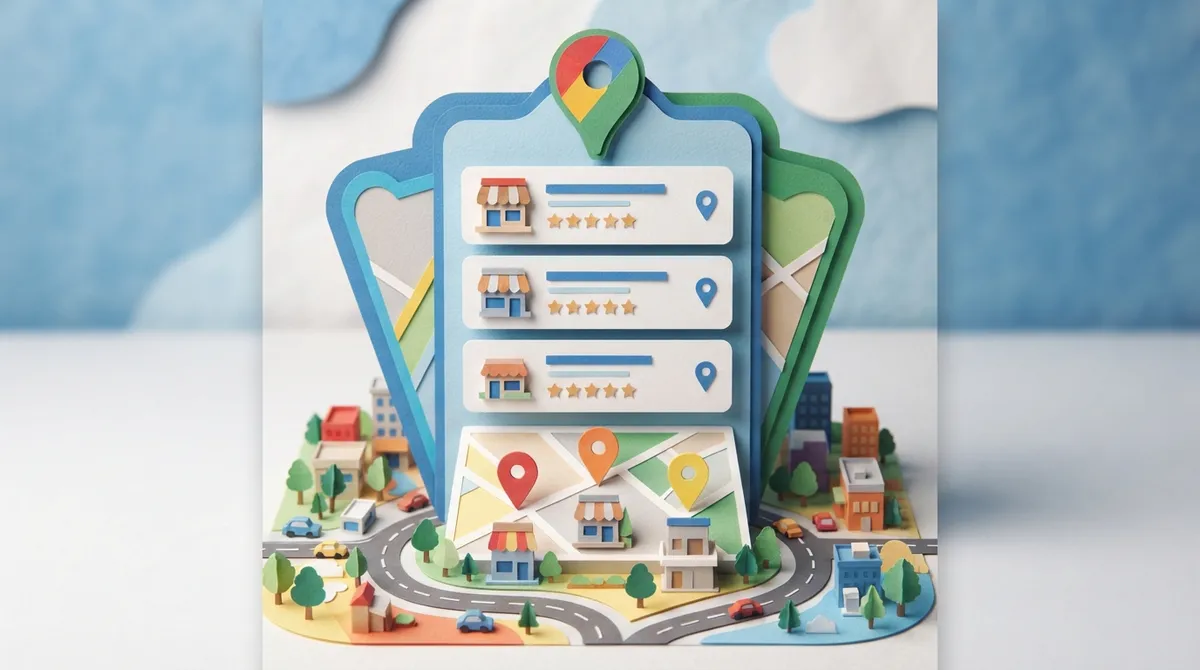
What Is the Google Map Pack?
The Map Pack is the group of three local business listings that shows up under a map on Google search results. It is also called the Local Pack or the Local 3-Pack. Google shows it when someone searches for something that has local intent.
Here are a few searches that often trigger it:
-
“Pizza near me”
-
“Dentist in Tampa”
-
“Best HVAC repair Brandon FL”
-
“Emergency plumber open now”
Each listing shows the business name, star rating, review count, hours, and quick buttons to call or get directions. Most of this information comes straight from your Google Business Profile. That is why your profile matters so much.
Why should you care? Map Pack listings grab a huge share of local clicks. If you are not in the top three, many searchers will never even see you.
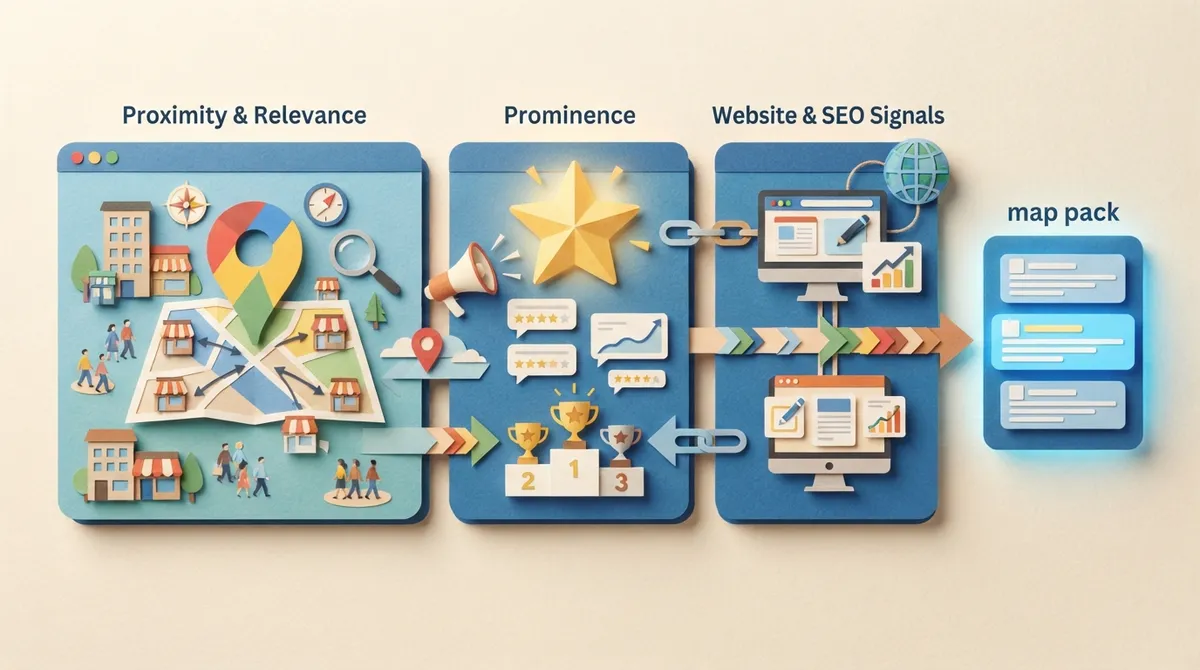
The 3 Core Factors Google Uses to Pick the Map Pack
Google has said for years that local rankings come down to three things: relevance, distance, and prominence. Think of them as three legs on a stool. If one leg is weak, the whole thing wobbles.
1. Relevance
Relevance means how well your business matches what the person is searching for. If someone types “emergency plumber,” Google looks for businesses that clearly offer emergency plumbing.
Google figures out relevance from things like:
-
Your primary and secondary business categories
-
Your business description
-
The services listed on your profile
-
The words on your website
-
Posts, photos, and Q&A on your profile
A common mistake is choosing the wrong primary category. If you are a roofing company but you picked “General Contractor,” you are sending a mixed message. Pick the category that matches your main money-making service.
2. Distance
Distance is how close your business is to the person searching, or to the location they typed into the search. This one is the hardest to control because you cannot move your office around.
Here is what to know:
-
Google uses the searcher’s phone location or the city they typed in.
-
A business closer to the searcher often gets a boost.
-
Service-area businesses can still rank, but the pin location matters.
You may not be able to change your address, but you can make sure it is accurate and that your service areas are set correctly. If you want to go deeper on this, our guide on what local SEO is and why it is important explains how location fits into the bigger picture.
3. Prominence
Prominence is how well known and trusted your business is, online and offline. Google wants to show businesses that look popular and reliable.
Prominence grows from:
-
The number and quality of your Google reviews
-
Your average star rating
-
Mentions of your business across the web (also called citations)
-
Links from other websites
-
Your overall website strength and organic rankings
This is where most small businesses can make the biggest gains. Reviews and a strong website can push you past a competitor who is closer or has a similar profile. We cover this more in 12 ways to rank higher than competitors in organic SEO.
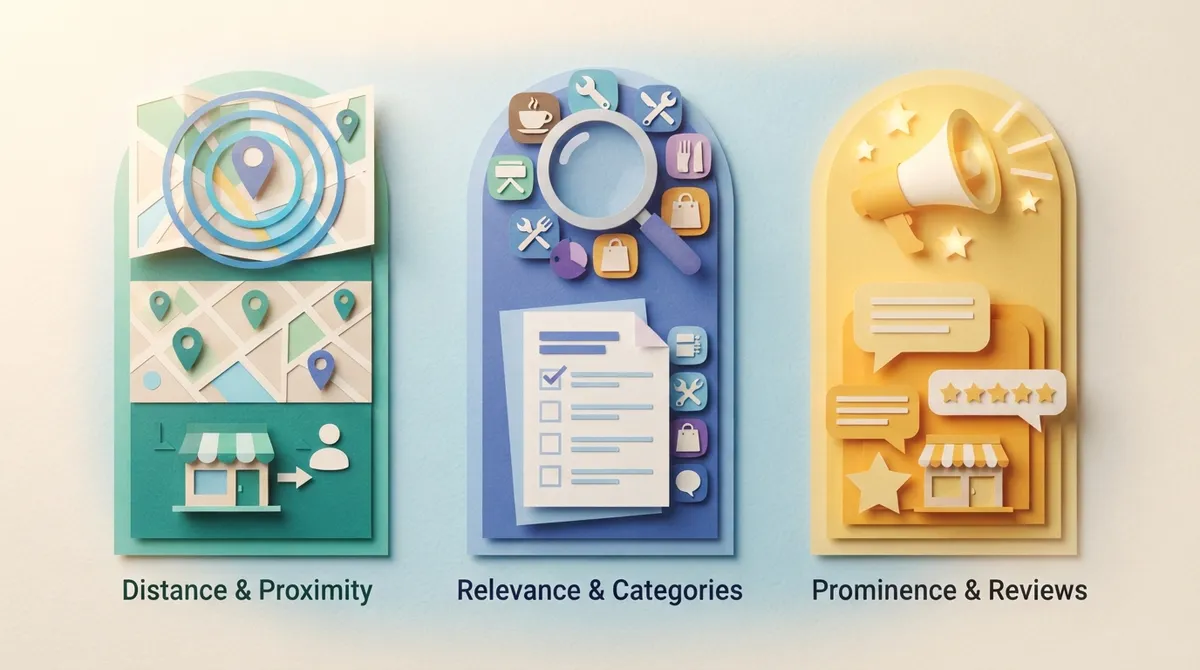
Quick Look: The Three Factors at a Glance
|
Factor |
What Google Asks |
How You Can Improve It |
|---|---|---|
|
Relevance |
Does this business match the search? |
Choose the right categories, list services, write a clear description |
|
Distance |
How close is this business to the searcher? |
Keep your address accurate and set service areas correctly |
|
Prominence |
Is this business well known and trusted? |
Earn reviews, build citations, grow website authority |

The Smaller Signals That Can Tip the Scales
Relevance, distance, and prominence are the big three. But when two businesses look very similar, smaller signals help Google break the tie. Let’s look at the ones that matter most.
Your Google Business Profile Quality
A complete profile beats a half-finished one almost every time. Fill out every section. Add your hours, phone number, website, services, products, and attributes. Upload real photos often. Post updates on a regular basis.
If your profile feels abandoned, Google may treat your business that way too. Our practical guide to Google My Business management walks through how to keep your profile fresh.
Review Quality, Quantity, and Recency
Reviews are a big deal. Google looks at three things:
-
Quantity: How many reviews you have in total.
-
Quality: Your average star rating and the content of the reviews.
-
Recency: How often new reviews come in.
A business with 200 reviews from three years ago may lose to one with 80 fresh reviews. Keep the flow going. Ask happy customers right after the job is done. Reply to every review, good or bad, in a warm and helpful way. Google’s review rules have shifted too, so it helps to read why Google’s review policy update changed everything.
NAP Consistency
NAP stands for name, address, and phone number. Google checks that these details match across the web. If your phone number is different on Yelp, your website, and your profile, that creates doubt.
Do a quick audit. Make sure your NAP is the same everywhere, down to small things like “St.” versus “Street.” Tiny differences can add up.
Website Content and Local Signals
Your website feeds the Map Pack more than people realize. Google reads your site to confirm what you do and where you do it. A site with clear service pages, city pages, and helpful content gives Google more proof that you deserve to rank.
This is where strong on-page SEO pays off. Put your main service and city in your title tags, headings, and body text. Add your address and embed your map on the contact page. A fast, mobile-friendly site also helps visitors stay and take action.
Behavior Signals
Google also watches how real people interact with your listing. These are often called engagement signals. They can include:
-
Clicks to call
-
Requests for directions
-
Website clicks
-
Photo views
-
Saves and shares
If lots of people tap your listing and act on it, Google reads that as a sign that you are a good match. Attractive photos, a strong star rating, and clear info all push people to engage.
Why Do Some Businesses Rank Even When They Are Farther Away?
Here is a question we hear a lot: “Why does my competitor rank when they are farther from the searcher than I am?”
The answer is usually prominence and relevance. Distance is important, but it is not the only thing. A farther business with more reviews, a better profile, and a stronger website can beat a closer business that is not doing the basics well.
Also, rankings can change block by block. You might show up at the top in one neighborhood and fall to page two a mile away. That is normal. It is why tracking your rankings across a map grid gives a clearer picture than checking from one spot.
Step-by-Step: How to Improve Your Chances of Landing in the Map Pack
Ready to take action? Here is a simple process you can follow. You do not need to do it all in a day. Just keep moving forward.
-
Claim and verify your Google Business Profile. If you have not done this yet, start here. Nothing else works without it.
-
Choose the right primary category. Match it to your main service. Add secondary categories for other things you offer.
-
Fill out every field. Hours, services, products, description, attributes, and your website link.
-
Add fresh photos every week or two. Show your team, your work, your storefront, and your happy customers.
-
Build a steady review habit. Ask every satisfied customer. Make it easy with a direct link. Reply to all reviews.
-
Fix your NAP everywhere. Clean up your listings on major directories so the details match.
-
Create location and service pages on your website. Use clear titles, helpful content, and local details.
-
Earn local links and mentions. Sponsor a local event, join a chamber of commerce, or get featured by a local blog.
-
Post to your profile regularly. Share offers, news, and updates.
-
Track and adjust. Watch your calls, direction requests, and rankings. Tweak what is not working.
If you want a deeper walkthrough, see how to do local SEO step by step in 2026. And if you are wondering what to avoid, check out these 7 local SEO mistakes that cost businesses customers.
Common Map Pack Myths (And the Truth)
There is a lot of noise out there. Let’s clear up a few popular myths.
-
Myth: Paying for Google Ads puts you in the Map Pack. Truth: Ads and Map Pack rankings are separate. Ads can show up in the pack area, but they do not boost your organic local ranking.
-
Myth: Keyword stuffing your business name helps. Truth: Adding extra words to your name breaks Google’s rules and can get your profile suspended.
-
Myth: Fake reviews are a shortcut. Truth: Google removes them, and it can hurt your standing. Real reviews from real customers are the only safe path.
-
Myth: Once you rank, you can stop working on it. Truth: Competitors keep improving. Local SEO is ongoing.
How AI Search Is Changing the Map Pack
Search keeps changing, and 2026 is no exception. Google now shows AI-generated answers on many searches, and people also use AI tools to find local businesses. Even so, the same trust signals still matter: reviews, accurate details, strong websites, and clear local relevance.
The businesses that win are the ones that keep their information consistent and easy to understand. That helps both the Map Pack and AI results. If you want to prepare for both, read 10 ways to optimize for AI search results in 2026. You can also see what changed with Google Maps immersive navigation and the mistakes hurting local SEO.
For an outside look at how Google describes local ranking, you can review Google’s own guide to improving local ranking. It lines up with the three factors we covered above.
Who Needs the Map Pack the Most?
Some businesses benefit more than others. If customers search for you with words like “near me” or add a city name, the Map Pack is likely a big source of leads. That includes:
-
Home service providers like plumbers, electricians, and roofers
-
Restaurants, cafes, and salons
-
Medical, dental, and wellness practices
-
Law firms and financial advisors
-
Auto repair shops and detailers
If you are not sure where you stand, our post on which businesses need local SEO the most can help you decide.
Let Brain Buzz Marketing Help You Win the Map Pack
Understanding how Google picks the Map Pack is the first step. Putting it into action is where the results come from. At Brain Buzz Marketing, we have been helping businesses grow online since 1998. We are a small but mighty team, and we offer local SEO services, Google Business Profile optimization, and Google review outreach that help you show up where customers are looking.
Want to see what real customers think? You can visit us on Google, Brain Buzz Marketing and read the reviews from the businesses we serve.
We work with local businesses across Brandon, Riverview, Tampa, and the greater Florida area, and with clients all over the United States. Everything is handled online, so it is easy to get started from anywhere.
Final Thoughts
Google picks the Map Pack using three main ideas: relevance, distance, and prominence. Around those sit smaller signals like profile quality, fresh reviews, consistent business details, website strength, and customer engagement. You cannot control everything, but you can control a lot.
Start with your Google Business Profile. Build a steady stream of real reviews. Clean up your listings. Keep your website helpful and local. Small steps add up, and the businesses that stay consistent are the ones that win those top three spots.
Ready to climb the map? Contact us today and let’s build a plan to get your business in front of more local customers.
FAQs
Q: How does Google decide who shows up in the Map Pack?
A: Google looks at three main factors: relevance, distance, and prominence. It checks how well your business matches the search, how close you are to the searcher, and how well known and trusted you are online. Smaller signals like reviews, profile quality, and website content help break ties.
Q: How many reviews do I need to get into the Map Pack?
A: There is no magic number, since it depends on your competition. The best move is to look at the top three businesses in your area and aim to match or beat their review count and rating. Keep new reviews coming in steadily so your profile always looks active and trusted.
Q: Can I rank in the Map Pack without a physical storefront?
A: Yes, you can! Service-area businesses like plumbers and cleaners can rank by setting up their service areas correctly in their Google Business Profile. Just remember that the location of your pin still plays a role in how you show up.
Q: How long does it take to improve my Map Pack ranking?
A: Some quick fixes, like choosing the right category or completing your profile, can show results within a few weeks. Bigger gains from reviews, citations, and website improvements usually take a few months. Staying consistent is the secret to lasting results.
Q: Do Google Ads help me appear in the Map Pack?
A: Not directly. Google Ads and the organic Map Pack work separately, so running ads will not boost your local ranking. Ads can still bring you more calls and clicks, but your Map Pack position comes from relevance, distance, and prominence.