Key Takeaways
-
Adopt a tri-strategy approach combining SEO, GEO (Generative Engine Optimization), and AEO (Answer Engine Optimization) to ensure your content appears across all modern AI-powered search formats, not just traditional search rankings.
-
Structure content around question-based headings with direct answers in the first 1-2 sentences to make it easy for AI systems to extract and cite your content in generated responses.
-
Build topical authority by creating a library of 8-12 related articles covering different angles of your core subject, linked together internally, to signal expertise to AI models.
-
Prioritize E-E-A-T signals (Experience, Expertise, Authoritativeness, Trustworthiness) by including author credentials, client testimonials, verified business information, and reputable backlinks.
-
Optimize website structure with clear heading hierarchies, Schema.org markup, fast loading speeds under 2 seconds, and mobile responsiveness to improve AI crawler accessibility and content extraction.
-
Monitor AI search performance monthly by tracking featured snippet appearances, zero-click impressions, and brand mentions across AI platforms, then adapt your strategy based on results and evolving ranking signals.
Search has changed dramatically. In 2026, AI-powered search engines are no longer a future concept — they are the present reality. Tools like Google’s AI Overviews, ChatGPT search, and other large language model (LLM) platforms now answer user questions directly. For small business owners, marketing managers, and local service providers, this shift means one thing: your digital marketing strategy must evolve or risk becoming invisible online.
Learning how to optimize for AI search results in 2026 is no longer optional. If your content is not being surfaced by AI-driven platforms, you are losing visibility, traffic, and potential customers to businesses that have adapted. The good news is that optimizing for AI search is achievable with the right approach. This guide breaks down 10 proven strategies to help your business show up in AI-generated answers, knowledge panels, and conversational search results — starting today.

Why AI Search Optimization Matters for Your Business
AI search engines do not work the same way as traditional search. Instead of simply ranking ten blue links, they synthesize information from multiple sources and deliver a single, confident answer. Platforms like Google’s AI Overviews and ChatGPT pull from trusted, well-structured content to generate these responses. If your website is not structured to feed these systems, your brand simply does not appear. Understanding SEO in the AI era means understanding how these models select, evaluate, and present information.

10 Strategies to Optimize for AI Search Results in 2026
1. Adopt a Tri-Strategy Approach: SEO, GEO, and AEO
Traditional SEO is still important, but in 2026, it must be paired with Generative Engine Optimization (GEO) and Answer Engine Optimization (AEO). GEO focuses on making your content readable and citable by AI-generated summaries. AEO targets voice assistants and answer engines that respond to direct questions. This tri-strategy approach ensures your content appears across all modern search formats. Agencies like Brain Buzz Marketing now build all three disciplines into their content strategies for clients.
2. Write Content That Directly Answers Questions
AI engines favor content that answers questions clearly and concisely. Structure your content around question-based headings (who, what, when, where, why, how). Provide direct answers in the first one or two sentences beneath each heading. This format makes it easy for AI systems to extract your answer and credit your source. Our content writing services are built around this question-first methodology.
3. Build Topical Authority on Your Core Subject
AI models trust sources that demonstrate deep expertise on a specific subject. Rather than writing one blog post about a topic, build a library of related content that covers every angle. This signals to AI systems that your website is an authoritative source on the subject. Focus your content calendar on one niche at a time and link related articles together internally. Learn more about establishing authority through our digital marketing services.
Here is how to build topical authority effectively:
- Identify your core topic and 8 to 12 subtopics beneath it.
- Publish a long-form pillar article covering the main topic.
- Create supporting articles for each subtopic and link them to the pillar.
- Update older content regularly to maintain freshness signals.
- Add structured data markup to each piece for AI readability.
4. Prioritize E-E-A-T Signals Across Your Website
Google’s Google E-E-A-T framework — Experience, Expertise, Authoritativeness, and Trustworthiness — directly influences which content AI systems choose to cite. You must demonstrate these qualities clearly on your website. Include author bios with credentials, link to reputable sources, earn backlinks from trusted sites, and showcase real client results. AI models are trained to prioritize content from sources that humans trust.
Key E-E-A-T signals to focus on include:
- Author credentials and bylines on every article
- Regular content updates with accurate, current information
- Verified business information (name, address, phone number)
- Client testimonials and case studies published on your site
- Third-party mentions and citations from reputable publications
5. Optimize Your Website Structure for AI Crawlability
AI search engines and LLMs access web content through crawlers. A poorly structured website makes it harder for these systems to extract and understand your content. A fast, clean, well-organized website is essential. Your website design should prioritize logical hierarchy, fast loading speeds, and mobile responsiveness. Structured data markup (Schema.org) is especially powerful for feeding AI systems the right information in a machine-readable format.
Website structure best practices for AI optimization:
- Use clear H1, H2, and H3 heading hierarchies
- Add FAQ schema, Article schema, and LocalBusiness schema
- Ensure your site loads in under two seconds
- Make every page mobile-friendly and responsive
- Submit an updated XML sitemap regularly
6. Use Conversational, Natural Language in Your Content
AI search engines process natural language. Content written in a stiff, keyword-heavy style is less likely to be surfaced in conversational AI responses. Write the way your customers speak and ask questions. Use long-tail phrases and full-sentence queries as headings. This approach aligns with how AI systems interpret search intent and match content to user needs. Review our guide on choosing SEO services for more insight on intent-based content strategies.
7. Leverage Local SEO Signals for AI-Driven Local Search
For local service providers and small businesses, AI search increasingly surfaces local results with business details, reviews, and location data. Keeping your Google Business Profile updated is essential. Consistent NAP (Name, Address, Phone) data across all directories strengthens your presence in AI-generated local results. Explore the power of local SEO services to maximize your visibility in AI-driven local searches. You can also visit us on Google to see how a well-optimized profile looks in action.
Local AI search optimization checklist:
- Claim and fully complete your Google Business Profile
- Collect consistent, positive customer reviews
- Use location-specific keywords throughout your content
- Build citations on trusted local directories
- Publish locally relevant content and landing pages
8. Create Content Formats AI Systems Prefer
AI search systems frequently pull from specific content formats when generating answers. Understanding which formats get cited most often gives you a competitive edge. The table below outlines the most AI-friendly content formats and why they perform well.
| Content Format | Why AI Systems Prefer It | Best Use Case |
|---|---|---|
| FAQ Sections | Directly answers common queries in a structured way | Service pages, blog posts |
| Numbered Lists | Easy to extract and cite as sequential steps | How-to guides, top lists |
| Definition Paragraphs | Provides clear, citable definitions of key terms | Glossary pages, introductory content |
| Comparison Tables | Organizes data for quick AI extraction | Product or service comparisons |
| Step-by-Step Guides | Maps well to user intent for instructional queries | Tutorial and how-to content |
9. Strengthen Your Brand Signals Across the Web
AI models are trained on massive datasets that include social media, news articles, review platforms, and online directories. The stronger your brand presence across the web, the more likely AI systems are to recognize and cite your business. Maintain active profiles on platforms like Instagram and Facebook to reinforce your digital footprint. Consistent brand messaging across all channels builds the trust signals that AI engines favor. Read our guide on local search engine optimization to understand how brand signals support your overall search strategy.
10. Monitor AI Search Performance and Adapt Quickly
AI search is evolving rapidly. What works in early 2026 may shift by year’s end. Use tools that track your AI search visibility, featured snippet appearances, and knowledge panel presence. Regularly audit your content to ensure it stays accurate, relevant, and aligned with current AI ranking signals. Staying informed and agile is the most important long-term strategy. Check our SEO services near me page to learn how we track and adapt to these changes for clients.
Key performance indicators to monitor for AI search:
- Featured snippet and AI Overview appearances
- Zero-click search impressions in Google Search Console
- Organic traffic from question-based search queries
- Brand mentions across AI platforms and news sources
- Rankings for long-tail, conversational keywords
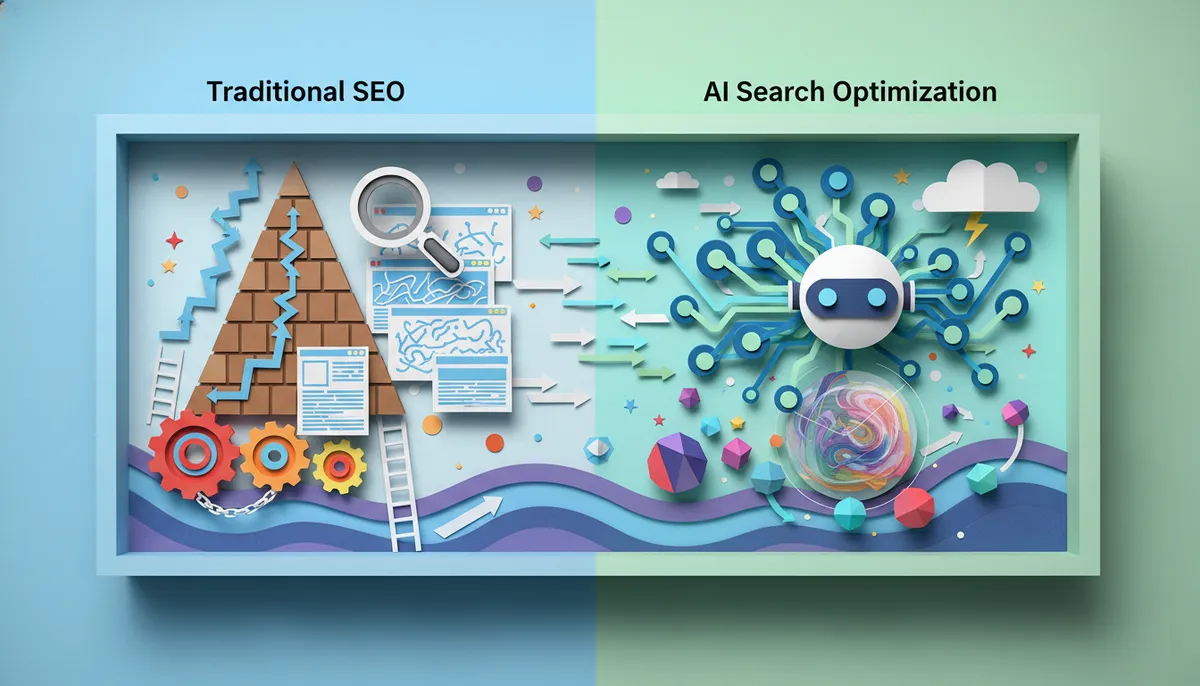
A Comparison of Traditional SEO vs. AI Search Optimization
Understanding the differences between traditional SEO and AI search optimization helps clarify why a combined strategy is essential in 2026.
| Factor | Traditional SEO | AI Search Optimization |
|---|---|---|
| Primary Goal | Rank on page one of search results | Be cited in AI-generated answers |
| Content Style | Keyword-focused, optimized density | Conversational, question-answering |
| Authority Signals | Backlinks, domain authority | E-E-A-T, brand mentions, citations |
| Technical Focus | Meta tags, page speed, indexing | Schema markup, structured data, crawlability |
| Measurement | Keyword rankings, organic traffic | AI snippet appearances, zero-click data |

How to Get Started Today
Optimizing for AI search does not require a complete overhaul of your current strategy. Start by auditing your existing content for question-based relevance and E-E-A-T compliance. Then, add structured data markup to your highest-traffic pages. Update your WordPress hosting environment to ensure your site speed and uptime are optimal for AI crawlers. From there, build outward with a consistent content publishing schedule focused on topical authority.
- Audit your top 10 pages for AI-readiness (structure, schema, E-E-A-T).
- Add FAQ sections with schema markup to service and product pages.
- Publish at least two question-answering blog posts per month.
- Claim and optimize all local directory and social media profiles.
- Set up monthly performance reviews to track AI search visibility.
If you are unsure where to start, reviewing the 9 signs you need an SEO agency near you can help you assess whether professional support is the right next step.
Conclusion
The way people find information online has fundamentally changed in 2026. AI-powered search engines are now the gatekeepers of visibility, and only businesses with structured, authoritative, and question-focused content will consistently appear in their results. Knowing how to optimize for AI search results in 2026 is the most important digital marketing skill your business can develop right now. From adopting the SEO, GEO, and AEO tri-strategy to strengthening your local signals and E-E-A-T credentials, every step you take moves your brand closer to the top of AI-generated answers. The businesses that adapt now will dominate search visibility for years to come.
Ready to future-proof your digital presence? The team at Brain Buzz Marketing specializes in AI-ready content strategies, technical SEO, and local search optimization for small and medium-sized businesses. Get in touch with our team today and let’s build a strategy that keeps your business visible no matter how search evolves.
FAQs
Q: What is the difference between SEO, GEO, and AEO?
A: SEO (Search Engine Optimization) focuses on ranking your content in traditional search results. GEO (Generative Engine Optimization) ensures your content is structured to be cited by AI-generated summaries. AEO (Answer Engine Optimization) targets voice assistants and answer-based platforms that respond directly to user questions. All three work together to maximize your visibility across modern search environments.
Q: How do AI search engines decide which content to cite?
A: AI search engines evaluate content based on factors like E-E-A-T signals, content structure, topical authority, and how directly the content answers user questions. Websites with clear schema markup, authoritative backlinks, and well-organized question-and-answer formatting are more likely to be selected as sources in AI-generated responses.
Q: Does traditional SEO still matter in 2026?
A: Yes, traditional SEO remains an essential foundation in 2026. However, it must now be combined with GEO and AEO strategies to account for AI-driven search platforms. Technical SEO elements like site speed, mobile responsiveness, and structured data are more important than ever because they directly impact how AI crawlers access and interpret your content.
Q: How long does it take to see results from AI search optimization?
A: Results from AI search optimization typically begin to appear within 60 to 90 days of implementing a consistent strategy. Building topical authority and earning E-E-A-T signals takes time, but businesses that publish high-quality, structured content consistently will see growing visibility in AI-generated answers within a few months.
Q: Can small businesses compete in AI search results?
A: Absolutely. AI search systems prioritize content quality, relevance, and trustworthiness over business size. A small business with a well-structured website, authoritative content, and strong local SEO signals can outperform larger competitors in AI-generated results. Focusing on a specific niche and building topical authority is one of the most effective strategies for smaller businesses.