Key Takeaways
-
Optimize title tags with primary keywords near the beginning and keep them under 60 characters to display fully in search results and improve click-through rates.
-
Create high-quality, original content that demonstrates expertise, experience, authoritativeness, and trustworthiness (E-E-A-T) rather than thin, generic content that won't rank well.
-
Build a strong internal linking structure by connecting pillar pages with supporting content using keyword-rich anchor text to pass link equity and improve discoverability.
-
Align your content with search intent by matching informational, navigational, commercial, or transactional queries to the appropriate content type for better rankings.
-
Optimize for mobile-first indexing by ensuring your site performs well on smartphones and tablets, as Google primarily uses mobile versions for ranking decisions.
-
Monitor performance regularly using Google Search Console to track organic traffic, click-through rates, keyword rankings, and Core Web Vitals to identify improvement opportunities.
Your website could be losing customers right now — and you might not even know it. If pages aren’t ranking on Google, the problem is often on-page SEO. This is the practice of optimizing individual web pages so search engines understand what your content is about and rank it higher in results.
On-page SEO covers everything visible on your page — titles, headings, content, images, and internal links. It also includes behind-the-scenes elements like meta tags and URL structure. When done correctly, it signals to Google that your page deserves to rank for specific search terms.
In 2026, search engines are smarter than ever. Google uses AI to evaluate content quality, relevance, and user experience. That means outdated tactics no longer work. This guide covers 13 proven on-page SEO techniques that actually move the needle for small businesses, e-commerce stores, and service providers alike.
What Is On-Page SEO and Why Does It Matter?
On-page SEO refers to all the optimizations made directly on a webpage to improve its search engine ranking. Unlike off-page SEO (which involves backlinks and external signals), on-page SEO is entirely within your control. That makes it one of the most powerful tools in your digital marketing strategy.
Search engines crawl your pages and look for signals that tell them what a page is about. Strong on-page SEO helps Google match your content with the right search queries. This means more qualified traffic — people who are actively looking for what you offer. You can learn more about professional SEO services that put these principles into practice every day.

13 On-Page SEO Techniques That Drive Real Results
1. Optimize Your Title Tags
The title tag is the clickable headline that appears in search results. It is one of the most important on-page SEO elements. Every page should have a unique title tag that includes the primary keyword near the beginning. Keep title tags under 60 characters so they display fully in Google’s search results.
A strong title tag should be descriptive, compelling, and accurate. Think of it as a mini advertisement for your page. It needs to tell users exactly what they will find when they click.
2. Write Compelling Meta Descriptions
Meta descriptions appear below the title in search results. While they are not a direct ranking factor, they significantly impact click-through rates. A well-written meta description can make the difference between a user clicking your page or a competitor’s.
Keep meta descriptions between 140 and 160 characters. Include your primary keyword naturally and end with a clear call to action. For example: “Learn how on-page SEO boosts your rankings. Get expert tips for 2026.”
3. Use Header Tags Strategically
Header tags (H1, H2, H3) give your content structure. They help both readers and search engines understand how your content is organized. Every page should have one H1 tag that includes the primary keyword. Use H2 and H3 tags to break up sections with relevant subheadings.
Think of your headers like a newspaper outline. They should guide readers through your content logically while reinforcing the topic to search engines. Strong header structure is a simple but effective on-page SEO technique that many businesses overlook.
4. Target the Right Keywords
Effective keyword targeting is the foundation of on-page SEO. You need to understand what terms your ideal customers are actually searching for. This goes beyond just primary keywords — it includes long-tail variations and related phrases known as LSI (Latent Semantic Indexing) terms.
Here is a simple process for keyword research:
- Start with your core service or product (e.g., “on-page SEO services”)
- Use tools like Google Search Console or keyword planners to find related terms
- Analyze search intent — are users looking for information, a service, or a product?
- Prioritize keywords with a balance of search volume and lower competition
- Map specific keywords to specific pages on your website
If you want professional guidance on keyword strategy, the team at content writing services can help you create keyword-targeted content that ranks.
5. Create High-Quality, Original Content
Google’s algorithms in 2026 reward content that demonstrates real expertise and value. According to Google E-E-A-T guidelines, content should show Experience, Expertise, Authoritativeness, and Trustworthiness. That means thin, generic content will not rank well — especially after recent AI-driven algorithm updates.
Focus on creating content that thoroughly answers the questions your target audience is asking. Long-form content that covers a topic in depth tends to perform better in search results. For more insight, read about why content is the backbone of SEO in 2026.
6. Optimize Your URL Structure
Clean, descriptive URLs help both users and search engines understand your page before they even visit it. A well-structured URL is short, readable, and includes the target keyword. Avoid long strings of numbers or irrelevant characters.
Best practices for URL structure include:
- Use hyphens to separate words (not underscores)
- Keep URLs as short as possible while remaining descriptive
- Include the primary keyword naturally
- Use lowercase letters only
- Avoid stop words like “and,” “the,” or “of” when possible
7. Optimize Images for Search Engines
Images are often overlooked in on-page SEO strategies. But optimized images can drive traffic through Google Image Search and improve overall page performance. Every image should have a descriptive file name and an alt text attribute that includes relevant keywords.
Image optimization also impacts page speed. Large, uncompressed images slow down your site. Slow sites rank lower and lose visitors quickly. Always compress images before uploading and use modern formats like WebP where possible. A custom website design built with SEO in mind will typically handle image optimization from the ground up.
8. Improve Page Load Speed
Page speed is a confirmed Google ranking factor. In 2026, users expect pages to load in under three seconds. Slow pages lead to high bounce rates, which signal poor user experience to search engines. Here are key ways to improve page speed:
- Use a reliable hosting service with fast server response times
- Enable browser caching and GZIP compression
- Minify CSS, JavaScript, and HTML files
- Reduce the number of HTTP requests on each page
- Use a Content Delivery Network (CDN) for global visitors
Reliable WordPress hosting plays a direct role in page speed performance and overall SEO health.
9. Optimize for Mobile Users
Google uses mobile-first indexing, meaning it primarily uses the mobile version of your site for ranking. If your site doesn’t perform well on smartphones and tablets, your rankings will suffer. In 2026, more than 60% of all web traffic comes from mobile devices.
A mobile-optimized site adjusts layout, font sizes, and navigation for smaller screens. Buttons should be easy to tap, text should be readable without zooming, and content should load quickly on cellular connections. Check out the 11 website design factors that drive results in 2026 for a deeper look at mobile best practices.
10. Build a Strong Internal Linking Structure
Internal links connect pages within your website. They help search engines discover and index your content. They also pass “link equity” — a measure of ranking authority — from one page to another. A strong internal linking strategy is one of the most underutilized on-page SEO techniques available.
Follow these steps to build an effective internal link structure:
- Identify your most important “pillar” pages (high-value service or product pages)
- Create supporting content that links back to those pillar pages
- Use descriptive, keyword-rich anchor text for every internal link
- Audit your site regularly and fix broken internal links
- Ensure every page can be reached within three clicks from the homepage
For example, a page about local SEO services can naturally link to pages about content writing, website design, and keyword strategy — creating a web of relevant, interconnected content.
11. Use Schema Markup
Schema markup is structured data code added to your web pages. It helps search engines understand your content more precisely. It can also generate rich snippets in search results — things like star ratings, FAQs, event details, and product prices that appear directly in Google’s listings.
Rich snippets make your listing stand out visually. They improve click-through rates without necessarily changing your ranking position. Common schema types for businesses include Local Business, FAQ, Review, and Article schemas. This is especially valuable for local service providers who want to dominate local search results.
12. Align Content with Search Intent
Search intent is the reason behind a user’s query. Google increasingly prioritizes content that matches what users actually want — not just content that contains the right keywords. There are four main types of search intent:
| Intent Type | User Goal | Content to Create |
|---|---|---|
| Informational | Learn something | Blog posts, guides, how-to articles |
| Navigational | Find a specific website | Brand pages, service landing pages |
| Commercial | Compare options | Comparison articles, reviews, case studies |
| Transactional | Buy or take action | Product pages, service pages, CTAs |
Matching your content to the right intent dramatically improves rankings. Read more about organic SEO and how to grow rankings without paid ads for practical intent-based strategies.
13. Monitor, Measure, and Improve
On-page SEO is not a one-time task. It requires ongoing monitoring and refinement. Google Search Console is a free tool that shows how your pages perform in search results. Use it to identify pages with declining traffic, poor click-through rates, or keyword ranking opportunities.
Track these key metrics regularly:
- Organic traffic by page
- Average keyword ranking positions
- Click-through rate (CTR) for title tags and meta descriptions
- Bounce rate and average time on page
- Core Web Vitals scores (Google’s speed and UX metrics)
Regular audits help you catch problems early and identify new opportunities. SEO audit services provide a detailed analysis of your site’s on-page health and create a clear roadmap for improvement.
On-Page SEO vs. Technical SEO: Understanding the Difference
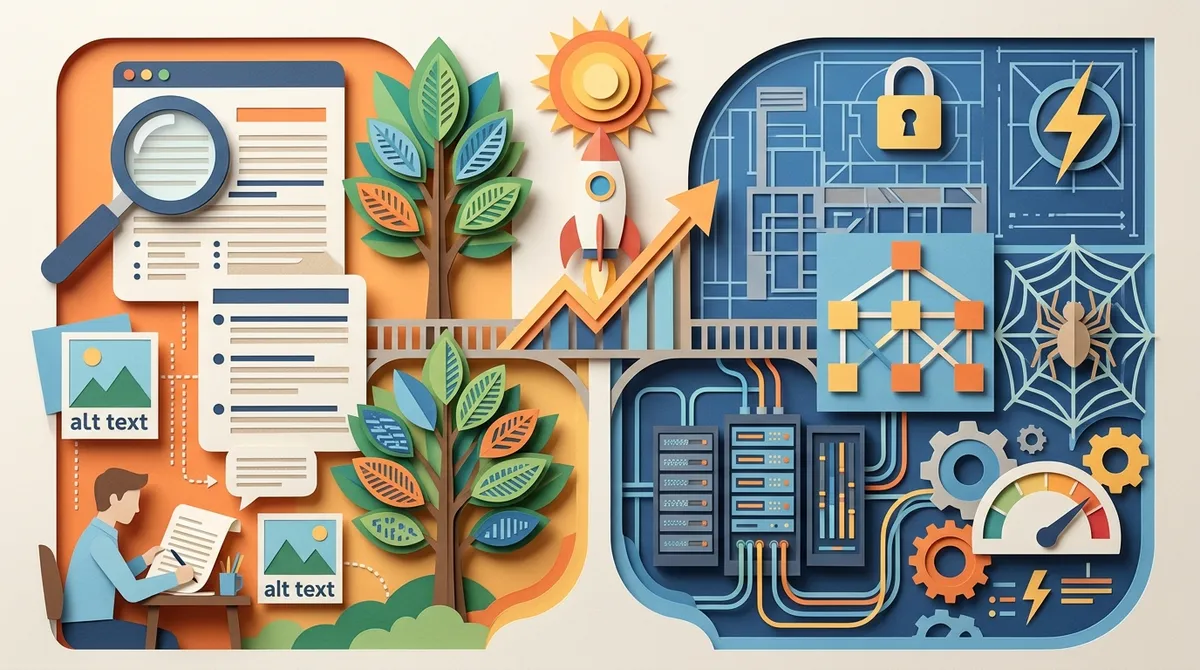
Many business owners confuse on-page SEO with technical SEO. While they are closely related, they cover different areas. Here is a quick comparison:
| Factor | On-Page SEO | Technical SEO |
|---|---|---|
| Focus Area | Content and visible elements | Site architecture and crawlability |
| Examples | Title tags, headers, keyword use | XML sitemaps, robots.txt, SSL |
| Who Handles It | Content and SEO teams | Web developers and SEO specialists |
| Impact Timeline | Weeks to months | Immediate to months |
Both are essential for a complete SEO strategy. On-page SEO ensures your content is relevant and compelling. Technical SEO ensures search engines can access and understand your site. To learn more about comprehensive digital marketing services, including both on-page and technical SEO solutions, explore what a full-service agency can offer.

How On-Page SEO Supports Your Broader Digital Marketing Strategy
On-page SEO doesn’t work in isolation. It is most powerful when combined with other digital marketing tactics. Content optimized for search engines also performs better in email campaigns and social media. Pages with strong on-page SEO convert better from paid traffic as well.
For local service providers in areas like Tampa, combining on-page SEO with local SEO services creates a powerful presence in both map results and organic search. This dual approach is one of the fastest ways to build consistent, qualified traffic to your website.
Follow Brain Buzz Marketing on Facebook and Instagram for regular tips on SEO, content strategy, and digital marketing best practices. You can also visit Brain Buzz Marketing on Google to read reviews from real clients who have seen measurable results.
Common On-Page SEO Mistakes to Avoid
Even experienced marketers make on-page SEO errors. Knowing what to avoid is just as important as knowing what to do. Here are the most common mistakes that hurt rankings:
- Duplicate title tags and meta descriptions across multiple pages
- Keyword stuffing — forcing keywords into content unnaturally
- Missing alt text on images, which hurts both SEO and accessibility
- Thin content that provides little to no value for readers
- No internal linking strategy, leaving pages isolated from the rest of your site
- Ignoring mobile optimization, especially for local service pages
Avoiding these mistakes is the first step toward stronger rankings. For a comprehensive look at what separates high-performing pages from low-ranking ones, explore the 12 ways to rank higher in organic SEO.
Conclusion: Start Optimizing Today
On-page SEO is one of the highest-ROI investments you can make in your digital presence. Every page you optimize is a new opportunity to attract qualified traffic, generate leads, and grow your business. The 13 techniques covered in this guide give you a clear, actionable roadmap — whether you’re a small business owner, an e-commerce retailer, or a local service provider.
The key is consistency. Start with your most important pages, implement these best practices, and track your results over time. If you need expert help building an on-page SEO strategy that delivers measurable growth, the team at Brain Buzz Marketing is ready to help. Reach out to our team today and let’s build a strategy that gets your business ranking where it belongs — at the top.
FAQs
Q: What is on-page SEO and why is it important?
A: On-page SEO is the practice of optimizing individual web pages to improve their visibility in search engine results. It includes elements like title tags, header structure, keyword usage, content quality, and internal linking. It matters because it directly controls how search engines interpret and rank your pages, making it a foundational component of any digital marketing strategy.
Q: How long does it take to see results from on-page SEO?
A: Most businesses begin to see measurable improvements within four to twelve weeks of implementing on-page SEO changes. The timeline depends on factors like your site’s current authority, keyword competition, and how frequently Google crawls your pages. Consistent optimization over time produces the most reliable and lasting results.
Q: Can I do on-page SEO myself or do I need a professional?
A: Many basic on-page SEO tasks — like updating title tags, improving meta descriptions, and adding alt text to images — can be done without professional help. However, a comprehensive strategy that covers technical elements, content depth, and ongoing performance tracking typically benefits from professional expertise. Working with an experienced SEO team helps ensure every optimization is aligned with your broader business goals.
Q: What is the most important on-page SEO factor in 2026?
A: Content quality aligned with search intent is widely considered the most critical on-page SEO factor in 2026. Google’s AI-driven algorithms evaluate whether your content genuinely answers user questions with depth and accuracy. Strong title tags and proper keyword placement remain important, but they cannot compensate for content that lacks real value or relevance.
Q: How does on-page SEO differ from off-page SEO?
A: On-page SEO involves optimizations made directly on your website, including content, headings, meta tags, and URL structure. Off-page SEO refers to external signals like backlinks from other websites, social media mentions, and online reviews. Both are essential to a complete SEO strategy, but on-page SEO is entirely within your control and is typically the best place to start.