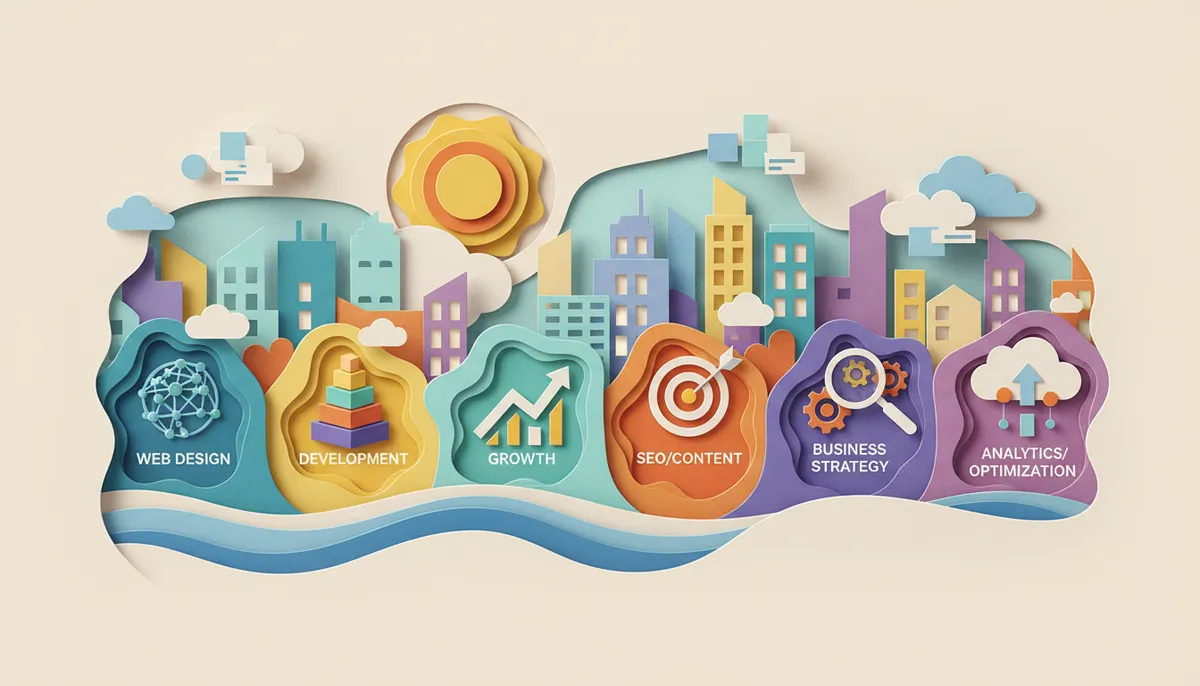
Key Takeaways
-
Build websites with strategic, conversion-focused layouts that guide visitors toward specific actions like calls-to-action, using visual hierarchy and trust signals to increase conversions rather than just creating beautiful designs.
-
Optimize for mobile-first design since over 60% of web traffic comes from mobile devices; Google uses mobile-first indexing for rankings, so poor mobile performance directly reduces search visibility and customer reach.
-
Prioritize page speed optimization as a one-second delay can reduce conversions by up to 7% and hurt search rankings; invest in quality hosting, clean code, and image compression to maximize performance.
-
Integrate SEO into design from day one with clean URLs, proper heading tags, schema markup, and site architecture rather than attempting to add SEO later, which creates costly problems and limits organic traffic potential.
-
Align content and design together to build trust and communicate expertise; use benefit-driven headlines, testimonials, and clear calls-to-action that demonstrate real experience and authority to visitors immediately.
-
Maintain consistent brand identity across your website using unified logos, color schemes, typography, and tone of voice to signal professionalism and build the credibility needed to convert first-time visitors into loyal customers.
Your website is often the first impression a potential customer has of your business. In 2026, that first impression happens in seconds. If your site looks outdated, loads slowly, or fails to guide visitors toward taking action, you are losing customers every single day. Web design and development is no longer just about making a site look nice. It is about building a digital asset that works for your business around the clock.
Whether you are a small business owner, a startup, or a local service provider, your website needs to do more than exist online. It needs to attract visitors, communicate your value clearly, and convert those visitors into paying customers. The good news is that the right web design and development strategy can transform your online presence entirely. In this article, we break down six proven principles that separate high-performing websites from ones that simply take up space on the internet.
1. Strategic Layout Drives Visitor Action
A well-designed website is built with intention. Every button, image, and block of text has a purpose. The layout should guide visitors naturally toward a specific goal, whether that is making a phone call, filling out a form, or purchasing a product. This is called conversion-focused design, and it is one of the most powerful tools in digital marketing.
Many business owners make the mistake of building a website that looks beautiful but does not convert. A stunning homepage means nothing if visitors leave without taking action. Strategic layout means placing your call-to-action buttons where the eye naturally travels, using visual hierarchy to highlight key messages, and removing distractions that pull attention away from your goal. Working with a skilled website design team ensures your layout is built with both aesthetics and conversion in mind.
Key Elements of a Conversion-Focused Layout
-
Clear and prominent calls-to-action above the fold
-
Simple navigation that does not overwhelm visitors
-
Visual contrast that draws attention to important elements
-
Whitespace that improves readability and reduces clutter
-
Trust signals such as testimonials, certifications, and reviews placed near decision points
2. Mobile-First Design Is Non-Negotiable
More than 60% of all web traffic now comes from mobile devices. If your website does not perform flawlessly on a smartphone, you are turning away the majority of your potential customers. Mobile-first design means building your website for smaller screens first, then scaling up for desktops. This approach ensures the best possible experience for every visitor, regardless of the device they use.
Google also uses mobile-first indexing, which means the mobile version of your site is what Google primarily reads when determining your search ranking. A site that performs poorly on mobile will rank lower in search results, reducing your visibility. This is why SEO and web design and development must work together from the very beginning of a project.
What Mobile-First Design Includes
-
Responsive layouts that adjust to any screen size automatically
-
Tap-friendly buttons that are large enough for fingers to click accurately
-
Compressed images and clean code to ensure fast load times on mobile networks
-
Simplified menus that are easy to navigate on small screens
3. Page Speed Is a Ranking and Revenue Factor
Every extra second your website takes to load costs you visitors. Studies show that a one-second delay in page load time can reduce conversions by up to 7%. For an e-commerce retailer or local service provider, that is a significant loss in revenue. Page speed is also a confirmed Google ranking factor, which means a slow site hurts your visibility in search results as well.
Optimizing page speed involves several technical layers of web development. Clean code, compressed images, browser caching, and reliable hosting all play a role. Choosing quality WordPress Hosting is one of the most impactful decisions you can make for your site’s performance. A fast, reliable server is the foundation of a high-performing website.
|
Page Load Time |
Estimated Bounce Rate Increase |
Impact on Conversions |
|---|---|---|
|
1–2 seconds |
Minimal |
Optimal performance |
|
3 seconds |
32% increase |
Noticeable drop in conversions |
|
5 seconds |
90% increase |
Significant revenue loss |
|
10 seconds |
123% increase |
Severe impact on leads and sales |
4. SEO Must Be Built Into the Design From Day One
Many businesses build a website first and try to add SEO later. This approach creates problems that are difficult and costly to fix. When web design and development are aligned with SEO best practices from the start, your site is built on a strong foundation that search engines can easily read, index, and rank.
SEO-integrated design includes clean URL structures, properly formatted heading tags, optimized image alt text, fast load speeds, and schema markup that helps search engines understand your content. It also includes creating a site architecture that makes it easy for both users and search engine crawlers to navigate. The team at Brain Buzz Marketing specializes in building custom WordPress websites where SEO and design work seamlessly together, giving your business the best possible chance to rank well and attract organic traffic. You can also explore Local SEO Services to strengthen your presence in your specific geographic area.
Core SEO Elements That Must Be In Every Website Build
-
Keyword-optimized page titles and meta descriptions
-
Fast load times supported by quality hosting and clean code
-
Internal linking structure that connects related pages
-
Schema markup for local businesses, reviews, and services
-
XML sitemaps submitted to Google Search Console
-
SSL certificate for a secure HTTPS connection
For a deeper understanding of how SEO can drive more local customers to your business, read our article on 7 Ways Local SEO Near You Drives More Customers In 2026.
5. Content and Design Must Work Together
Great design without great content is an empty shell. Your website’s content, meaning the words, headlines, and calls-to-action, is what communicates your value and convinces visitors to take the next step. Design and content must be developed together, not separately. When they are aligned, every page tells a cohesive story that resonates with your target audience.
This is especially important for startups and small businesses that need to build trust quickly. Visitors who land on your website are essentially asking, “Can I trust this business?” Your content needs to answer that question confidently and immediately. According to Google E-E-A-T guidelines, content that demonstrates real experience, expertise, and trustworthiness performs better in search rankings and builds stronger connections with readers. Investing in professional content writing services ensures your website communicates authority from the very first word.
How to Align Content With Web Design
-
Write headlines that are benefit-driven and immediately clear about what you offer
-
Use short paragraphs and bullet points to make pages easy to scan
-
Place testimonials and case studies near high-intent pages to build social proof
-
Ensure every page has one primary goal and one clear call-to-action
Pairing high-quality content with thoughtful design also supports Answer Engine Optimization (AEO) and Generative Engine Optimization (GEO), which are increasingly important as AI-driven search tools become more common in 2026. Websites that answer questions directly and clearly are more likely to be surfaced in AI-generated results.
6. Brand Consistency Builds Trust and Recognition
Your website is not just a standalone digital page. It is the central hub of your entire brand identity. Every color, font, image, and tone of voice should be consistent across your website and all other marketing channels. Brand consistency signals professionalism and builds the kind of trust that turns first-time visitors into long-term customers.
This includes having a professionally designed logo that reflects your brand values, a consistent color palette used across all pages, and typography that is both readable and on-brand. If your logo or brand identity needs a refresh, investing in professional Logo Designs is a foundational step before launching or redesigning your website. A cohesive brand presence also reinforces your credibility when running paid advertising campaigns, as your ads and landing pages should look and feel like natural extensions of your website.
Brand Consistency Checklist for Your Website
-
Consistent logo placement on every page
-
Unified color scheme that matches your brand guidelines
-
Typography that reflects your brand personality and is easy to read
-
Professional photography or branded imagery throughout the site
-
Matching tone of voice across all page copy and calls-to-action
When your brand is consistent and your website communicates clearly, your digital advertising also becomes more effective. Visitors who click on a Google Ad and land on a page that looks polished and trustworthy are far more likely to convert. This is why integrated digital marketing services that combine web design, SEO, and paid advertising deliver the strongest results.
Bringing It All Together for Maximum Results
Web design and development is far more than an aesthetic exercise. It is a strategic business investment that directly affects your ability to attract, engage, and convert customers online. Each of the six principles outlined above plays a specific role in building a website that performs. When they work together, the results are compounding and long-lasting.
|
Design Principle |
Primary Benefit |
Who Benefits Most |
|---|---|---|
|
Strategic Layout |
Higher conversion rates |
All businesses |
|
Mobile-First Design |
Better rankings and user experience |
Local service providers, e-commerce |
|
Page Speed Optimization |
Reduced bounce rate, more leads |
E-commerce retailers, startups |
|
SEO Integration |
Organic traffic growth |
Small businesses, marketing managers |
|
Content and Design Alignment |
Stronger trust and engagement |
Startups, local service providers |
|
Brand Consistency |
Professional credibility |
All businesses |
If you are ready to see real examples of what thoughtful web design and development looks like in practice, visit our Testimonials page to hear directly from business owners who have experienced measurable growth. You can also visit us on Google to read our latest client reviews and see why businesses across Tampa trust Brain Buzz Marketing with their digital presence. Stay connected with our team for ongoing tips and updates by following us on Facebook and Instagram.
Conclusion
A high-performing website does not happen by accident. It is the result of intentional planning, expert execution, and a deep understanding of what your target audience needs. Web design and development done right creates a digital foundation that supports every other marketing effort you make. From SEO to paid advertising to content strategy, everything performs better when your website is built with purpose.
If your current website is not generating the leads and customers your business deserves, now is the time to take action. Explore our Website Agency services or connect with our Tampa Website Designer team to learn how a custom-built website can transform your online presence. Ready to get started? Reach out to our team today and let us build a website that works as hard as you do.
FAQs
Q: What is the difference between web design and web development?
A: Web design focuses on the visual layout, user experience, and aesthetic elements of a website, including colors, typography, and page structure. Web development refers to the technical side, such as coding, functionality, database integration, and ensuring the site performs correctly across all devices and browsers. Both disciplines work together to create a website that is both visually compelling and technically sound.
Q: How long does it take to build a professional business website?
A: The timeline for a professional web design and development project typically ranges from two to eight weeks, depending on the complexity of the site, the number of pages, and the availability of content and brand assets. A simple service website may be completed in two to three weeks, while a more robust site with custom functionality may take six to eight weeks. Clear communication and timely feedback from the client are the biggest factors in keeping a project on schedule.
Q: Do I need to rebuild my website to improve SEO?
A: Not always, but in many cases a rebuild is the most efficient path to strong SEO performance. If your current site has slow load times, poor mobile performance, outdated code, or a disorganized structure, a rebuild that integrates SEO best practices from the ground up will deliver significantly better results than patching an existing site. A professional audit can help determine whether optimization or a full redesign is the right approach for your specific situation.
Q: Why is mobile-first design important for my business website?
A: Mobile-first design is essential because the majority of web traffic in 2026 comes from smartphones and tablets. Google uses mobile-first indexing, meaning it evaluates the mobile version of your site to determine search rankings. A website that is not optimized for mobile devices will rank lower in search results, load poorly for most visitors, and result in higher bounce rates and fewer conversions.
Q: What makes a WordPress website a good choice for small businesses?
A: WordPress is one of the most flexible and widely supported website platforms available, making it an excellent choice for small businesses and growing companies. It offers a vast ecosystem of plugins for SEO, e-commerce, contact forms, and performance optimization. When paired with quality hosting and a custom design, a WordPress website delivers professional results at a scalable cost that fits within a small business budget.