Key Takeaways
-
Structure content in Q&A format with answers of 40-60 words under H2/H3 question headings to optimize for featured snippets and AI tool extraction.
-
Implement FAQ schema markup and structured data (Schema.org) on your website to help AI tools and search engines identify and select your content as authoritative answers.
-
Research question-based keywords using tools like AnswerThePublic and Google's 'People Also Ask' section, then build your content strategy around directly answering these queries.
-
Build E-E-A-T signals (Experience, Expertise, Authoritativeness, Trustworthiness) through author credentials, reputable citations, client testimonials, and quality backlinks to establish credibility with AI tools.
-
Optimize for voice search by using conversational, natural language tone in your answers since voice assistants read content aloud and users phrase voice queries as full questions.
-
Create comprehensive FAQ sections on every major service page and blog post, then maintain and refresh all content quarterly to keep information current and signal trustworthiness to answer engines.
Search is changing fast. People no longer just type keywords into Google and scroll through a list of blue links. They ask questions — and they expect direct answers. This shift has given rise to a powerful new discipline in digital marketing: Answer Engine Optimization (AEO). If your business is not yet thinking about AEO, you may already be losing visibility to competitors who are.
Answer Engine Optimization is the practice of structuring your content so that AI-powered tools, voice assistants, and search engines can surface your brand as the direct answer to a user’s question. In 2026, this is no longer optional. With the rise of tools like ChatGPT, Google’s AI Overviews, Perplexity, and voice search via smart devices, the way people consume information has fundamentally changed. Understanding AEO — and knowing how to implement it — can make a significant difference in your online visibility and lead generation.

What Is Answer Engine Optimization?
Answer Engine Optimization (AEO) is the process of optimizing your digital content so that it gets selected as the definitive answer to a user’s query. Unlike traditional SEO, which focuses on ranking a page in search results, AEO focuses on becoming the source that an AI or answer engine quotes directly. Think of featured snippets, Google’s AI Overviews, or the spoken response from a voice assistant — those are all AEO in action.
The goal is simple: when someone asks a question relevant to your business, your content should be the answer that appears — instantly, clearly, and without the user needing to click further. This kind of brand visibility builds trust and drives qualified traffic to your website.

Why AEO Matters for Your Business in 2026
The search landscape in 2026 looks very different from just a few years ago. AI-driven search engines and large language models (LLMs) now summarize answers directly from web content. Users increasingly interact with platforms like Perplexity AI, Google’s Search Generative Experience, and voice-based assistants instead of traditional search listings.
This shift creates both a challenge and an opportunity for businesses. If your content is not structured to answer questions clearly, AI tools will simply choose a source that is. Here are some key reasons AEO matters right now:
- Zero-click searches are rising: More users get answers without ever clicking to a website.
- Voice search is growing: Smart speakers and mobile assistants pull answers from well-optimized content.
- AI tools reference authoritative sources: LLMs favor content that is structured, trustworthy, and clear.
- Featured snippets drive visibility: Position zero in Google often leads to more brand exposure than rank one.
- Brand authority increases: Being cited as the answer builds credibility and trust with your audience.
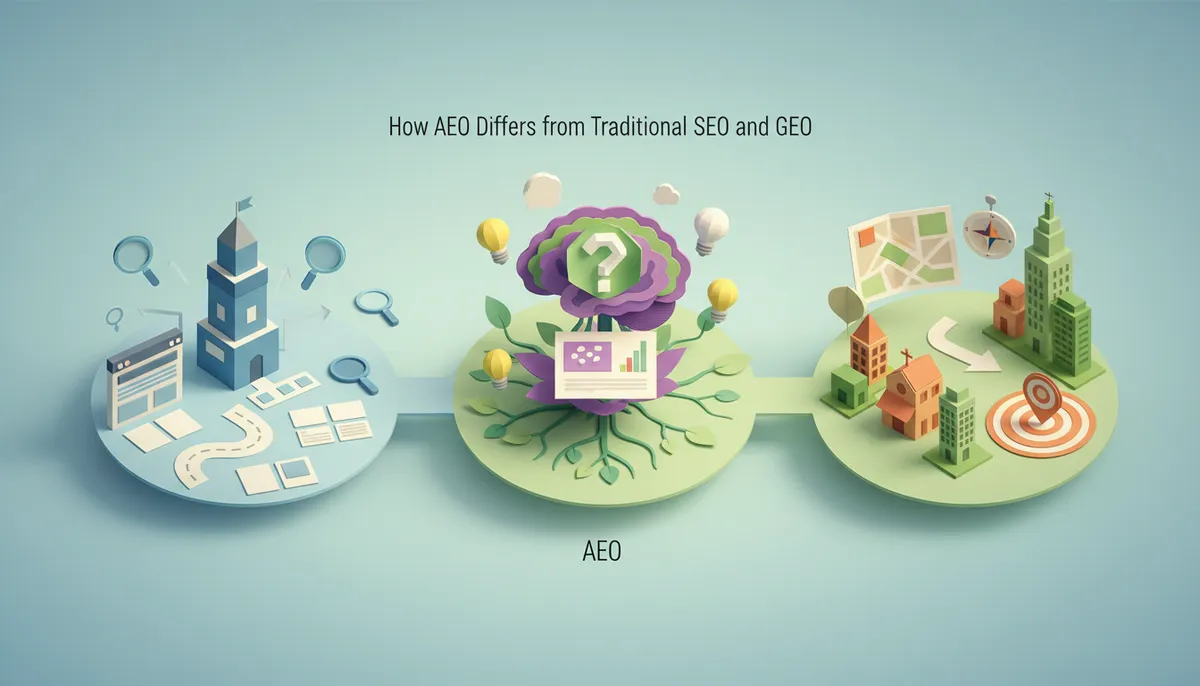
How AEO Differs from Traditional SEO and GEO
It helps to understand how AEO fits alongside other content strategies. While they share some foundations, each serves a different purpose in your digital marketing plan.
| Strategy | Primary Goal | Main Platform | Content Focus |
|---|---|---|---|
| SEO | Rank high in search results | Google, Bing | Keyword optimization, backlinks |
| GEO (Generative Engine Optimization) | Appear in AI-generated summaries | ChatGPT, Gemini, Perplexity | Authoritative, factual long-form content |
| AEO (Answer Engine Optimization) | Become the direct answer to a query | Voice search, featured snippets, AI Overviews | Concise Q&A format, structured data |
A well-rounded digital marketing strategy in 2026 incorporates all three. SEO builds your foundation. GEO gets you referenced by AI tools. AEO ensures you are the answer people hear or read first.

How to Do Answer Engine Optimization: A Step-by-Step Guide
Implementing AEO requires a deliberate approach to content creation and technical structure. The following steps will help you build an AEO-ready content strategy that positions your brand as a trusted authority.
Step 1: Research Question-Based Keywords
AEO starts with understanding the exact questions your audience is asking. Use tools like Google’s “People Also Ask” section, AnswerThePublic, or keyword research platforms to identify question-based queries in your industry. Focus on questions that begin with who, what, where, when, why, and how.
Prioritize questions with high intent — those that signal a user is ready to make a decision or needs a specific answer. Your content writing strategy should be built around directly answering these questions.
Step 2: Structure Content in a Q&A Format
Once you have your questions, format your content to answer them clearly and concisely. The best AEO content follows a simple pattern: state the question as a heading, then answer it in two to four sentences directly below. This mirrors how featured snippets and AI tools pull information.
Here are key formatting principles to follow:
- Use H2 or H3 tags for the question itself.
- Provide a direct answer in the first sentence after the heading.
- Keep answers between 40 and 60 words for featured snippet optimization.
- Expand with supporting detail below the concise answer.
- Avoid burying the answer deep in a paragraph.
Step 3: Use Structured Data Markup (Schema)
Structured data, also known as schema markup, helps search engines and AI tools understand your content. For AEO, the most important schema types include FAQ schema, HowTo schema, and Article schema. Adding these to your web pages signals to Google and AI platforms that your content is a structured, authoritative source of answers.
If your business website runs on WordPress, many plugins simplify this process. Investing in a well-built website design that supports proper schema implementation is a strong foundation for AEO success.
Step 4: Build E-E-A-T Signals into Your Content
AI tools and search engines prioritize content from sources that demonstrate Experience, Expertise, Authoritativeness, and Trustworthiness — a framework Google refers to as Google E-E-A-T. To rank well in answer engines, your content must reflect genuine knowledge and credibility.
Practical ways to build E-E-A-T include:
- Including author bios with real credentials.
- Citing reputable external sources within your content.
- Maintaining consistent publishing of accurate, updated information.
- Earning quality backlinks from trusted industry websites.
- Displaying client testimonials and case studies on your website.
Step 5: Optimize for Voice Search
Voice search queries are longer and more conversational than typed searches. When someone uses a voice assistant, they typically ask a full question. Your content should match this natural, conversational tone. Write as if you are answering a question in plain language — because voice assistants will read your answer aloud.
Use natural phrasing, avoid technical jargon where possible, and ensure your answers make sense when spoken out loud. Local businesses should also incorporate location-specific language, since voice searches often have local intent. Explore our local SEO services to see how location optimization pairs with AEO.
Step 6: Build a Strong FAQ Section on Every Key Page
FAQ sections are one of the most powerful AEO tools available. They directly address questions users ask, and when paired with FAQ schema, they have a high chance of appearing in featured snippets and AI-generated answers. Every major service page and blog post on your website should include a relevant FAQ section.
Think about the top five questions your customers ask before making a purchase or inquiry. Answer each one clearly and concisely. This not only improves AEO performance but also reduces friction in the buyer’s journey.
Step 7: Refresh and Maintain Your Content Regularly
Answer engines favor content that is current and accurate. Outdated information can cause AI tools to deprioritize your content in favor of more recent sources. Build a content maintenance schedule to review and update your key pages and articles at least quarterly.
This is especially important in fast-moving industries like digital marketing, where best practices, tools, and statistics change frequently. Regular updates signal to search engines that your content is actively maintained and trustworthy.
AEO Content Best Practices at a Glance
| Best Practice | Why It Matters | Impact Level |
|---|---|---|
| Question-based headings | Matches how users phrase queries | High |
| Concise 40-60 word answers | Optimized for featured snippet extraction | High |
| FAQ schema markup | Helps AI tools identify structured answers | High |
| Conversational tone | Aligns with voice search behavior | Medium |
| E-E-A-T signals | Builds credibility with AI and search engines | High |
| Regular content updates | Maintains relevance and accuracy | Medium |
| Internal linking structure | Supports crawlability and topical authority | Medium |
Common AEO Mistakes to Avoid
Even well-intentioned content strategies can fall short with AEO if certain pitfalls are not addressed. The following are the most common mistakes businesses make when first approaching Answer Engine Optimization:
- Writing for humans only: Your content must also be readable and parseable by AI tools and search engine crawlers.
- Ignoring schema markup: Unstructured content is much harder for answer engines to extract and use.
- Burying answers in long paragraphs: Get to the point immediately — answer engines do not have patience for fluffy introductions.
- Neglecting mobile and voice optimization: A large share of answer engine queries come from mobile devices and smart speakers.
- Publishing and forgetting: Static, outdated content loses its AEO effectiveness over time.
How Brain Buzz Marketing Approaches AEO
At Brain Buzz Marketing, we do not just write content for Google rankings. Our content strategy is built around the future of search — combining traditional SEO, Generative Engine Optimization (GEO), and Answer Engine Optimization (AEO) into a single, unified approach. This means your brand gets found across traditional search, AI-generated summaries, and voice assistant responses.
Our team crafts every piece of content with both the reader and the algorithm in mind. Whether you need a full website content overhaul or a targeted blog strategy, we help businesses in Tampa and beyond build digital authority that lasts. You can also visit our Google Business Profile to see what our clients say about the results we deliver.
For businesses interested in the tools that power modern content strategies, SEO Rocket is a fully automated blog platform worth exploring for scaling content production efficiently.
Measuring Your AEO Success
Tracking AEO performance requires looking beyond traditional ranking metrics. Here is what to monitor:
- Featured snippet appearances: Track which of your pages appear in position zero in Google.
- Voice search traffic: Use Google Search Console to identify conversational query patterns.
- AI citation tracking: Monitor whether your content appears in tools like Perplexity, Gemini, or ChatGPT responses.
- Click-through rate (CTR) from snippets: Measure how often snippet visibility translates to website visits.
- Organic impressions for question-based queries: Growth here indicates improving AEO performance.
Understanding these metrics helps you refine your content strategy over time. If you are unsure where to start, our team at Brain Buzz Marketing is experienced in both strategy and execution. Learn more about how to choose SEO services that actually grow your business and see how AEO fits into a broader growth plan.
Conclusion: The Future of Search Belongs to Answer Engines
Answer Engine Optimization is not a trend — it is the direction that search is heading. As AI tools become the default way people find information, businesses that invest in AEO today will have a significant advantage tomorrow. The good news is that AEO does not require a complete overhaul of your existing strategy. It builds on the SEO foundation you may already have, adding a layer of structure and clarity that AI tools reward.
Start with question-based content, implement schema markup, build your E-E-A-T signals, and commit to keeping your content current. If you want expert guidance on building an AEO strategy tailored to your business, our team is ready to help. Follow us on Facebook and Instagram for ongoing digital marketing insights and updates.
Ready to position your brand at the front of the AI-powered search revolution? Get in touch with our team today and let us build an answer engine strategy that puts your business exactly where your customers are looking.
FAQs
Q: What is Answer Engine Optimization (AEO)?
A: Answer Engine Optimization (AEO) is the practice of structuring your digital content so that AI tools, voice assistants, and search engines select it as the direct answer to a user’s query. It goes beyond traditional SEO by targeting featured snippets, Google’s AI Overviews, and LLM-powered platforms like Perplexity and ChatGPT.
Q: How is AEO different from traditional SEO?
A: Traditional SEO focuses on ranking a web page high in search results through keyword optimization and backlink building. AEO focuses specifically on formatting content so that answer engines and AI tools extract and present it as the definitive response to a question — often without the user clicking through to the website at all.
Q: What types of content work best for Answer Engine Optimization?
A: Content that performs best for AEO includes Q&A-formatted articles, FAQ sections with schema markup, HowTo guides, and concise definitions written in plain language. Pages that answer specific questions clearly and briefly — typically 40 to 60 words per answer — are most likely to be selected by featured snippets and AI-generated summaries.
Q: Does AEO replace SEO or work alongside it?
A: AEO works alongside SEO rather than replacing it. A strong SEO foundation — including technical optimization, quality backlinks, and keyword strategy — supports your AEO efforts by establishing the domain authority and crawlability that AI tools rely on when selecting trusted sources.
Q: How long does it take to see results from AEO?
A: Results from AEO can vary depending on your domain authority, content quality, and competition. Some businesses see featured snippet appearances within a few weeks of implementing structured Q&A content and schema markup. For sustained AI citation visibility, a consistent content strategy maintained over several months typically produces the strongest results.