Key Takeaways
-
Organic SEO delivers sustained, cost-effective traffic that continues generating results months and years after initial investment, unlike paid ads that stop working when spending stops.
-
Long-tail keywords with lower competition and higher conversion intent—like ‘organic SEO services for small businesses in Tampa’—drive more qualified leads than broad, competitive terms.
-
Expect realistic timelines: 3-4 months for initial improvements, 5-6 months for noticeable ranking gains, and 7-12+ months for sustained organic growth and compounding returns.
-
Technical SEO, on-page optimization, keyword research, quality backlinks, and local SEO are five interconnected pillars—neglecting any one significantly weakens overall performance.
-
Track organic traffic, keyword rankings, conversion rates, backlink growth, and cost-per-lead to measure ROI; beware of agencies promising first-page rankings in days or weeks.
-
AI-powered search results, E-E-A-T ranking factors, Core Web Vitals, voice search optimization, and entity-based SEO are reshaping 2026 strategy beyond traditional keyword targeting.
Every business wants more website traffic. But paying for every single click gets expensive fast. That is where organic SEO comes in. Organic SEO is the process of improving your website’s visibility in search engine results without relying on paid advertisements. When done correctly, it brings a steady stream of qualified visitors to your site — month after month — without ongoing ad spend.
In 2026, organic search remains one of the most powerful and cost-effective digital marketing channels available. Whether you are a small business owner, an e-commerce retailer, or a local service provider, understanding how organic SEO works — and how to execute it properly — can transform your online presence. This guide covers everything you need to know, from core strategies to realistic timelines, common mistakes, and how to measure real results.

What Is Organic SEO and Why Does It Matter
Organic SEO refers to all the techniques used to earn high search engine rankings naturally. This includes optimizing your website content, improving your site’s technical structure, and building authority through quality backlinks. Unlike paid ads that stop delivering the moment you stop spending, organic rankings can sustain traffic over the long term.
For businesses focused on sustainable growth, organic SEO delivers compounding returns. The effort you invest today continues to generate results months and even years later. According to industry research, organic search drives the majority of all website traffic across industries — making it an essential component of any serious digital marketing services strategy.

Core Benefits of Organic SEO for Your Business
Understanding why organic SEO matters helps justify the investment. Here are the key advantages it delivers:
-
Long-Term Traffic: Once your pages rank, they attract visitors without additional cost per click.
-
Credibility and Trust: Users trust organic results more than paid ads, viewing top-ranked pages as genuine recommendations from Google.
-
Cost-Effective Lead Generation: The cost per lead from organic SEO decreases over time as your rankings strengthen.
-
Targeted Audience Reach: By targeting specific keywords, you attract people who are already searching for what you offer.
-
Competitive Advantage: Strong organic rankings are difficult for competitors to displace quickly, giving you a durable edge.
-
Brand Authority: Consistently appearing in top results builds brand recognition and positions your business as an industry leader.
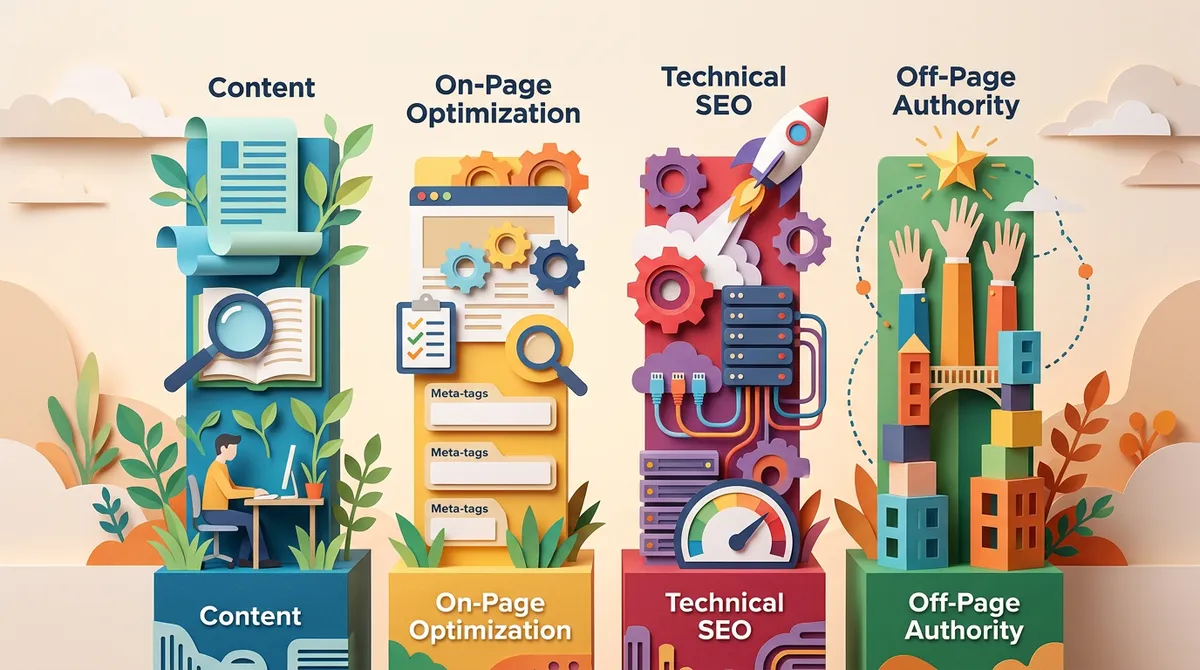
The Main Pillars of a Strong Organic SEO Strategy
Effective organic SEO is built on several interconnected disciplines. Ignoring any one of them weakens your overall performance.
1. Technical SEO
Technical SEO ensures that search engines can crawl and index your website efficiently. Key elements include site speed, mobile-friendliness, secure HTTPS connections, clean URL structures, and proper XML sitemaps. A technically sound website creates the foundation that all other SEO efforts are built upon. You can explore SEO services that address both technical and on-page optimization together for the best results.
2. On-Page SEO and Content Optimization
On-page SEO involves optimizing the actual content on your pages. This includes using your target keywords in titles, headers, meta descriptions, and naturally throughout the body text. High-quality, well-researched content that genuinely answers user questions is the cornerstone of organic search success. Google’s Google E-E-A-T framework — Experience, Expertise, Authoritativeness, and Trustworthiness — directly influences how pages are evaluated and ranked.
3. Keyword Research and Long-Tail Strategy
Keyword research identifies the exact phrases your target audience uses when searching. A smart keyword strategy goes beyond broad, high-competition terms. Long-tail keywords — longer, more specific phrases — typically have lower competition and higher conversion intent. For example, targeting “organic SEO services for small businesses in Tampa” will reach a more qualified audience than simply targeting “SEO.” Our content writing services are built around this kind of precision keyword targeting.
4. Link Building and Domain Authority
Backlinks — links from other reputable websites pointing to yours — remain one of the strongest ranking signals in Google’s algorithm. Earning high-quality backlinks from authoritative, relevant sources signals that your website is trustworthy and valuable. Ethical, white-hat link-building strategies include guest posting, digital PR, and earning mentions through genuinely useful content.
5. Local SEO
For businesses serving specific geographic areas, local SEO is a critical subset of organic optimization. Optimizing your Google Business Profile, building local citations, and earning reviews all contribute to visibility in local search results and map packs. You can learn more about this through our Local SEO services and our article on 7 Ways Local SEO Near You Drives More Customers in 2026.

White-Hat vs. Black-Hat SEO: Why the Difference Matters
Not all SEO tactics are created equal. White-hat SEO refers to ethical practices that align with search engine guidelines. Black-hat SEO uses manipulative shortcuts that may deliver short-term gains but carry serious long-term risks.
|
White-Hat SEO |
Black-Hat SEO |
|---|---|
|
High-quality original content |
Keyword stuffing and spun content |
|
Earning backlinks naturally |
Buying links or using private blog networks |
|
Proper site structure and technical optimization |
Cloaking or hidden text |
|
Targeting relevant keywords with user intent |
Targeting unrelated keywords for traffic manipulation |
|
Transparent reporting and honest metrics |
Fake reviews and manipulated metrics |
Google’s algorithm updates — such as Panda, Penguin, and the Helpful Content updates — were designed specifically to penalize black-hat tactics. Businesses that rely on shortcuts risk having their rankings wiped out overnight. Always choose an SEO partner that follows proven, ethical SEO practices that actually grow your business.
Realistic Timeline for Organic SEO Results
One of the most common misconceptions about organic SEO is that results happen quickly. In reality, organic SEO is a long-term investment. Here is a general timeline of what to expect:
-
Months 1–2: Technical audit, keyword research, and on-page optimization. Initial fixes are implemented, but visible ranking changes are minimal at this stage.
-
Months 3–4: Content production ramps up. Google begins to index new pages and re-evaluate updated pages. Small ranking improvements start to appear.
-
Months 5–6: Backlink building gains momentum. Keyword rankings improve more noticeably. Organic traffic begins to grow steadily.
-
Months 7–9: Compounding effects take hold. Pages that ranked on page two begin moving to page one. Traffic and lead generation increase significantly.
-
Months 10–12+: Sustained organic growth is established. Rankings stabilize for primary keywords, and long-tail terms continue to bring in additional traffic.
Beware of any agency that promises first-page rankings within days or weeks. Legitimate organic SEO is a gradual process. Patience combined with consistent effort delivers reliable, lasting results. For signs that you may already need professional help, read our article on 9 Signs You Need an SEO Agency Near You.
Organic SEO for E-Commerce vs. Service-Based Businesses
The core principles of organic SEO apply across all business types, but the execution differs depending on your business model.
E-Commerce SEO Priorities
-
Optimizing individual product pages with unique, keyword-rich descriptions
-
Implementing structured data markup for product rich snippets
-
Managing duplicate content across category and filter pages
-
Building content strategies around product-related search queries
-
Improving site speed and checkout experience for mobile users
Service-Based Business SEO Priorities
-
Creating service pages that clearly explain offerings and target local keywords
-
Building location-specific landing pages for multi-area businesses
-
Generating and managing online reviews to support local rankings
-
Developing educational blog content that addresses customer questions
-
Optimizing Google Business Profiles for maximum local visibility
Understanding these distinctions helps ensure your SEO strategy is aligned with your specific business goals. A custom-designed website that is built with SEO architecture in mind from the start significantly accelerates the time it takes to achieve organic rankings.
How to Audit Your Current Organic SEO Performance
Before improving your SEO, you need to understand where you currently stand. A thorough SEO audit examines the following areas:
-
Technical Health Check: Use tools like Google Search Console to identify crawl errors, broken links, and indexing issues.
-
On-Page Analysis: Review title tags, meta descriptions, header structures, and keyword usage across key pages.
-
Content Quality Review: Assess whether your existing content is comprehensive, accurate, and aligned with search intent.
-
Backlink Profile Audit: Analyze the quality and quantity of websites linking back to your domain.
-
Competitor Benchmarking: Identify which keywords your top-ranking competitors own and find gaps you can fill.
-
Local SEO Assessment: Check your Google Business Profile, local citations, and review consistency across directories.
If you are unsure where to start, exploring SEO services near you can help connect you with professionals who can conduct a full audit and develop a targeted improvement plan.
Common Organic SEO Mistakes to Avoid
Even well-intentioned SEO efforts can go wrong. Here are the most frequent mistakes businesses make:
-
Ignoring Search Intent: Targeting keywords without understanding what users actually want from those searches leads to poor engagement and low conversions.
-
Thin or Duplicate Content: Pages with minimal, generic, or repeated content are deprioritized by search engines.
-
Neglecting Mobile Optimization: With the majority of searches now happening on mobile devices, a poor mobile experience directly harms rankings.
-
Skipping Meta Tags: Missing or poorly written title tags and meta descriptions reduce click-through rates from search results.
-
Overlooking Page Speed: Slow-loading pages hurt both user experience and search rankings, particularly after Google’s Core Web Vitals updates.
-
Building Low-Quality Backlinks: Links from spammy or irrelevant sources can trigger Google penalties rather than helping your rankings.
Measuring Organic SEO ROI: Key Metrics to Track
Understanding the return on your SEO investment requires tracking the right data points. Here is a comparison of the most important organic SEO metrics:
|
Metric |
What It Measures |
Why It Matters |
|---|---|---|
|
Organic Traffic |
Visitors arriving from unpaid search results |
Indicates overall SEO performance |
|
Keyword Rankings |
Position of target keywords in search results |
Shows visibility progress over time |
|
Organic Conversion Rate |
Percentage of organic visitors who take action |
Measures quality of traffic |
|
Backlink Growth |
Number and quality of new inbound links |
Reflects domain authority development |
|
Bounce Rate |
Percentage of single-page visits |
Signals content relevance and UX quality |
|
Cost Per Organic Lead |
Total SEO investment divided by leads generated |
Demonstrates business ROI |
Consistent tracking of these metrics over time allows you to refine your strategy and demonstrate the tangible business value of your organic SEO investment.
Organic SEO Trends Shaping 2026
The SEO landscape continues to evolve rapidly. Staying ahead of these trends gives your business a meaningful competitive advantage:
-
AI-Powered Search Results: Generative AI features in search engines are reshaping how users find information. Optimizing for these environments — known as Generative Engine Optimization (GEO) and Answer Engine Optimization (AEO) — is becoming as important as traditional keyword optimization.
-
E-E-A-T as a Ranking Factor: Google places increasing weight on first-hand experience and demonstrated expertise. Content that shows real-world knowledge outperforms generic, surface-level articles.
-
Core Web Vitals and User Experience: Page performance metrics continue to influence rankings. Fast, smooth, mobile-friendly experiences are no longer optional.
-
Voice Search Optimization: More users are conducting searches using conversational, question-based queries. Content structured around natural language improves visibility in voice results.
-
Entity-Based SEO: Search engines increasingly understand topics and relationships between entities rather than just matching keywords. Building topical authority across related content clusters is a powerful strategy in 2026.
At Brain Buzz Marketing, our content and SEO strategy is built to perform across all of these dimensions — from traditional keyword rankings to AI-driven search environments. You can also follow us on Facebook and Instagram for regular tips on staying ahead of organic search trends.
How to Choose the Right Organic SEO Partner
Selecting an SEO agency is one of the most important decisions you will make for your digital growth. Here is what to evaluate before committing:
-
Industry Experience: Look for a provider with a demonstrated track record in your niche or business type.
-
Transparent Reporting: Your SEO partner should provide regular, clear reports showing exactly what actions were taken and what results they produced.
-
Customized Strategies: Avoid agencies that offer the same cookie-cutter package to every client. Your business has unique goals and challenges.
-
Ethical Practices: Confirm that the agency uses only white-hat, Google-compliant SEO methods.
-
Proven Results: Ask for case studies, client testimonials, and concrete examples of ranking improvements achieved for similar businesses.
You can also read about what local search engine optimization is and why your business needs it to deepen your understanding of the broader SEO landscape. Additionally, reviewing client testimonials and our certifications gives you the confidence of working with a qualified team.
Conclusion: Invest in Organic Growth That Lasts
Organic SEO is not a quick fix. It is a strategic, long-term investment that builds real, compounding value for your business. When executed properly — with strong technical foundations, targeted keyword strategies, authoritative content, and ethical link building — organic SEO delivers qualified traffic, lower cost-per-lead, and sustainable competitive positioning that paid advertising simply cannot replicate.
The key is working with a team that understands your goals, applies proven methodology, and adapts to an ever-changing search landscape. Visit us on Google to see what our clients say, and when you are ready to take the next step toward stronger organic rankings, we invite you to get in touch with our team for a personalized strategy consultation.
FAQs
Q: How long does it take to see results from organic SEO?
A: Most businesses begin to see measurable improvements in organic rankings and traffic between months three and six of a consistent SEO campaign. Significant, sustained results typically develop over a nine to twelve month period, depending on the competitiveness of your industry and the current state of your website.
Q: What is the difference between organic SEO and paid search advertising?
A: Organic SEO focuses on earning search engine rankings through content quality, technical optimization, and backlink authority — without paying per click. Paid search advertising places your website at the top of results instantly, but stops delivering traffic the moment your budget runs out. Organic SEO provides compounding, long-term value that paid ads cannot replicate.
Q: Is organic SEO worth the investment for small businesses?
A: Yes. Organic SEO is one of the most cost-effective marketing strategies available to small businesses. Once your pages achieve strong rankings, traffic continues to arrive without ongoing per-click costs. Over time, the cost per lead from organic SEO is significantly lower than from paid advertising channels.
Q: What are the most important factors in organic SEO rankings?
A: The most influential ranking factors include high-quality, relevant content aligned with search intent, a technically sound and fast-loading website, a strong backlink profile from authoritative sources, and a positive user experience on both desktop and mobile devices. Google’s E-E-A-T standards — Experience, Expertise, Authoritativeness, and Trustworthiness — also play an increasingly significant role in how pages are evaluated.
Q: Can organic SEO help my business appear in AI-driven search results?
A: Yes. In 2026, optimizing for AI-powered search environments — through Generative Engine Optimization (GEO) and Answer Engine Optimization (AEO) — is an important extension of traditional organic SEO. Creating comprehensive, authoritative content that directly answers user questions improves your chances of being surfaced in AI-generated search summaries and large language model responses.