Key Takeaways
-
AEO is not a replacement for traditional SEO but an extension of it—together they form a complete search visibility strategy by helping content appear in AI-generated answers while maintaining SERP rankings.
-
Both AEO and SEO rely on identical foundational elements: high-quality authoritative content, E-E-A-T signals, keyword research, schema markup, and backlinks, making a unified strategy more efficient than separate approaches.
-
Question-based content with clear, concise direct answers in the first two sentences significantly increases chances of being selected as AI answers while improving traditional search rankings.
-
Implement FAQ schema markup, structured data, and topical authority across your site to satisfy both AI search tools and traditional search engines simultaneously with one unified investment.
-
Monitor AI citations and optimize for conversational, voice-search-friendly language to capture growing traffic from AI tools like Google's AI Overviews, ChatGPT, and Perplexity that pull answers without requiring clicks.
-
Small businesses gain competitive advantages by targeting long-tail question-based keywords and building topical depth, as larger competitors often overlook AEO optimization opportunities in local markets.
Search is changing fast. In 2026, people don’t just type keywords into Google — they ask full questions and expect direct answers. This shift is reshaping how digital marketers think about visibility. If you’ve been wondering, is AEO a part of SEO? — the short answer is yes, but the full picture is much more valuable to understand.
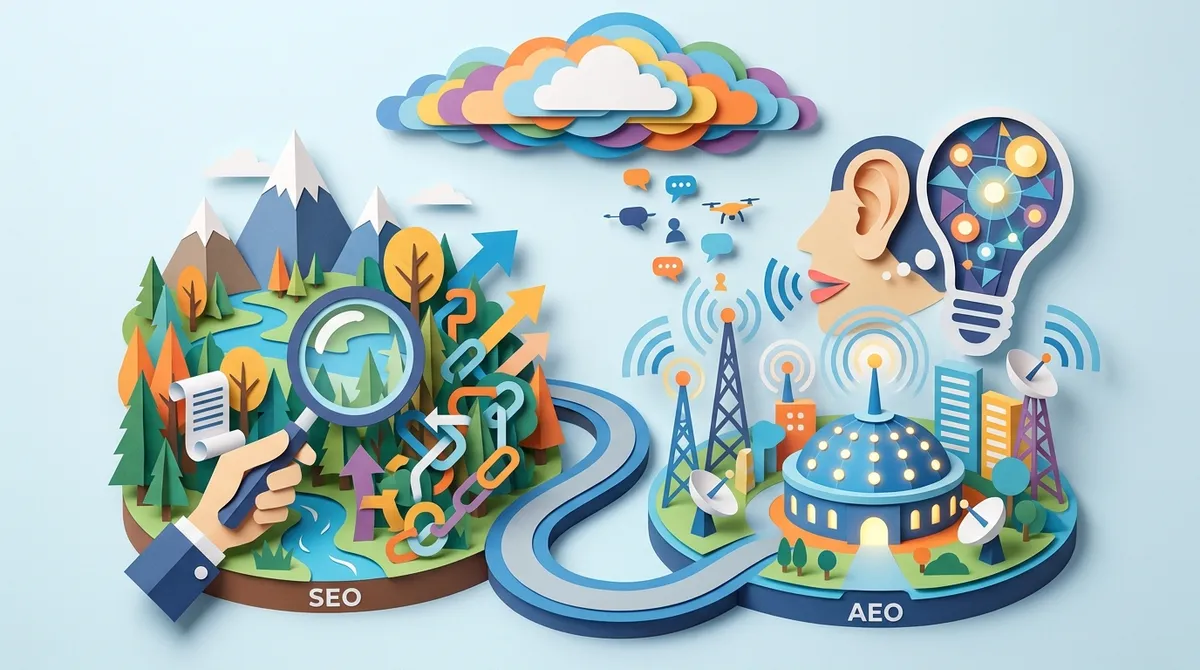
Answer Engine Optimization (AEO) is not a replacement for traditional SEO. It’s a powerful extension of it. When done correctly, AEO helps your content appear in AI-generated answers, voice search results, and featured snippets — all while your foundational SEO keeps your pages ranking on search engine results pages (SERPs). Together, they form a complete search visibility strategy.
This article breaks down exactly how AEO fits inside SEO, and what you need to know to start using both to grow your business online.
What Is AEO and How Does It Relate to SEO?
Answer Engine Optimization (AEO) is the practice of structuring your content so that AI-powered search tools can pull direct answers from it. These tools include Google’s AI Overviews, ChatGPT, Perplexity AI, and voice assistants like Siri and Alexa.
Traditional SEO focuses on ranking your web pages in search results. AEO focuses on getting your content selected as the actual answer to a user’s question. While their goals differ slightly, they share the same building blocks: quality content, authoritative sources, technical accuracy, and user intent.
Think of SEO as the foundation of your house. AEO is the roof that keeps everything working at the top level. You can’t have one without the other performing well.

Why Both Strategies Work Better Together
Search engines are evolving into answer engines. Google’s AI Mode and AI Overviews are pulling content directly from websites and presenting it without users needing to click. To show up in those answers, your content must meet the standards of both traditional SEO and AEO.
According to Google E-E-A-T guidelines, search engines evaluate content based on Experience, Expertise, Authoritativeness, and Trustworthiness. These same signals that power strong SEO are the exact signals that AEO relies on. This overlap proves that AEO is not separate from SEO — it grows directly out of it.
For small business owners, marketing managers, and local service providers, this is critical to understand. You don’t need two separate strategies. You need one unified approach that satisfies both goals.

7 Ways AEO Is a Part of SEO
1. Both Rely on High-Quality, Authoritative Content
Strong SEO has always required well-written, factual, and helpful content. AEO demands the same thing — but takes it a step further. Your content must answer specific questions clearly and concisely. Content writing that targets user questions directly gives you the best chance of ranking in traditional results AND being selected as an AI answer.
- Write content that answers who, what, when, where, why, and how
- Use clear, direct language in every paragraph
- Back up claims with data, examples, or expert opinion
- Structure answers so the key point appears in the first two sentences
2. Keyword Research Supports Both Strategies
Traditional keyword research identifies the terms people search for. AEO extends this by targeting question-based keywords — the full phrases people type or speak into AI tools. Phrases like “is AEO a part of SEO?” or “how does AEO work?” are ideal targets for both.
When you use question-based keywords in your content, you satisfy the intent behind both traditional search queries and AI-driven searches. This is one of the clearest examples of how AEO is a part of SEO rather than something separate from it.
- Target long-tail, conversational keywords
- Include FAQ-style sections in your content
- Use tools that surface question-based search queries
- Align your content with the specific language your audience uses
3. Structured Data Markup Serves Both Goals
Schema markup is a technical SEO tool that helps search engines understand your content. It also plays a major role in AEO. When you add FAQ schema, how-to schema, or article schema to your pages, you increase the chance that Google will pull your content into a featured snippet or AI-generated answer.
This is a direct case where SEO and AEO share the same technical tools. You invest in structured data once and benefit across both strategies. Learn more about how Answer Engine Optimization works in practice and how schema fits into a complete content strategy.
4. Page Speed and Technical Performance Matter for Both
A slow website hurts your SEO rankings. It also hurts your AEO results. AI search engines and Google’s crawlers both evaluate page performance before selecting content to feature. If your website loads slowly or has broken elements, your content is less likely to be surfaced — regardless of its quality.
Technical website design and performance are the backbone of any digital marketing strategy. Optimizing your site’s speed, mobile responsiveness, and Core Web Vitals supports your SEO and gives your AEO strategy a stronger foundation.
- Compress images and use modern file formats
- Enable browser caching and use a content delivery network (CDN)
- Minimize unnecessary scripts and third-party plugins
- Test your site on mobile devices regularly
5. Topical Authority Strengthens AEO Performance
SEO rewards websites that demonstrate deep expertise on a specific topic. This concept — known as topical authority — is equally important for AEO. AI tools are trained to recommend sources that consistently provide accurate, in-depth information on a subject.
When your website covers a topic thoroughly through multiple well-linked articles, AI search engines begin to recognize your site as a trusted resource. This increases the frequency with which your content is cited in AI-generated responses. Building topical authority is a long-term SEO play that directly powers your AEO visibility.
6. User Intent Alignment Is Central to Both
Great SEO always starts with understanding what a user actually wants when they search. AEO takes that same principle and applies it to the specific format of the answer. If someone asks a yes/no question, your content should lead with a clear yes or no. If they ask “how to,” your content should start with a numbered list of steps.
Matching content format to user intent is a shared principle of both SEO and AEO. When you understand the intent behind a search, you can write content that satisfies both the algorithm and the reader. Explore how SEO vs. AEO strategies compare when applied to different types of search queries.
7. Backlinks and Authority Signals Affect Both Rankings
High-quality backlinks have always been a core SEO ranking factor. They signal to search engines that your content is credible and worth referencing. AI answer engines use similar authority signals when deciding which sources to pull answers from. A site with strong domain authority and reputable backlinks is far more likely to be selected as an AI answer source.
This means your off-page SEO work — building links, earning mentions, and growing brand authority — also directly improves your AEO results. The overlap couldn’t be clearer. For a deeper look at this topic, read about whether backlinks are still essential for organic traffic in 2026.

AEO vs. SEO: A Side-by-Side Comparison
While AEO is a part of SEO, they do have distinct characteristics. The table below highlights the key differences and similarities to help you understand how they work together.
| Feature | Traditional SEO | AEO (Answer Engine Optimization) |
|---|---|---|
| Primary Goal | Rank pages in search results | Get selected as a direct AI answer |
| Content Format | Long-form, keyword-optimized pages | Direct, concise Q&A-style content |
| Keyword Type | Short and long-tail keywords | Question-based, conversational phrases |
| Technical Tools | Schema markup, sitemaps, metadata | FAQ schema, structured answers, schema |
| Authority Signals | Backlinks, domain authority | E-E-A-T, topical depth, citations |
| Primary Platforms | Google, Bing, search engines | AI Overviews, ChatGPT, Perplexity, voice |
| Measurement | Rankings, organic traffic, CTR | AI citations, featured snippets, visibility |
Common Mistakes Businesses Make When Treating AEO and SEO Separately
Many business owners make the mistake of viewing AEO and SEO as two separate investments requiring separate budgets and strategies. This creates unnecessary complexity and missed opportunities. Here are the most common errors to avoid:
- Ignoring question-based content: Focusing only on short keywords and skipping FAQ or Q&A-style content misses AEO opportunities entirely.
- Skipping schema markup: Not adding structured data means search engines and AI tools have to guess what your content is about — reducing your chance of being featured.
- Writing for robots, not people: Stuffing keywords without answering real user questions fails both SEO and AEO standards.
- Neglecting page speed: Slow-loading pages hurt both your organic rankings and your AI answer eligibility.
- Ignoring authority building: Skipping link-building and brand citation efforts weakens your credibility across both strategies.
Understanding these mistakes helps you build a more complete digital strategy. Check out 13 AEO in SEO mistakes that are hurting your search visibility for a detailed breakdown.
How to Build a Combined AEO and SEO Strategy in 2026
The most effective approach is to build a unified content strategy that satisfies both SEO and AEO at the same time. Follow these steps to get started:
- Audit your existing content to identify pages that rank but don’t answer specific questions directly.
- Add FAQ sections to your top-performing pages with clear, concise answers to common questions in your industry.
- Implement schema markup on all FAQ, how-to, and product pages to help AI tools parse your content accurately.
- Build topical authority by creating content clusters around core topics relevant to your business.
- Monitor AI citations using tools that track when your brand is referenced in AI-generated answers.
- Earn quality backlinks from reputable sources to boost your domain authority and E-E-A-T signals.
- Optimize for voice search by writing content in natural, conversational language that mirrors how people speak.
At Brain Buzz Marketing, we specialize in building content strategies that cover traditional SEO, AEO, and GEO (Generative Engine Optimization) — all under one roof. Our approach ensures your brand shows up across Google, AI tools, and voice search simultaneously. You can also visit us on Google to see what our clients say about our work.
Why AEO Matters More Than Ever in 2026
The rise of AI-powered search tools has fundamentally changed how people find information. Google’s AI Mode, Perplexity AI, and conversational assistants are now answering questions directly — often without users clicking a single link. If your content isn’t optimized to be selected as an answer, you’re invisible to a growing portion of search traffic.
This is why understanding that AEO is a part of SEO — not a replacement — is so important. Businesses that invest in both will dominate search in 2026 and beyond. Those that ignore AEO will gradually lose visibility as AI search continues to grow. Explore 10 ways to optimize for AI search results in 2026 to stay ahead of this trend.
For additional insights on how search is evolving, follow the conversation on our Instagram page and Facebook page, where we share regular updates on AEO, SEO, and digital marketing strategy.
Conclusion
So, is AEO a part of SEO? Absolutely. AEO grows from the same roots as SEO — quality content, technical optimization, authority signals, and user intent. What sets AEO apart is its focus on being selected as a direct answer by AI-powered search tools. When you combine both strategies, your business becomes visible across every layer of modern search.
You don’t need to choose between SEO and AEO. You need a strategy that delivers both. The digital marketing services at Brain Buzz Marketing are built to do exactly that — helping small businesses, startups, e-commerce retailers, and local service providers gain maximum search visibility in an AI-driven world.
Ready to build a search strategy that covers SEO, AEO, and everything in between? Reach out to our team today and let’s create a plan that gets your business found — no matter how people are searching.
FAQs
Q: Is AEO a part of SEO or a completely different strategy?
A: AEO is a part of SEO, not a separate strategy. It extends traditional SEO by optimizing content to be selected as a direct answer by AI-powered search tools, voice assistants, and featured snippets. The two strategies share the same foundational elements — quality content, authority signals, and technical optimization.
Q: Do I need to change my existing SEO strategy to include AEO?
A: You don’t need to replace your existing SEO strategy — you need to build on it. Adding question-based content, FAQ schema markup, and concise direct answers to your existing pages is often enough to begin capturing AEO opportunities. A unified approach that satisfies both is the most efficient path forward.
Q: What types of content perform best for AEO within an SEO strategy?
A: Content that directly answers specific questions tends to perform best for AEO. This includes FAQ sections, how-to guides, definition-style pages, and structured lists. When combined with proper schema markup and strong E-E-A-T signals, this type of content is most likely to appear in AI-generated answers and featured snippets.
Q: How does AEO affect my organic traffic from traditional SEO?
A: AEO can complement your organic traffic by making your content visible in zero-click search results and AI-generated answers. While some AEO placements may not result in direct clicks, they significantly boost brand visibility and authority — which over time positively influences your traditional SEO performance as well.
Q: Can small businesses benefit from combining AEO and SEO?
A: Absolutely. Small businesses stand to gain significant competitive advantages by combining AEO and SEO, especially in local markets. When your content answers the specific questions your local customers are asking — and is structured for AI tools to find — you gain visibility that larger competitors may be overlooking.