Google Ads vs ChatGPT Ads: Which Wins in 2026?
Google Ads vs ChatGPT Ads: compare cost, targeting, and results to pick the best platform for your business in 2026.

Key Takeaways
-
Google Ads targets people actively searching with keywords and is best for ready-to-buy customers and local leads, while ChatGPT ads reach people researching options through conversational questions.
-
ChatGPT ads currently require a $750 monthly minimum ad spend paid to the platform, compared with Google Ads where you set your own budget.
-
Google Ads is a 20+ year-old platform with more mature targeting and reporting, whereas ChatGPT ads are newer, with fewer tools and stricter eligibility policies.
-
ChatGPT ads face less competition right now, which may give early advertisers an advantage for higher-consideration products like software or professional services.
-
Running both platforms can cover more of the buyer journey, since Google captures ready-to-buy shoppers and ChatGPT ads warm up people still deciding.
-
Before spending on either platform, define your goal, check your budget against minimums, and make sure your website converts, since ads are only as effective as the page they link to.
If you run a small business, you have probably heard the buzz. Google Ads has been the go-to paid search tool for over two decades. Now ChatGPT is testing ads of its own. So which one deserves your marketing dollars? That is the big question behind google ads vs chatgpt ads, and it is a fair one to ask.
Here is the good news. You do not have to guess. Both platforms can bring in customers, but they work in very different ways. One catches people who are searching. The other meets people who are chatting and asking for advice. Each has a place in a smart plan.
In this guide, we will break down how each platform works, what they cost, who they fit best, and how to pick the right one for your goals. We will keep it simple and friendly. By the end, you will know exactly where to put your next ad dollar.
What Are Google Ads?
Google Ads is a pay-per-click (PPC) platform. You bid on keywords, and your ad shows up when someone searches for them. You only pay when a person clicks. It is a clean, proven system. If you want a deeper look, check out our guide on how Google Ads work.
Google Ads reaches people in many places, including:
- Search results pages
- YouTube videos
- Gmail inboxes
- Websites across the Google Display Network
- Google Maps and Shopping listings
The biggest strength of Google Ads is intent. When someone types “plumber near me” or “buy running shoes,” they are ready to act. That is gold for local service providers and online stores alike.

What Are ChatGPT Ads?
ChatGPT ads are a newer way to reach people inside AI conversations. Instead of typing a short keyword, users have a back-and-forth chat. They ask detailed questions, like “What is the best CRM for a five-person team?” Ads can appear alongside those answers when they match the topic.
Because this platform is still growing, it works a little differently from Google. Advertisers group ads around customer intent and write short “context hints” that tell the platform when the ad fits a conversation. Policies are strict, and not every business qualifies right away.
Think of it this way. Google Ads catches the shopper at the search bar. ChatGPT ads catch the shopper while they are still thinking things through. If you want to see how this plays out in practice, read our piece on how to advertise on ChatGPT in 2026.
Google Ads vs ChatGPT Ads: Side-by-Side Comparison
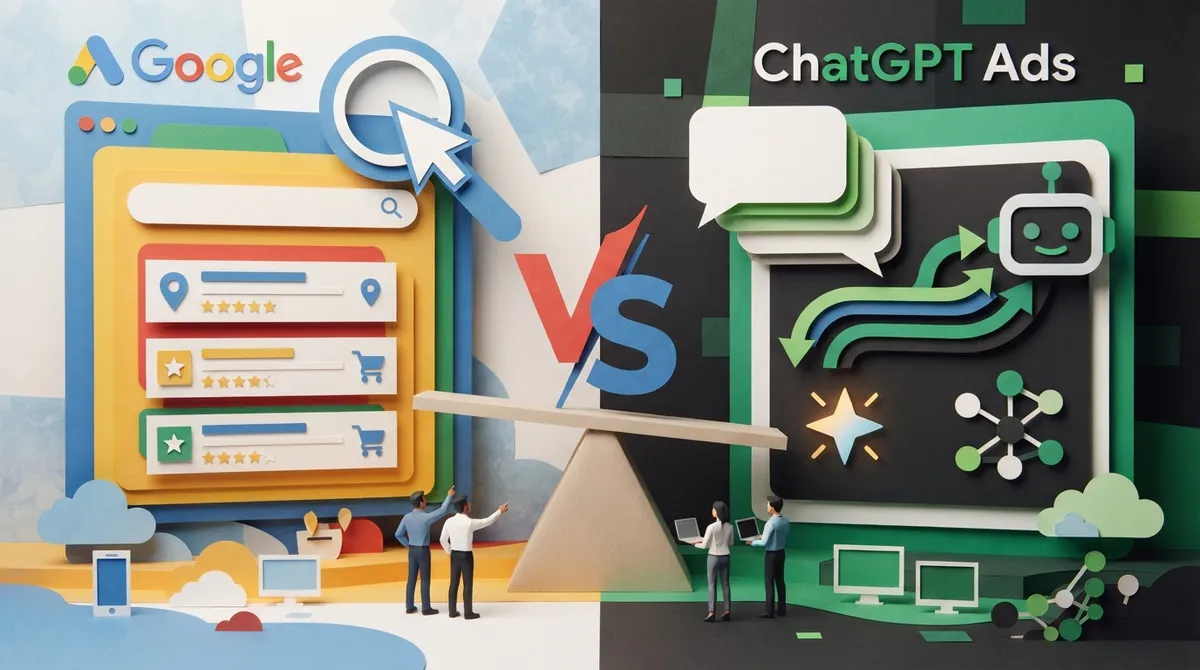
Let us put the two platforms head to head. This table shows the key differences at a glance.
| Feature | Google Ads | ChatGPT Ads |
|---|---|---|
| How people find you | Keyword searches | Conversational questions |
| Maturity | Over 20 years old | New and still evolving |
| Targeting options | Very detailed (keywords, location, audience, device) | Intent-based with context hints, plus location and device |
| Ad formats | Search, display, video, shopping, maps | Conversational and native placements |
| Reporting depth | Advanced and well tested | Growing, with more tools coming |
| Best for | Ready-to-buy shoppers and local leads | Research-stage buyers comparing options |
| Competition level | High in many industries | Lower right now |
Neither platform is “better” in every case. The right pick depends on who you want to reach and where they are in their buying journey.
Targeting and Intent: How Each Platform Finds Customers
Google Ads Targeting
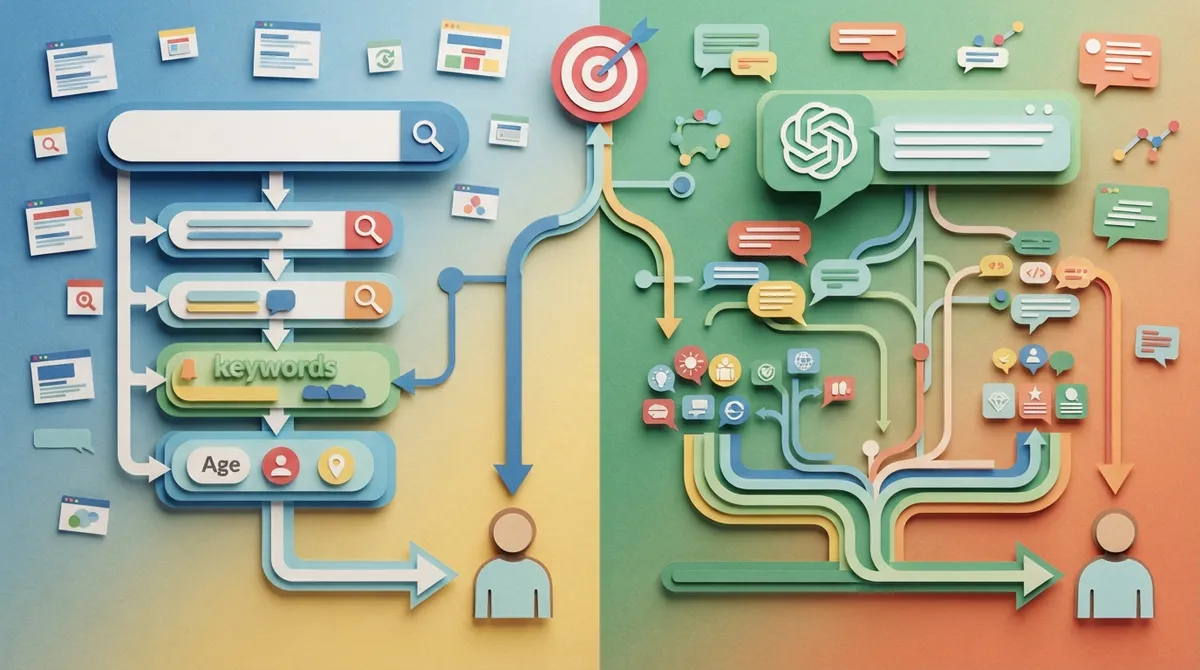
Google gives you a lot of control. You can target by keyword, city, zip code, device, time of day, and even audience type. For local businesses, this is a big deal. A Tampa roofer can show ads only to people within a few miles of the shop.
You can also use negative keywords to block wasted clicks. That means you stop paying for searches that will never turn into sales.
ChatGPT Ads Targeting
ChatGPT ads lean on the meaning behind a conversation. Instead of picking exact keywords, you describe the kind of question your ideal customer might ask. The platform then matches your ad to chats where it makes sense.
This can feel more natural. Someone asking for help picking a website designer is already deep in research mode. A well-placed ad meets them right there.
Cost: What Will You Actually Pay?
Budget matters, so let us talk numbers. Google Ads costs vary a lot by industry. Some clicks cost a couple of dollars. Others, like legal or insurance terms, can run much higher. Our breakdown of Google PPC charges in 2026 walks through typical ranges.
ChatGPT ads currently ask for a higher minimum commitment to get started. At Brain Buzz Marketing, for example, ChatGPT requires a monthly ad spend of $750 paid directly to the platform. Our management fee for ChatGPT ads is $250 per month plus a $250 one-time setup fee. Google Ads management with us runs $750 per month plus a $250 one-time setup fee.
| Cost Item | Google Ads | ChatGPT Ads |
|---|---|---|
| Management fee (Brain Buzz Marketing) | $750 per month | $250 per month |
| One-time setup fee | $250 | $250 |
| Ad spend paid to the platform | You choose your budget | $750 per month minimum |
Want help planning your numbers? Try our marketing spend calculator to see what fits your goals.
Who Should Use Google Ads?
Google Ads is a strong fit when you need leads now. It works especially well for:
- Local service providers who want phone calls from nearby customers
- E-commerce retailers who want shopping ads and product traffic
- Small business owners who need a steady flow of inquiries
- Growing companies that want to scale lead generation fast
If your customers already know what they want and search for it, Google Ads is hard to beat. It is also a great way to get traffic while your SEO is still building.
Who Should Try ChatGPT Ads?
ChatGPT ads can be a smart add-on, especially if your product or service needs some explaining. They tend to fit:
- Startups that want to get ahead of the crowd on a newer platform
- Businesses with higher-consideration purchases, like software, financing, or professional services
- Brands whose buyers do a lot of research before they pick a provider
Since fewer advertisers are on the platform right now, early movers may enjoy less competition. You can learn more about who qualifies in our post on what businesses can advertise on ChatGPT in 2026.
Pros and Cons at a Glance
Google Ads Pros
- Huge reach and proven results
- Powerful targeting and reporting
- Great for local and ready-to-buy customers
- Easy to track calls and form fills
Google Ads Cons
- Competitive in many industries
- Can get pricey without good management
- Needs steady testing and tuning
ChatGPT Ads Pros
- Reaches people during the research stage
- Less crowded than search right now
- Fits the way people are starting to look for answers
ChatGPT Ads Cons
- Newer, so tools and data are still growing
- Stricter policies and eligibility checks
- Higher starting ad spend
How to Decide: A Simple 5-Step Process
Not sure which way to lean? Walk through these steps.
- Define your goal. Do you want fast phone calls, online sales, or early brand awareness?
- Look at your buyer. Do they search with short keywords, or do they ask long, detailed questions?
- Check your budget. Make sure you can cover the platform minimums and a management fee.
- Review your website. Ads send people to your site, so it must load fast and convert. A strong custom website design makes every ad dollar work harder.
- Start with one, then expand. Many businesses begin with Google Ads and add ChatGPT ads once the first campaign is humming.
That last step is key. This does not have to be an either-or choice. The best results often come from using both.
Why Not Use Both?
Here is a friendly truth. Customers do not stick to one path. Someone might ask ChatGPT for ideas, then jump to Google to compare local options. If you show up in both places, you meet them at each step.
Google Ads can capture the ready-to-buy crowd. ChatGPT ads can warm up people who are still deciding. Together, they cover more of the journey. Just keep your budget realistic and your tracking tight so you can see what works.
Your organic presence matters too. Strong SEO and smart content help AI tools and search engines trust your brand. Paid ads and organic work best as a team. If you want to explore that side, see our guide on optimizing for AI search results in 2026.
Common Mistakes to Avoid
Whichever platform you choose, a few slip-ups can waste money fast.
- Sending traffic to a weak page. A slow or confusing site kills conversions.
- Skipping tracking. If you cannot measure calls and sales, you cannot improve.
- Going too broad. Vague targeting burns through budget.
- Setting it and forgetting it. Good campaigns need regular attention and testing.
You can dig deeper into this in our post on pay-per-click advertising mistakes that drain your budget.
How Brain Buzz Marketing Can Help
Brain Buzz Marketing is a small but mighty digital marketing agency run by husband-and-wife team Eric and Nicole. We have been in the game since 1998, and we manage both Google Ads and ChatGPT ads for businesses across Tampa Bay, throughout Florida, and around the country. Everything is handled virtually, so working with us is easy no matter where you are.
Our Google Ads management includes campaign planning, keyword research, ad copywriting, daily optimization, call tracking, and monthly reporting. Our ChatGPT ads management covers eligibility checks, context hint writing, A/B testing, and policy monitoring. You can learn more about our digital marketing services and see what our clients say on our testimonials page. You can also visit us on Google — Brain Buzz Marketing to read reviews from real customers.
We like to keep things honest and simple. Want to stay current on what is working in marketing? You can follow our founder Eric on LinkedIn for regular tips, or follow us on Instagram for quick updates. Curious about automated content that ranks? Check out SEO Rocket for fully automated blog posts that rank.
The Bottom Line on Google Ads vs ChatGPT Ads
So, who wins the google ads vs chatgpt ads showdown? For most small businesses, Google Ads is still the reliable workhorse. It brings in ready-to-buy customers and gives you deep control. ChatGPT ads are the exciting newcomer, perfect for reaching researchers and testing a fresh channel while competition is light.
The smartest move is often to start where your customers are today and grow from there. Keep your website sharp, track your results, and let the data guide you. You do not have to figure it all out alone, either. Our team is here to build a plan that fits your goals and your budget.
Ready to put your ad budget to work? Contact us today and let us help you decide the best path forward for your business.
FAQs
Q: Is Google Ads or ChatGPT Ads better for small businesses?
A: For most small businesses, Google Ads is the safer place to start because it reaches people who are ready to buy and offers deep targeting and tracking. ChatGPT ads can be a great add-on once your first campaign is running well. Many businesses end up using both.
Q: How much do ChatGPT ads cost compared to Google Ads?
A: Google Ads lets you set your own budget, while ChatGPT currently asks for a monthly ad spend of around $750 paid directly to the platform. Management fees are separate. With Brain Buzz Marketing, ChatGPT ads management is $250 per month and Google Ads management is $750 per month, each with a $250 setup fee.
Q: Can I run Google Ads and ChatGPT Ads at the same time?
A: Yes, and it is often a smart move. Google Ads catches people who are ready to act, while ChatGPT ads reach people who are still researching. Running both helps you meet customers at more points in their buying journey.
Q: Do all businesses qualify for ChatGPT ads?
A: Not always. ChatGPT has strict ad policies and runs an eligibility check before approving advertisers. A good agency can review your business against those rules before you spend a dollar.
Q: How long does it take to see results from paid ads?
A: Google Ads can bring in clicks and calls within days of launch, though the best results come after a few weeks of testing and tuning. ChatGPT ads are newer, so it helps to give them some time and track results closely to see what works for your business.
Our Service Area