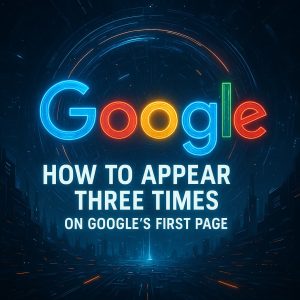
Proven strategies on how to appear three times on Google’s first page and boost your brand visibility, clicks, and customer growth today
Introduction
The Evolution of Google’s Search Results
The first page of Google has transformed dramatically from the simple list of ten blue links that defined search results just a few years ago. In 2025, Google’s search engine results page (SERP) has evolved into a complex ecosystem of competing elements, each vying for user attention and clicks. While this evolution has created new challenges for businesses seeking visibility, it has also opened unprecedented opportunities for those who understand how to navigate this new landscape strategically.
The Stakes: Why First Page Visibility Matters
The statistics paint a clear picture of the stakes involved. The top three organic search results collectively receive an impressive 68.7% of all clicks, with the number one position alone capturing 27.6% of user engagement. However, these figures only tell part of the story. Today’s Google first page features multiple pathways to visibility, including paid advertisements, local business listings, featured snippets, and various other SERP features that can provide additional touchpoints with potential customers.
The Three-Pronged Strategy Revealed
This comprehensive guide reveals a powerful three-pronged strategy that enables businesses to achieve multiple appearances on Google’s first page simultaneously. By strategically leveraging Google Ads for immediate visibility, optimizing Google Business Profile for local dominance, and implementing robust organic SEO for long-term authority, businesses can effectively dominate search results and capture significantly more traffic than competitors relying on a single approach.
The Power of Synergistic Effects
The beauty of this multi-channel strategy lies not just in increased visibility, but in the synergistic effects that occur when all three elements work together. Each channel reinforces the others, creating a compound effect that builds brand authority, increases click-through rates, and ultimately drives more qualified traffic and conversions. While paid advertisements may only receive 6% of total clicks compared to organic listings, their strategic placement at the top of results serves as a powerful first impression that can influence user behavior throughout their search journey.
Understanding and implementing this three-pronged approach requires more than surface-level knowledge of each platform. It demands a deep understanding of how Google’s algorithms work, what factors influence rankings in each channel, and how to create cohesive campaigns that maximize the strengths of each approach while minimizing their individual weaknesses. The following sections will provide you with the detailed strategies, tactics, and insights needed to achieve this level of search domination.
Understanding Google’s First Page Landscape in 2025
The Digital Marketing Revolution
The transformation of Google’s search results page represents one of the most significant shifts in digital marketing history. What once was a predictable list of ten organic results has evolved into a dynamic, feature-rich environment that prioritizes user experience and immediate answer delivery. This evolution has fundamentally changed how businesses must approach search engine visibility and has created both new challenges and unprecedented opportunities for strategic marketers.
AI Overviews: The Game Changer
At the heart of this transformation is Google’s commitment to providing users with the most relevant information as quickly as possible. The introduction of AI Overviews in May 2024 marked a pivotal moment in this evolution, as Google began generating AI-powered summaries that appear at the top of search results for many queries. These overviews can significantly impact click-through rates to traditional organic listings, as they often provide users with immediate answers to their questions without requiring them to visit external websites.
Featured Snippets and Position Zero
The modern Google SERP now features an array of specialized elements, each designed to serve specific user intents and query types. Featured snippets, often referred to as “Position Zero,” appear above traditional organic results and can capture substantial click-through rates by providing direct answers to user questions. These snippets are particularly valuable because they position your content as the authoritative answer to specific queries, even if your website doesn’t rank number one in traditional organic results.
Local Pack: The Local Business Advantage
Local businesses benefit from the prominence of the Local Pack, which displays a map alongside three local business listings for location-based searches. This feature has become increasingly important as mobile search continues to grow, with users frequently seeking immediate, location-specific information. The Local Pack represents a significant opportunity for businesses to achieve first-page visibility even in highly competitive markets, as local rankings operate on different algorithms than traditional organic search.
People Also Ask and Knowledge Panels
The “People Also Ask” (PAA) section has emerged as another valuable real estate opportunity on the first page. These expandable questions provide additional chances for your content to appear prominently in search results, and they often generate follow-up searches that can drive sustained traffic to your website. Understanding how to optimize content for PAA boxes can effectively multiply your first-page presence.
Knowledge Panels, which appear in the sidebar for entity-based searches, provide authoritative information about businesses, people, and organizations. While these panels reduce the likelihood of users clicking through to websites, they also establish credibility and can include important business information such as contact details, hours of operation, and customer reviews.
Visual Content and Shopping Integration
The integration of image and video carousels has made visual content more important than ever. Google now prioritizes multimedia content in many search results, with video content from platforms like YouTube frequently appearing at the top of results pages. This shift toward visual content represents both an opportunity and a necessity for businesses looking to maintain comprehensive first-page visibility.
Shopping ads and product listings have transformed e-commerce search results, often appearing above traditional organic listings for commercial queries. These visual, product-focused results can capture significant click-through rates and provide immediate access to purchase information, making them essential for retail businesses.
Understanding Click Distribution
Understanding the click distribution across these various SERP features is crucial for developing an effective multi-channel strategy. While organic listings still receive the majority of clicks, with the top three positions capturing 68.7% of total engagement, the remaining clicks are distributed across paid advertisements, local listings, and other SERP features. This distribution creates multiple pathways to visibility and engagement, each with its own optimization requirements and strategic considerations.
The key insight for businesses is that achieving multiple appearances across these different SERP features can dramatically increase total visibility and click-through rates. Rather than competing solely for organic rankings, successful businesses now develop integrated strategies that leverage multiple channels simultaneously, creating a compound effect that maximizes their overall search presence.
Strategy 1: Google Ads – Achieving Instant First Page Visibility
The Speed Advantage of Paid Advertising
Google Ads represents the fastest pathway to first-page visibility, offering businesses the ability to appear at the top of search results within hours of campaign launch. While paid advertisements receive only approximately 6% of total clicks compared to organic listings, their strategic value extends far beyond raw click-through rates. The immediate visibility provided by Google Ads serves multiple purposes: establishing brand presence, capturing high-intent traffic, and providing valuable data that can inform broader marketing strategies.
Understanding Google Ads Positioning and Ad Rank
The Ad Rank Algorithm
The foundation of successful Google Ads campaigns lies in understanding how Ad Rank determines your advertisement’s position on the search results page. Ad Rank is calculated using a sophisticated algorithm that multiplies your maximum bid by your Quality Score, along with considering the expected impact of ad extensions and other ad formats. This means that simply having the highest bid does not guarantee the top position; the quality and relevance of your advertisements play an equally important role in determining placement.
Quality Score Components
Quality Score, Google’s rating of the quality and relevance of your keywords and ads, operates on a scale from one to ten and significantly impacts both your ad position and cost-per-click. The three primary components of Quality Score are expected click-through rate, ad relevance, and landing page experience. Understanding and optimizing these factors is essential for achieving cost-effective first-page positioning.
Expected Click-Through Rate Optimization
Expected click-through rate reflects Google’s prediction of how likely users are to click on your ad when it appears for a particular keyword. This prediction is based on historical performance data and considers factors such as ad copy relevance, keyword match types, and historical account performance. Improving your expected click-through rate requires crafting compelling ad copy that directly addresses user search intent and includes relevant keywords in headlines and descriptions.
Ad Relevance and Landing Page Experience
Ad relevance measures how closely your ad copy matches the intent behind a user’s search query. Google evaluates whether your ads contain keywords that are relevant to what users are searching for and whether your ad copy provides a clear connection between the search query and your offering. Achieving high ad relevance requires careful keyword grouping and creating specific ad copy for tightly themed keyword groups.
Landing page experience evaluates the quality and relevance of the page users reach after clicking your ad. Google considers factors such as page loading speed, mobile-friendliness, content relevance, and ease of navigation. A high-quality landing page experience not only improves your Quality Score but also increases conversion rates and overall campaign ROI.
Advanced Google Ads Optimization Strategies
Strategic Keyword Research and Selection
Successful Google Ads campaigns require a strategic approach to keyword research and selection that goes beyond basic keyword tools. Effective keyword strategies involve identifying high-intent keywords that indicate users are ready to take action, while also incorporating longer-tail keywords that may have lower competition but higher conversion potential. The key is to balance search volume with commercial intent, focusing on keywords that your target audience uses when they are closest to making a purchasing decision.
Negative Keywords and Traffic Quality
Negative keyword implementation represents one of the most underutilized yet powerful optimization techniques in Google Ads. By systematically identifying and excluding irrelevant search terms, you can prevent your ads from appearing for queries that are unlikely to convert, thereby improving your click-through rates and reducing wasted ad spend. Regular negative keyword audits should be conducted by analyzing search term reports and identifying patterns of irrelevant traffic.
Ad Copy and Extensions Optimization
Ad copy optimization requires a deep understanding of your target audience’s pain points, motivations, and language preferences. Effective ad copy should include compelling headlines that incorporate target keywords, clear value propositions that differentiate your offering, and strong calls-to-action that encourage immediate response. Testing multiple ad variations simultaneously allows you to identify the messaging that resonates most strongly with your audience.
The strategic use of ad extensions can significantly improve your ad’s visibility and click-through rates while providing additional real estate on the search results page. Sitelink extensions allow you to include additional links to specific pages on your website, while callout extensions enable you to highlight unique selling points or special offers. Location extensions are particularly valuable for businesses with physical locations, as they can help capture local search traffic and drive foot traffic to your stores.
Bidding Strategies and Automation
Bidding strategy selection has evolved significantly with Google’s increased emphasis on automated bidding options. While manual bidding provides maximum control, automated strategies such as Target CPA (Cost Per Acquisition) and Target ROAS (Return on Ad Spend) can leverage Google’s machine learning capabilities to optimize bids in real-time based on conversion likelihood. The choice between manual and automated bidding should be based on your campaign goals, available data, and comfort level with algorithmic optimization.
Campaign Structure and Performance Optimization
Building Effective Campaign Architecture
Proper campaign structure forms the foundation of successful Google Ads performance and enables more precise targeting and optimization. The most effective approach involves creating tightly themed ad groups that contain closely related keywords, allowing you to create highly relevant ad copy and landing pages for each keyword group. This granular approach improves Quality Scores and enables more accurate performance tracking and optimization.
Advanced Audience Targeting
Audience targeting capabilities in Google Ads have expanded dramatically, offering sophisticated options for reaching users based on their demographics, interests, behaviors, and previous interactions with your website. Remarketing campaigns allow you to re-engage users who have previously visited your website but didn’t convert, often at significantly lower costs than acquiring new traffic. Custom audiences enable you to target users based on their search history, website visits, and app usage patterns.
Geographic and Performance Optimization
Geographic targeting requires careful consideration of where your customers are located and how location affects search behavior and conversion rates. Local businesses should focus their ad spend on geographic areas where they can actually serve customers, while online businesses may benefit from broader geographic targeting with bid adjustments based on performance data from different regions.
Performance monitoring and optimization should be conducted regularly using a data-driven approach that focuses on metrics aligned with your business objectives. While click-through rates and impression share provide insights into ad performance and visibility, conversion-focused metrics such as cost per conversion and conversion rate ultimately determine campaign success. Regular analysis of search term reports, demographic performance, and geographic data enables continuous refinement of targeting and bidding strategies.
The integration of Google Ads with Google Analytics provides deeper insights into user behavior after they click on your advertisements. This integration enables you to track the complete customer journey, from initial ad click through website engagement and conversion, providing valuable data for optimizing both your ads and your website experience.
Strategy 2: Google Business Profile – Dominating Local Search Results
The Local Search Opportunity
Google Business Profile (formerly Google My Business) represents one of the most powerful yet underutilized opportunities for achieving first-page visibility, particularly for businesses with physical locations or those serving specific geographic areas. The Local Pack, which displays a map alongside three business listings, appears prominently in search results for queries with local intent and operates on fundamentally different ranking algorithms than traditional organic search results. This creates unique opportunities for businesses to achieve first-page visibility even in highly competitive markets where organic rankings might be difficult to attain.
Understanding Local Search Ranking Factors
The Three Pillars of Local Rankings
Google’s local search algorithm evaluates businesses based on three primary factors: proximity, relevance, and prominence. Understanding how these factors interact and influence local rankings is essential for developing an effective Google Business Profile optimization strategy that can secure consistent Local Pack appearances.
Proximity: Location Matters
Proximity refers to the physical distance between the searcher’s location and your business location. While you cannot control where your business is located relative to potential customers, you can optimize for proximity by ensuring your business address is accurately listed and by understanding how location affects your visibility for different search queries. Businesses located in city centers or high-traffic areas naturally have advantages for proximity-based rankings, but suburban and rural businesses can still compete effectively by focusing on relevance and prominence factors.
Relevance: Matching User Intent
Relevance measures how well your business listing matches what users are searching for. Google evaluates relevance based on the information in your Business Profile, including your business name, category selections, description, and the keywords used throughout your listing. Optimizing for relevance requires careful attention to how you describe your business and services, ensuring that your profile accurately reflects the terms your potential customers use when searching for businesses like yours.
Prominence: Building Authority
Prominence reflects how well-known and established your business is, both online and offline. Google considers factors such as the number and quality of online reviews, the consistency of your business information across the web, the strength of your website’s SEO, and your overall online presence. Building prominence requires a comprehensive approach that extends beyond your Google Business Profile to include review management, local citation building, and broader digital marketing efforts.
Comprehensive Google Business Profile Optimization
Foundation Setup and Verification
Creating a fully optimized Google Business Profile requires attention to numerous details that collectively influence your local search visibility. The foundation begins with claiming and verifying your business listing, ensuring that all basic information is accurate and complete. This includes your business name, address, phone number (NAP), website URL, business hours, and category selections.
Strategic Category Selection
Category selection represents one of the most critical optimization decisions, as it directly influences which searches your business will appear for. Google allows you to select one primary category and multiple additional categories that describe your business. The primary category should represent your main business focus, while additional categories can capture secondary services or specializations. Researching which categories your competitors use and understanding how different category selections affect search visibility can provide valuable insights for optimization.
Compelling Business Descriptions
Your business description provides an opportunity to include relevant keywords while accurately describing your services and unique value proposition. This description should be written for potential customers rather than search engines, focusing on clear, compelling language that explains what your business does and why customers should choose you. Including location-specific terms and service-related keywords naturally within your description can improve relevance for local searches.
Visual Content Strategy
High-quality photos and videos significantly impact user engagement and can influence local rankings. Google Business Profiles with complete photo sets typically receive more views and engagement than those with limited visual content. Your photo strategy should include exterior and interior shots of your business location, photos of your products or services, team photos, and images that showcase your business personality and brand. Regular photo updates signal to Google that your business is active and engaged with its online presence.
Google Posts and Content Marketing
The Google Posts feature allows you to share updates, offers, events, and other timely content directly on your Business Profile. These posts appear in your profile and can include calls-to-action that drive specific user behaviors such as making purchases, booking appointments, or visiting your website. Regular posting activity demonstrates business engagement and provides additional opportunities to include relevant keywords and location-specific content.
Building Local Authority and Prominence
Review Generation and Management
Customer reviews represent one of the most influential factors in local search rankings and user decision-making. Businesses with higher quantities of positive reviews typically achieve better local rankings and higher click-through rates from Local Pack appearances. Developing a systematic approach to review generation involves making it easy for satisfied customers to leave reviews, following up with customers after positive experiences, and providing exceptional service that naturally encourages positive feedback.
Professional Review Response Strategy
Review management extends beyond simply collecting positive reviews to include responding professionally to all reviews, both positive and negative. Your responses to reviews are publicly visible and provide opportunities to demonstrate excellent customer service, address concerns, and include relevant keywords naturally. Responding to reviews also signals to Google that you are actively engaged with your customers and committed to providing quality service.
Local Citation Building
Local citation building involves ensuring that your business information is consistently listed across relevant online directories, industry-specific websites, and local business listings. Consistency in your NAP information across these citations reinforces your business legitimacy and can positively impact local rankings. Focus on high-authority directories such as Yelp, Better Business Bureau, industry associations, and local chamber of commerce websites.
Q&A Section Optimization
The Questions and Answers section of your Google Business Profile provides another opportunity to include relevant information and keywords while addressing common customer inquiries. You can proactively add questions and answers that address frequent customer concerns, provide important business information, and include location-specific and service-related keywords. Monitoring this section regularly allows you to respond quickly to customer questions and maintain control over the information displayed.
Community Engagement and Link Building
Local link building involves earning backlinks from other local businesses, organizations, and websites within your geographic area. These local links signal to Google that your business is an established part of the local community and can positively impact both local and organic search rankings. Opportunities for local link building include partnerships with other local businesses, sponsoring local events, participating in community organizations, and engaging with local media outlets.
Community engagement activities, both online and offline, contribute to building local prominence and can generate valuable local links and mentions. This includes participating in local events, supporting community causes, engaging with local social media groups, and building relationships with other local business owners. These activities create natural opportunities for online mentions and links while establishing your business as an active community member.
Strategy 3: Organic SEO—Building Long-Term Search Authority
The Foundation of Sustainable Visibility
Organic search engine optimization represents the foundation of sustainable first-page visibility, offering the highest click-through rates and long-term value for businesses willing to invest in comprehensive optimization strategies. While organic SEO requires more time and effort to show results compared to paid advertising, it provides the most cost-effective traffic over time and builds lasting digital authority that compounds in value. The top organic search result alone captures an average of 27.6% of all clicks, making first-page organic rankings extremely valuable for businesses in any industry.
Current Ranking Factors and Algorithm Considerations
Google’s 2024 Algorithm Updates
Google’s ranking algorithm has evolved significantly in recent years, with major updates in 2024 focusing on promoting high-quality, helpful content while demoting low-value SEO content. The March 2024 Core Update and August 2024 Core Update both emphasized Google’s commitment to surfacing content that provides genuine value to users rather than content created primarily for search engine manipulation. Understanding these algorithmic priorities is essential for developing SEO strategies that align with Google’s quality guidelines and achieve sustainable rankings.
Content Quality and Relevance
Content quality and relevance remain the most important ranking factors, but Google’s evaluation of quality has become increasingly sophisticated. The search engine now considers factors such as content depth, expertise demonstration, original research inclusion, and user engagement signals when determining content quality. High-quality content must thoroughly address user search intent, provide comprehensive information on the topic, and demonstrate clear expertise and authority in the subject matter.
Technical SEO and User Experience
Technical SEO factors have gained increased importance as Google prioritizes user experience in its ranking decisions. Core Web Vitals, which measure page loading performance, interactivity, and visual stability, directly impact search rankings and user satisfaction. Websites that provide fast, smooth, and stable user experiences are more likely to achieve and maintain high search rankings, particularly on mobile devices where the majority of searches now occur.
E-A-T Framework Implementation
The E-A-T framework (Expertise, Authoritativeness, and Trustworthiness) has become central to Google’s content evaluation process, particularly for topics that could impact users’ health, financial well-being, or safety. Demonstrating expertise requires showcasing relevant credentials, experience, and knowledge in your content. Authoritativeness involves building recognition as a trusted source within your industry through citations, mentions, and backlinks from other authoritative sources. Trustworthiness encompasses factors such as website security, transparent business information, and positive user reviews and testimonials.
User Experience Signals
User experience signals, including click-through rates, time on page, bounce rates, and return visits, provide Google with insights into how users interact with your content and website. While these behavioral signals are not direct ranking factors, they influence Google’s understanding of content quality and user satisfaction. Optimizing for positive user experience signals requires creating engaging content, improving website navigation, and ensuring that your content fully satisfies user search intent.
Advanced On-Page SEO Optimization Techniques
Title Tag and Meta Description Optimization
Title tag optimization remains one of the most important on-page SEO factors, as titles directly influence both search rankings and click-through rates from search results. Effective title tags should include your primary target keyword, accurately describe the page content, and create compelling reasons for users to click through to your website. The optimal title length is typically between 50-60 characters to ensure full display in search results, though Google’s dynamic title generation means that longer titles may still be effective if they provide clear value to users.
Meta descriptions, while not direct ranking factors, significantly impact click-through rates and can influence user behavior in search results. Compelling meta descriptions should summarize the page content, include relevant keywords, and provide clear value propositions that encourage clicks. The optimal length for meta descriptions is approximately 150-160 characters, though Google may display longer descriptions for certain queries and devices.
Header Structure and Content Organization
Header tag structure (H1, H2, H3, etc.) helps Google understand your content organization and hierarchy while improving user readability. Your H1 tag should clearly indicate the main topic of the page and typically include your primary target keyword. Subsequent header tags should create a logical content structure that guides users through your information and includes relevant secondary keywords naturally within the context.
Internal Linking and URL Optimization
Internal linking strategy plays a crucial role in distributing page authority throughout your website and helping Google understand the relationship between different pages. Effective internal linking involves connecting related content, using descriptive anchor text that includes relevant keywords, and creating clear pathways for users to discover additional valuable content on your website. Strategic internal linking can help improve rankings for target pages while increasing user engagement and time on site.
URL structure optimization involves creating clean, descriptive URLs that include relevant keywords and clearly indicate page content. Short, readable URLs perform better in search results and are more likely to be shared by users. Avoiding unnecessary parameters, using hyphens to separate words, and maintaining consistent URL structures across your website contribute to better search performance and user experience.
Content Strategy for Featured Snippets and SERP Features
Featured Snippet Optimization
Featured snippets represent valuable opportunities to achieve “Position Zero” visibility above traditional organic results, often capturing significant click-through rates even when your page doesn’t rank first organically. Optimizing for featured snippets requires understanding the different snippet formats (paragraph, list, table) and structuring your content to match Google’s preferred formats for specific query types.
Paragraph and List Snippet Strategies
Paragraph snippets typically appear for definition-style queries and “what is” questions. To optimize for paragraph snippets, create concise, comprehensive answers to common questions in your industry, typically between 40-60 words in length. These answers should be formatted as standalone paragraphs that can be easily extracted and displayed in search results while still providing value within the context of your full content.
List snippets appear for “how to” queries and process-oriented searches. Optimizing for list snippets involves creating clear, step-by-step instructions or comprehensive lists that address user queries. Using proper HTML list formatting (ordered or unordered lists) helps Google identify and extract your content for snippet display.
Table Snippets and People Also Ask
Table snippets appear for comparison queries and data-oriented searches. Creating well-structured HTML tables with clear headers and relevant data can help your content appear in table snippets for queries related to comparisons, specifications, or statistical information.
The “People Also Ask” (PAA) section provides additional opportunities for first-page visibility by addressing related questions that users commonly search for. Identifying PAA opportunities involves researching the questions that appear for your target keywords and creating comprehensive content that addresses these related queries. Including FAQ sections on your pages can help capture PAA visibility while providing additional value to users.
Technical SEO and Website Performance Optimization
Core Web Vitals and Page Speed
Website speed optimization has become increasingly critical as Google prioritizes user experience in its ranking algorithm. Core Web Vitals metrics, including Largest Contentful Paint (LCP), First Input Delay (FID), and Cumulative Layout Shift (CLS), directly impact search rankings and user satisfaction. Optimizing these metrics requires technical improvements such as image compression, code minification, server response time optimization, and eliminating render-blocking resources.
Mobile-First Indexing
Mobile-first indexing means that Google primarily uses the mobile version of your website for indexing and ranking purposes. Ensuring that your website provides an excellent mobile experience is no longer optional but essential for search visibility. This includes responsive design implementation, mobile-friendly navigation, fast loading times on mobile devices, and ensuring that all content and functionality are accessible on mobile devices.
Security and Technical Infrastructure
SSL certificate implementation (HTTPS) is a confirmed ranking factor and essential for website security and user trust. Google has indicated that HTTPS is a ranking signal, and browsers now display security warnings for non-HTTPS websites, which can negatively impact user experience and conversion rates.
XML sitemap optimization helps Google discover and index your website content more efficiently. A well-structured XML sitemap should include all important pages on your website, exclude low-value or duplicate content, and be regularly updated as you add new content. Submitting your sitemap through Google Search Console provides valuable insights into indexing status and potential issues.
Structured data markup (Schema.org) helps Google understand your content context and can enable rich snippets and enhanced search result displays. Implementing relevant structured data for your content type (articles, products, local businesses, etc.) can improve search visibility and click-through rates by providing additional information directly in search results.
Integration Strategies – Maximizing Cross-Channel Synergies
The Power of Unified Approach
The true power of the three-pronged approach to Google first-page domination lies not in implementing each strategy in isolation, but in creating synergistic effects that amplify the performance of all channels simultaneously. When Google Ads, Google Business Profile, and organic SEO work together strategically, they create a compound effect that builds brand authority, increases overall visibility, and drives significantly more qualified traffic than any single approach could achieve independently.
Keyword and Message Consistency
Keyword consistency across all three channels forms the foundation of effective integration. The keywords that drive your Google Ads campaigns should align with the terms you optimize for in organic SEO and the language you use in your Google Business Profile. This consistency reinforces your relevance for target search terms and creates multiple touchpoints with potential customers throughout their search journey. When users see your business appearing in paid ads, local listings, and organic results for the same query, it significantly increases brand recognition and trust.
Brand messaging consistency ensures that users receive a cohesive experience regardless of which channel they encounter first. Your Google Ads copy, Google Business Profile description, and website content should all communicate the same value propositions, use consistent terminology, and maintain the same brand voice and personality. This consistency builds trust and recognition while reinforcing your key marketing messages across multiple touchpoints.
Data Sharing and Cross-Channel Insights
Data sharing between platforms provides valuable insights that can improve performance across all channels. Google Ads provides immediate feedback on which keywords drive the highest-quality traffic and conversions, information that can inform your organic SEO keyword targeting and content creation strategies. Similarly, organic search performance data can identify high-performing keywords that may be worth bidding on in Google Ads campaigns. Google Business Profile insights reveal local search trends and customer behavior patterns that can inform both paid and organic strategies.
Strategic Budget Allocation
Budget allocation strategies should consider the strengths and limitations of each channel while maximizing overall return on investment. Google Ads provides immediate visibility and can be particularly valuable for new businesses or when launching new products or services. However, the ongoing costs require careful budget management and performance monitoring. Organic SEO requires significant upfront investment in content creation and technical optimization but provides the highest long-term value and lowest ongoing costs. Google Business Profile optimization requires minimal financial investment but can provide substantial returns for local businesses.
Implementation Timeline Strategy
The implementation timeline should be strategically planned to maximize early wins while building long-term authority. Google Ads campaigns can be launched immediately to provide instant visibility and begin generating traffic and conversions. Google Business Profile optimization can be completed relatively quickly and should be prioritized for businesses with local components. Organic SEO requires the longest timeline to show results but should be started immediately as the benefits compound over time.
Measuring Success and Optimizing Performance
Channel-Specific Metrics
Effective measurement and optimization require tracking the right metrics for each channel while understanding how they contribute to overall business objectives. Google Ads performance should be evaluated based on metrics such as click-through rates, conversion rates, cost per conversion, and return on ad spend (ROAS). These metrics provide immediate feedback on campaign performance and enable rapid optimization adjustments.
Google Business Profile success can be measured through metrics such as search views, map views, website clicks, phone calls, and direction requests available through Google Business Profile Insights. These metrics indicate how effectively your local optimization efforts are driving user engagement and can help identify opportunities for improvement.
Organic SEO performance requires longer-term tracking of metrics such as organic traffic growth, keyword ranking improvements, featured snippet captures, and organic conversion rates. Tools such as Google Search Console, Google Analytics, and third-party SEO platforms provide comprehensive data for tracking organic performance and identifying optimization opportunities.
Cross-Channel Attribution Analysis
Cross-channel attribution analysis helps understand how the three strategies work together to drive conversions. Users may see your Google Ad, visit your Google Business Profile, and then convert through organic search results. Understanding these customer journey patterns enables more accurate ROI calculations and better budget allocation decisions.
Regular Performance Reviews
Regular performance reviews should be conducted to identify trends, opportunities, and areas for improvement across all channels. Monthly reviews allow for tactical adjustments, while quarterly reviews enable strategic planning and budget reallocation based on performance data and changing business objectives.
Conclusion
The Integrated Advantage
Achieving multiple appearances on Google’s first page requires a comprehensive, integrated approach that leverages the unique strengths of Google Ads, Google Business Profile, and organic SEO. While each strategy can provide value independently, their combined implementation creates synergistic effects that dramatically increase overall search visibility and business results.
Adapting to the New Search Landscape
The evolving nature of Google’s search results page has created unprecedented opportunities for businesses willing to adapt their strategies to the new landscape. Rather than competing solely for traditional organic rankings, successful businesses now develop multi-channel approaches that capture attention across various SERP features and user touchpoints.
Investment and Returns
The investment required to implement this three-pronged strategy varies significantly based on business size, industry competitiveness, and available resources. However, the potential returns justify the effort for businesses serious about dominating their market’s search results. Google Ads provide immediate visibility and quick wins, Google Business Profile optimization offers cost-effective local dominance, and organic SEO builds lasting authority and sustainable traffic growth.
Long-Term Success Factors
Success with this approach requires patience, persistence, and continuous optimization based on performance data and changing search landscape dynamics. Google’s algorithms and SERP features continue to evolve, requiring ongoing adaptation and refinement of strategies. However, businesses that commit to comprehensive implementation and continuous improvement will find themselves well-positioned to capture the majority of search traffic in their markets.
The future of search continues to evolve with artificial intelligence, voice search, and new user behaviors, but the fundamental principles of providing value to users, building authority and trust, and maintaining consistent optimization efforts will remain central to search success. By implementing the strategies outlined in this guide and maintaining a commitment to continuous improvement, businesses can achieve and maintain dominant positions on Google’s first page while building sustainable competitive advantages in their markets.
Ready to elevate your brand? Contact Brain Buzz Marketing today!
FAQs:
Q: Is it really possible to appear three times on Google’s first page for the same search query?
A: Yes, absolutely. By strategically using Google Ads (paid advertising), optimizing your Google Business Profile (local listings), and implementing strong organic SEO, you can achieve multiple appearances on the same search results page. Each channel operates on different algorithms and serves different user intents, creating multiple opportunities for visibility.
Q: How long does it take to see results from each of the three strategies?
A: The timeline varies significantly by channel. Google Ads can show results within hours of launching a campaign, making it the fastest option. Google Business Profile optimization typically shows improvements within 2-4 weeks once your profile is fully optimized. Organic SEO takes the longest, usually requiring 3-6 months to see significant ranking improvements, but provides the most sustainable long-term results.
Q: Which strategy should I prioritize if I have a limited budget?
A: For immediate results with limited budget, start with Google Business Profile optimization since it requires minimal financial investment but can provide substantial local visibility. Next, focus on organic SEO for long-term growth, as it provides the highest ROI over time. Google Ads should be added when you have budget for ongoing advertising spend and need immediate visibility for competitive keywords.
Q: Do I need a physical location to benefit from Google Business Profile?
A: While having a physical location provides the most benefit, service-area businesses (like plumbers, consultants, or delivery services) can also optimize Google Business Profile by setting up a service area instead of showing their address. However, purely online businesses without any local component should focus primarily on Google Ads and organic SEO strategies.
Q: Won’t Google penalize me for trying to dominate search results with multiple listings?
A: No, Google does not penalize legitimate businesses for appearing in multiple SERP features. In fact, Google’s algorithm is designed to show the most relevant results across different formats (ads, local listings, organic results) to best serve user intent. As long as you’re following each platform’s guidelines and providing genuine value, multiple appearances are not only allowed but encouraged.
Q: How much should I expect to spend monthly on Google Ads to maintain first-page visibility?
A: Google Ads costs vary dramatically based on industry, competition, and geographic location. Local service businesses might spend $500-2,000 monthly, while competitive industries like legal or insurance could require $5,000-20,000+ monthly. The key is to start with a smaller budget, optimize for Quality Score to reduce costs, and gradually increase spend based on ROI. Focus on long-tail keywords initially to stretch your budget further.