Key Takeaways
-
Shift marketing budgets from broad reach to precise intent channels—AI SEO jumped 98%, influencer marketing grew 78%, while organic social dropped 64%, signaling a move toward measurable, high-intent conversions.
-
Concentrate budget in channels delivering stronger intent signals rather than spreading dollars across multiple platforms; 61% of B2B and 57% of B2C marketers are increasing overall spend by cutting underperforming channels aggressively.
-
Protect core investment in measurable, high-intent channels (paid search, email, SEO, CRO) where you can prove ROI directly, then allocate only 10-15% of budget for experimentation on new channels that must earn their allocation.
-
Build first-party data capabilities and email marketing to compensate for disappearing third-party cookies and declining platform predictability—this measurability becomes your competitive advantage in 2026.
-
Review and reallocate budget mid-quarter based on performance signals rather than waiting for annual planning cycles; speed of adjustment is now a competitive advantage as market conditions change rapidly.
-
For small businesses and local service providers, prioritize local SEO and influencer partnerships for high-intent traffic and trust-driven discovery over expensive broad-reach campaigns without clear attribution.
Marketing is changing in 2026 — and faster than most businesses realize. Budgets are not shrinking. They are shifting. The brands that win will not be the ones with the biggest budgets. They will be the ones who move the fastest and spend the smartest.
Data from over 9,200 marketers reveals a dramatic reshuffling of where dollars are going. AI SEO investment jumped 98%. Influencer marketing grew 78%. Meanwhile, organic social media budgets dropped 64%. These numbers tell a clear story: the rules of digital marketing have fundamentally changed.
Whether you run a small business, manage an e-commerce store, or oversee a local service company, understanding these shifts is no longer optional. This guide breaks down exactly where marketing budgets are being wasted — and where they should go instead. If you want to compete in today’s landscape, this is where you start.
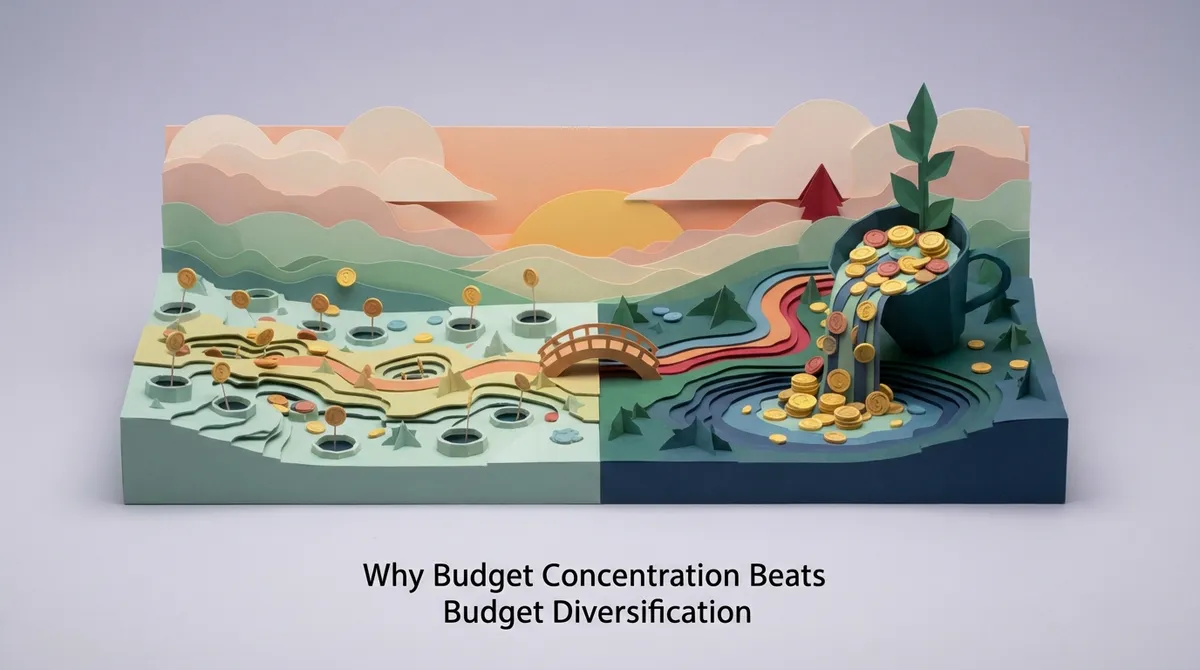
Why Budget Concentration Beats Budget Diversification
Many businesses spread their marketing dollars across every available channel. It feels safe. It feels balanced. But the data proves it is one of the fastest ways to lose ground in 2026.
According to research covering thousands of marketers, 61% of B2B marketers are increasing their overall spend this year. B2C marketers are following closely, with 57% also increasing budgets. Yet even teams with growing budgets are cutting specific channels aggressively. They are not spreading more — they are concentrating more.
The key question every marketer should ask before allocating a single dollar is this: “Is this channel giving me clearer intent signals than it did last year?” If the answer is no, that channel belongs on your cut list. If the answer is yes, that is where you concentrate your firepower.
The gap between simply using AI tools and actually getting results from them is where most marketing budgets are currently being wasted. Teams experiment everywhere instead of doubling down on what is already working. Our digital marketing services are built around this exact principle — focus, precision, and measurable results.
The 3 Biggest Budget Shifts Happening Right Now
Understanding where money is moving helps you make smarter decisions. Here are the three most significant budget shifts taking place across the digital marketing landscape in 2026.
1. AI SEO Is the Fastest-Growing Investment
AI SEO investment has jumped 98%, making it the single biggest growth area in recent marketing data. The reason is straightforward. Zero-click searches and AI-generated overviews have completely changed how visibility works online.
You are no longer just optimizing for a click. You are optimizing to be cited as an authoritative source inside the AI-generated answer itself. This means your content must demonstrate expertise, trustworthiness, and authority — what Google E-E-A-T standards define as essential for ranking in modern search environments.
Our SEO approach at Brain Buzz Marketing goes beyond traditional optimization. We write for Search Engine Optimization (SEO), Generative Engine Optimization (GEO), and Answer Engine Optimization (AEO) — ensuring your brand surfaces in AI-driven results and large language model responses.
2. Influencer Marketing Is Surging
Influencer marketing grew 78%, with 69% of marketers increasing their spend. This is no longer about Instagram sponsorships. Brands are betting that trust-driven recommendations convert better than cold paid clicks.
Consumers trust people over brands. Influencers create awareness and social proof earlier in the buyer journey — exactly where traditional attribution becomes harder to track. The brands cutting organic social budgets are often redirecting those dollars into influencer partnerships instead.
3. Organic Social Budgets Are Falling Fast
Organic social media budgets are facing the steepest pullback in recent data. A full 64% of marketers are decreasing their organic social spend. The reason is not that social media stopped working. It is that the game has completely changed.
Social platforms have shifted from follower-based networks to interest-based media. Your brand no longer competes only against businesses in your niche. You now compete against every piece of entertaining content on the internet. That requires skills most traditional marketing teams were never hired to develop — scripting, video production, storytelling, and on-camera presence.

How Intent Precision Beats Broad Reach
The biggest budget shift in 2026 is not from one channel to another. It is from broad reach to precise intent. The channels absorbing the most capital are those that capture buyers at the moment they are ready to act.
Here is how the top-performing channels stack up against each other:
|
Channel |
Budget Trend |
Primary Strength |
|---|---|---|
|
AI SEO |
+98% increase |
Authority in AI-generated answers |
|
Influencer Marketing |
+78% increase |
Trust-driven discovery and social proof |
|
Paid Search |
Stable / growing |
High-intent, clear attribution |
|
Email Marketing |
Stable / growing |
First-party data, consistent delivery |
|
CRO and UX |
+52% increasing |
Revenue maximization per visit |
|
Organic Social |
-64% decreasing |
Discovery (but skills gap is limiting) |
Paid search, email, and conversion rate optimization (CRO) remain vital because they offer clear attribution. You can prove what is working. In an environment where every dollar counts, that clarity becomes a competitive advantage. Learn more about how effective SEO services near you can help you capture high-intent traffic at exactly the right moment.

Why Measurability Is Now Your Competitive Moat
Third-party data signals continue to degrade. Cookies are disappearing. Platform algorithms are less predictable. In this environment, the ability to measure your marketing clearly has become one of the most powerful competitive advantages a business can have.
Budgets are consolidating into measurable channels for a simple reason: when you cannot prove ROI everywhere, you protect budget in places where you can. Here is what the data shows about resilient, measurable channels:
-
Email and lifecycle marketing: 60% of marketers are keeping spend flat, and 23% are increasing it. First-party data enables consistent message delivery even as paid reach declines.
-
CRO and UX investment: 52% of marketers are increasing spend. Fewer clicks mean you must squeeze more revenue from every visit.
-
Paid search: Still a cornerstone channel because intent is clear and attribution is direct.
-
Content marketing: Shifting toward fewer, higher-impact pieces rather than volume-based publishing.
The best-performing teams are not just defending measurable channels. They are using first-party data to make every channel more measurable. That is the sophisticated move happening beneath the surface of these budget shifts.
Our content writing services are designed with this measurability mindset — every piece of content is built to rank, convert, and be tracked. You can also explore our work and track record by checking out our client testimonials.
The 4-Part Framework for Smarter Budget Allocation
Budget decisions in 2026 should not be driven by trends. They should be driven by evidence. Here is a four-part framework for allocating your marketing dollars with confidence and defensibility.
Step 1: Anchor Spend in Proven Demand
Start by protecting the budget tied directly to revenue and high-intent activity. These are your foundation channels: paid search, email, CRO, and SEO. If you cannot defend these budgets with clear ROI data, you have a bigger problem than allocation.
For local businesses especially, this means investing in channels that connect you with nearby buyers who are actively searching. Our local SEO services are specifically designed to capture that high-intent, location-specific traffic.
Step 2: Build Flexibility Around Performance Signals
Do not lock yourself into annual commitments for channels that are not delivering. Set aside 10–15% of your budget for experimentation without destabilizing what already works. Shift dollars based on real outcomes, not assumptions.
The teams that win in 2026 are reviewing performance monthly and moving budget mid-quarter when signals change. They are not waiting for annual planning cycles to catch up to market reality.
Step 3: Separate Experimentation from Core Investment
The most expensive mistake marketing teams make is treating every new channel as if it deserves equal budget. New channels must earn their allocation by proving results — not by being popular or trendy. Here is how to think about new channel investment:
-
Start with a small, defined test budget (no more than 10–15% of total spend).
-
Set clear performance benchmarks before launching the test.
-
Measure incrementality — does this channel add results beyond what you already achieve?
-
Scale only when the data justifies it, not when the channel feels exciting.
Step 4: Reallocate Faster Than Your Competitors
Speed of adjustment is a competitive advantage in volatile conditions. The businesses that win are the ones that can shift budget mid-quarter based on real performance signals. Annual planning cycles are no longer sufficient in a landscape that changes this quickly.
Ask yourself three questions right now:
-
Are more than 30% of your marketing dollars in channels you cannot measure confidently? If yes, that is a red flag.
-
Are you investing in channels where intent signals are getting stronger — or weaker?
-
Can you reallocate budget mid-quarter, or are you locked into commitments made months ago?
What This Means for Small Businesses and Local Service Providers
If you run a small business or local service company, these trends carry specific implications. You do not need a massive budget to compete — but you do need to spend strategically. Here is what to prioritize:
-
Invest in local SEO first. High-intent, location-specific searches deliver some of the best ROI available to small businesses. Explore our guide on 7 ways local SEO near you drives more customers in 2026.
-
Build your email list aggressively. First-party data is more valuable than ever as third-party signals degrade.
-
Focus on your website’s conversion rate. Fewer visitors convert when your site is not optimized. A well-designed custom website can dramatically increase the revenue you generate from existing traffic.
-
Explore influencer partnerships. Even micro-influencers in your local market can deliver trust-driven traffic at a fraction of traditional ad costs.
-
Cut channels you cannot measure. If you cannot track what a channel is contributing to your bottom line, it belongs on your review list.
For startups and e-commerce retailers, the same principles apply. Anchor spend in provable demand. Build flexibility. Experiment carefully. And move faster than your competitors when the data tells you to. You can also follow Brain Buzz Marketing on Facebook and Instagram for regular updates on the latest digital marketing strategies.
The Channels That Are Winning — and Losing — in 2026
To summarize the major shifts, here is a clear breakdown of where budgets are moving and why:
Channels gaining budget:
-
AI SEO and generative engine optimization (GEO)
-
Influencer and creator partnerships
-
Email marketing and lifecycle automation
-
Paid search and PPC advertising
-
Conversion rate optimization (CRO)
Channels losing budget:
-
Organic social media (for most brands without entertainment-level content skills)
-
Traditional display advertising
-
Broad-reach campaigns without clear attribution
The pattern is clear. Marketers are putting more money into channels that drive measurable conversions and customer retention. They are pulling back from traditional approaches that lack clear attribution and deliver diminishing returns.
Understanding what local search engine optimization can do for your business is a great starting point. If you are unsure whether your current strategy is working, reviewing the 9 signs you need an SEO agency near you can provide useful clarity.
Take Action Before Your Competitors Do
Marketing is changing in 2026 — and the window to get ahead is open right now. The businesses that act on these budget shifts today will build a structural advantage that compounds over time. Those that wait will find themselves chasing a gap that keeps growing.
At Brain Buzz Marketing, we help small and medium-sized businesses navigate exactly these kinds of shifts. As a 100% virtual agency with decades of experience dating back to 1998, we bring big-agency results without the overhead. From SEO to paid advertising to custom website design, every solution we build is focused on measurable outcomes. Visit us on Google to see what our clients are saying about the results we deliver.
If you are ready to stop wasting your marketing budget and start investing where it actually counts, now is the time to act. Reach out to our team today and let us help you build a smarter, faster, more defensible marketing strategy for 2026 and beyond.
FAQs
Q: Why are marketing budgets shifting so dramatically in 2026?
A: Marketing budgets are shifting because buyer behavior has changed. Consumers now discover brands through AI search tools, validate through trusted voices, and convert through high-intent channels. Marketers are consolidating dollars into channels that offer clear attribution and strong intent signals, while pulling back from broad-reach tactics that are harder to measure and prove.
Q: Is organic social media still worth investing in for small businesses?
A: Organic social media can still work, but it now requires entertainment-level content creation skills — scripting, video production, and on-camera presence. Most small business teams were not built for this. A more effective approach is to partner with local influencers or creators, or redirect those dollars toward higher-intent channels like local SEO and paid search.
Q: What is AI SEO and why is it growing so fast?
A: AI SEO refers to optimizing your content to appear as an authoritative source within AI-generated search results and answer engines. It is growing fast because search behavior has shifted — many users now receive answers directly from AI tools without clicking a traditional link. Brands that appear inside those answers gain significant visibility and trust.
Q: How much of my marketing budget should I set aside for testing new channels?
A: Industry data and leading marketing practitioners recommend setting aside 10 to 15 percent of your total marketing budget for experimentation. This allows you to test new channels and tactics without destabilizing the core investments that are already delivering measurable results. Any new channel should be required to prove its value before receiving a larger allocation.
Q: How do I know if my current marketing budget is being wasted?
A: A clear warning sign is when more than 30 percent of your marketing budget sits in channels you cannot measure confidently. Additional red flags include a heavy reliance on last-click attribution, spending on channels where intent signals are weakening year over year, and an inability to reallocate budget mid-quarter based on real performance data.