
Key Takeaways
-
Website optimization is an ongoing investment with compounding returns, not a one-time expense—a well-optimized site continues generating leads and traffic without paying per click, creating sustainable competitive advantage over paid advertising alone.
-
Professional website optimization covers seven interconnected areas: technical fixes, on-page SEO, page speed, mobile responsiveness, content optimization, conversion rate improvements, and local search—all must work together to maximize results.
-
Prioritize technical fixes first before content or design work, as broken links, slow speeds, and mobile issues act as roadblocks preventing Google from properly crawling and ranking your site.
-
Implement a structured seven-step process: conduct a full audit, fix technical issues, optimize on-page SEO, improve content (including AI-driven search optimization), target local search, improve conversions, and continuously monitor metrics monthly.
-
Most businesses see measurable results within 60-120 days depending on site condition and market competitiveness; basic optimization packages suit startups while full-service packages (120-180 days) are needed for competitive e-commerce markets.
-
Choose partners based on transparent processes, proven case studies with measurable outcomes, and their own strong online presence—verify they practice what they preach by checking their portfolio's speed scores and search rankings.
Your website is your most powerful sales tool. But if it is slow, hard to find, or confusing to navigate, it is costing you customers every single day. That is where professional website optimization services come in. These services are designed to improve every layer of your website — from how fast it loads to how well it ranks on Google — so that more visitors find you and more of those visitors become paying customers.
Whether you run a local service business in Tampa or manage an e-commerce store, website optimization is not optional in 2026. It is the foundation of a successful digital marketing strategy. This guide will walk you through exactly how to use website optimization services effectively, what to look for, and how to get measurable results from your investment.

What Website Optimization Services Actually Include
Many business owners assume website optimization simply means making a site look better. In reality, it covers a wide range of technical, content, and performance improvements. Understanding what is included helps you ask the right questions and choose the right partner.
Professional website optimization services typically cover the following core areas:
- Page speed optimization: Reducing load times so visitors do not leave before the page appears
- On-page SEO: Optimizing titles, headings, meta descriptions, and content for target keywords
- Mobile responsiveness: Ensuring your site works perfectly on phones and tablets
- Technical SEO: Fixing crawl errors, broken links, duplicate content, and site structure issues
- Conversion rate optimization (CRO): Improving calls-to-action, forms, and layout to turn visitors into leads
- Content optimization: Refreshing existing pages with keyword-targeted, authoritative content
- Core Web Vitals improvement: Meeting Google’s performance benchmarks for ranking eligibility
When these elements work together, your site becomes a true growth engine. You can learn more about these core offerings by exploring the digital marketing services available from experienced agencies.
Step-by-Step: How to Use Website Optimization Services Effectively
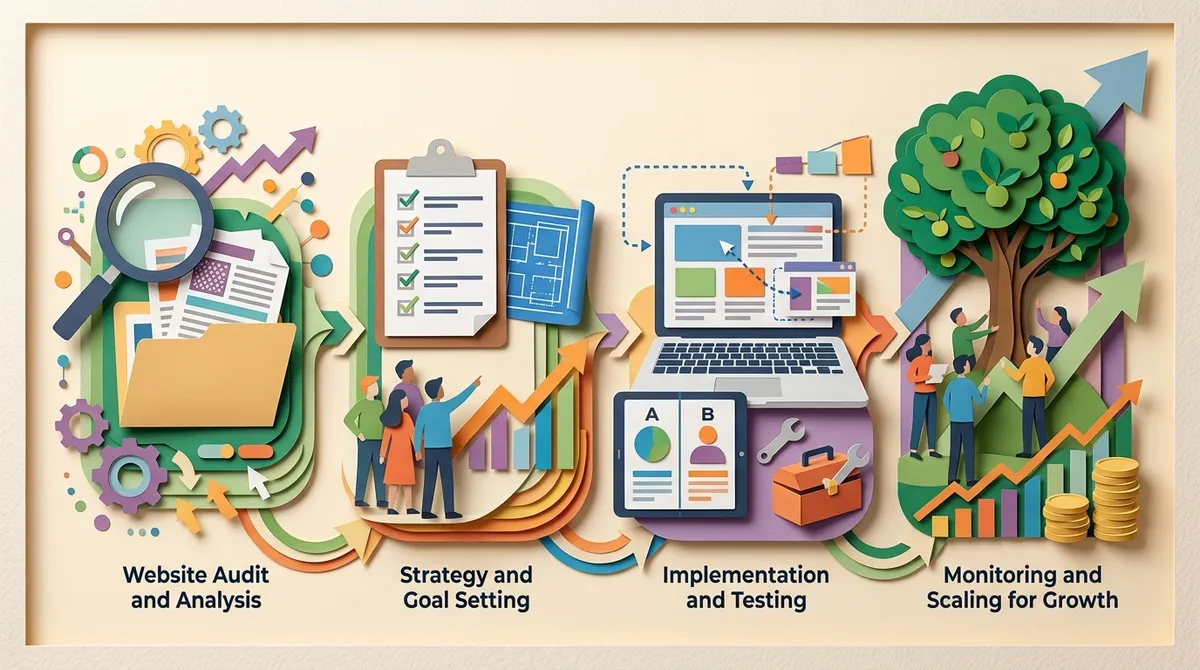
Using website optimization services is not a one-time task. It is an ongoing process with clear phases. Here is how to approach it the right way.
Step 1: Conduct a Full Website Audit
Before any optimization begins, you need to know what is broken and what is working. A comprehensive site audit will identify technical errors, speed issues, content gaps, and SEO weaknesses. This gives your optimization partner a clear roadmap.
A quality audit should evaluate:
- Page load speed on desktop and mobile
- Indexation status and crawl errors
- Current keyword rankings and traffic data
- Internal link structure and navigation flow
- Content quality and keyword relevance
Step 2: Prioritize Technical Fixes First
Technical issues act as roadblocks. Google cannot rank a site it cannot properly crawl and index. Before working on content or design, technical problems must be resolved. This includes fixing broken links, improving site speed, and ensuring proper mobile formatting.
If your site runs on WordPress, these fixes are often faster and less costly to implement. Reliable WordPress hosting also plays a key role in site speed and uptime, both of which affect your Google rankings directly.
Step 3: Optimize On-Page SEO Elements
Once technical issues are resolved, focus on on-page optimization. This means updating every page to clearly communicate its topic to both users and search engines. Strong SEO at the page level is one of the highest-impact actions you can take.
On-page SEO tasks include:
- Writing keyword-rich title tags under 60 characters
- Crafting compelling meta descriptions that encourage clicks
- Using H1, H2, and H3 headings with relevant keywords
- Adding internal links to connect related pages across your site
- Optimizing image alt text and file names
Step 4: Improve and Expand Your Content
Content is the backbone of website optimization. Search engines reward pages that answer user questions thoroughly and accurately. Thin or outdated content is a major reason why sites lose rankings over time.
Professional content writing services can help you create keyword-targeted articles, service pages, and landing pages that attract organic traffic. In 2026, content must also be optimized for AI-driven search results through Generative Engine Optimization (GEO) and Answer Engine Optimization (AEO). This ensures your brand appears not just in traditional search results but also in large language model responses.
According to Google E-E-A-T guidelines, content must demonstrate experience, expertise, authoritativeness, and trustworthiness to rank well in competitive markets.
Step 5: Optimize for Local Search
If your business serves a specific geographic area, local SEO is a critical part of your website optimization strategy. Local search optimization helps you appear in map results and local pack listings when nearby customers search for your services.
Key local optimization actions include:
- Adding your city and service area to title tags and page content
- Creating location-specific landing pages
- Keeping your Google Business Profile accurate and updated
- Building local citations and directory listings
- Generating genuine customer reviews
For businesses in the Tampa area, working with a dedicated local SEO services provider can make a significant difference in how quickly you rank for nearby searches. You can also explore 7 ways local SEO near you drives more customers in 2026 for deeper insight.
Step 6: Improve Conversion Rate Elements
Getting traffic to your site is only half the battle. Your site must also convert those visitors into leads or customers. Conversion rate optimization (CRO) focuses on removing friction from the user journey.
Effective CRO improvements include:
- Placing clear, action-oriented calls-to-action above the fold
- Simplifying contact forms to ask only essential questions
- Adding trust signals like reviews, certifications, and case studies
- Using heatmaps and analytics to identify where users drop off
- A/B testing different headlines, button colors, and layouts
You can view the testimonials and certifications of experienced agencies to understand what accountability and proven results look like.
Step 7: Monitor, Measure, and Refine
Website optimization is not a set-it-and-forget-it process. After implementing changes, you need to track performance metrics consistently. Regular monitoring ensures you catch new issues quickly and build on what is working.
Key metrics to track monthly include:
- Organic search traffic (total sessions from Google)
- Keyword ranking positions for target terms
- Bounce rate and average session duration
- Conversion rate (leads or sales divided by visitors)
- Core Web Vitals scores in Google Search Console

Comparing Website Optimization Service Packages
Not all website optimization services are created equal. The table below breaks down what different service tiers typically include to help you identify the right level of support for your business.
| Service Level | Best For | Key Inclusions | Expected Timeframe for Results |
|---|---|---|---|
| Basic Optimization | Startups and small local businesses | Technical audit, speed fixes, meta tag updates | 60–90 days |
| Growth Package | Growing SMBs and service businesses | On-page SEO, content optimization, local SEO, CRO | 90–120 days |
| Full-Service Optimization | E-commerce and competitive markets | All of the above + GEO/AEO content, PPC integration, reporting | 120–180 days |
Understanding the scope of each tier helps you set realistic expectations and invest at the right level for your growth goals.

Signs Your Website Needs Optimization Right Now
Many businesses delay optimization until problems become critical. Here are clear warning signs that your website needs professional attention immediately:
- Your site takes more than 3 seconds to load on mobile
- Your Google rankings have dropped over the past few months
- Your bounce rate is above 70% across key landing pages
- You are not appearing in local search results for your primary services
- Your contact form generates few or no submissions despite steady traffic
If any of these apply, it is time to act. You can also read 9 signs you need an SEO agency near you for a more complete diagnostic checklist.
How to Choose the Right Website Optimization Partner
Choosing the wrong agency can waste your budget and damage your rankings. Here is a clear process for evaluating potential partners.
- Review their portfolio: Look at actual websites they have built and optimized. Check speed scores using Google PageSpeed Insights.
- Ask about their process: A reputable agency will explain their audit, strategy, and reporting process clearly.
- Check transparency: You should always know what work is being done and why. Agencies that hide their methods are a red flag.
- Look for proven results: Case studies, client testimonials, and measurable outcomes demonstrate real expertise.
- Verify their digital presence: An agency that ranks well and maintains an active online presence — including on Facebook and Instagram — practices what they preach.
Brain Buzz Marketing has served small and medium-sized businesses in the Tampa area since 1998. As a husband-and-wife led virtual agency, they offer the personal attention of a boutique firm with the expertise of a seasoned team. You can learn more about their background on the about Brain Buzz Marketing page or visit their Google Business Profile to see what clients are saying.
For Tampa-area businesses specifically, a local expert makes a real difference. Explore options with a trusted Tampa website designer who understands your market and your audience. You can also read how to choose SEO services that actually grow your business for additional guidance on evaluating agencies.
The Long-Term Value of Website Optimization Services
Website optimization is not an expense — it is an investment with compounding returns. A well-optimized site continues to attract organic traffic, generate leads, and build brand authority month after month without paying for every click.
As your site earns more authority through consistent optimization, content, and technical improvements, your cost per lead decreases while your visibility increases. This creates a sustainable competitive advantage that paid advertising alone cannot replicate.
Businesses that invest in professional website optimization services consistently outperform those that rely solely on word-of-mouth or social media. In 2026, with AI-driven search becoming more prominent, optimization is more important than ever. Your site must be built for both human readers and intelligent search systems.
Conclusion
Website optimization services give your business the foundation it needs to compete and grow online. From technical fixes and on-page SEO to content strategy and conversion improvements, each element works together to bring you more traffic, more leads, and more revenue. The key is starting with a clear audit, following a structured process, and partnering with an agency that delivers transparent, measurable results.
If you are ready to turn your website into your best-performing marketing asset, get in touch with our team today and take the first step toward sustainable online growth.
FAQs
Q: What are website optimization services and what do they include?
A: Website optimization services are professional solutions designed to improve a website’s performance, visibility, and conversion rate. They typically include technical SEO fixes, page speed improvements, on-page content optimization, mobile responsiveness enhancements, and local SEO strategies that work together to drive more qualified traffic and leads.
Q: How long does it take to see results from website optimization?
A: Most businesses begin to see measurable improvements within 60 to 120 days, depending on the current state of the site and the competitiveness of the target market. Technical fixes and on-page SEO updates tend to produce faster results, while content-driven and authority-building strategies build momentum over several months.
Q: Is website optimization the same as SEO?
A: SEO is one important component of website optimization, but not the only one. Website optimization also encompasses page speed, mobile usability, conversion rate optimization, site architecture, and content strategy — all of which work together to improve both search rankings and user experience.
Q: How do I know if my website needs optimization services?
A: Common signs include slow page load times, declining search rankings, a high bounce rate, low conversion rates, or poor visibility in local search results. A professional website audit is the most reliable way to identify specific issues and prioritize the fixes that will have the greatest impact on your business.
Q: Can website optimization services help my local business attract more nearby customers?
A: Absolutely. Local SEO is a core part of website optimization for service-area businesses. By optimizing location-specific pages, updating your Google Business Profile, and targeting geo-relevant keywords, website optimization services can significantly increase your visibility among customers searching for services in your area.