Key Takeaways
-
AI agents are now the primary audience for content—they dissect and cite specific information in real time, making machine-readable structure and direct answers critical for visibility in agent-driven search results.
-
Citation frequency in AI responses and agent retrieval rates are replacing keyword rankings and click-through rates as the key metrics that define marketing success in 2026.
-
Over 70% of daily searches happen outside Google across YouTube, TikTok, ChatGPT, Perplexity, and other platforms—brands must build authoritative presence across these AI-powered research channels to remain competitive.
-
Structure your content with leading answers, schema markup, clear attribution, and layered depth to optimize for AI citation; this new competitive moat is built through systematic, authoritative information architecture rather than traffic volume.
-
AI-referred visitors convert at 30-40% higher rates than organic search traffic despite representing less than 1% of site traffic—early adoption of agent-focused content strategies in 2026 compounds advantage faster than catching up later.
-
Build integrated content pipelines with feedback loops that measure agent retrieval and citation data, moving from one-off AI tools to systematic AI-integrated operations that continuously improve based on real performance metrics.
Something significant shifted in the first half of 2026. Five of the most powerful CEOs in the AI industry — Sam Altman, Jensen Huang, Sundar Pichai, Satya Nadella, and Elon Musk — each made bold statements about where technology is heading. Separately, their comments seemed like routine executive updates. Together, they reveal a pattern that every business owner and marketer needs to understand right now.
They all stopped talking about AI models. They started talking about AI systems, infrastructures, and agents. For anyone involved in digital marketing services, this shift changes how content must be created, measured, and distributed. This article breaks down what each CEO said, what it means for your marketing strategy in 2026, and exactly what you should do about it starting this week.
What Five AI CEOs Said About 2026
Each of these leaders comes from a different company with a different focus. But their messages align in a way that is too consistent to ignore. Here is what each CEO said and why it matters for marketing 2026.
Sam Altman: Intelligence Becomes a Utility
OpenAI’s CEO published a post called “The Gentle Singularity” in which he described 2025 as the year AI agents began doing real cognitive work. He predicted that 2026 would bring AI systems capable of generating novel insights on their own. He also said something that stands out clearly: “We see a future where intelligence is a utility like electricity or water.”
When electricity became a utility, you stopped thinking about how it worked — you just used it. Altman is saying AI will reach that same level. Autonomous agents will run for weeks, completing research tasks and making purchasing recommendations. The critical question for your business is: will those agents pull information from your content, or from a competitor’s? To understand more about how AI is reshaping search visibility, read about what AEO is and why your business needs it.
Jensen Huang: AI Is Now Essential Infrastructure
NVIDIA’s CEO stated at GTC 2026 that AI is no longer a single application — it is essential infrastructure. He added that the “inference inflection” has arrived, meaning AI can now do productive work at scale. NVIDIA is reportedly sitting on a trillion-dollar chip backlog through 2027, with demand doubling in just 12 months.
The marketing translation is direct. When the person who physically powers the AI economy tells you that AI has moved from training to productive work, he is telling you the audience for your content has changed. AI agents are now transforming how websites get found, and that infrastructure is already in place.
Sundar Pichai: Google Search Becomes an Agent Orchestrator
Google’s CEO described the evolution of Search into what he called an “agent orchestrator” — a system that autonomously completes complex tasks. He also acknowledged that Google Search and Gemini will overlap in some ways and profoundly diverge in others. Gemini 3 Pro reached 750 million monthly active users, which Pichai described as the fastest adoption of any model in Google’s history.
This means the question for your website is no longer simply, “Does my page rank for this keyword?” The real question is: “Does the AI agent select my content when completing a task for a user?” That is an entirely different optimization problem. Learn more about how to get cited on Google’s AI Mode to stay ahead of this shift.
Satya Nadella: From Models to Systems
Microsoft’s CEO published a post in December 2025 that framed the transition clearly: “We will evolve from models to systems when it comes to deploying AI for real-world impact.” At Davos 2026, he added that if AI creates real surplus across industries — the way electricity did — it is a transformation, not a bubble.
He also described AI agents as teammates, not tools. Later, Microsoft launched an internal “Copilot code red” initiative driven by competitive pressure. This is not a marketing announcement. This is a real internal fire drill from one of the largest technology companies in the world. For marketers, the message is clear: move from using AI as a one-off tool to building AI-integrated systems.
Elon Musk: Entire Professions Become Agent Platforms
Musk’s timelines are aggressive, and it is worth acknowledging that openly. However, even if you cut his predictions in half, the direction is clear. He announced “Macrohard,” an AI agent system designed to perform anything a white-collar worker can do on a computer. He also predicted that programming as a profession could significantly decline as AI generates code directly from human language.
The marketing implication is this: entire workflows are being rebuilt as agent-driven platforms. If a manager’s research job is being automated, then your content is increasingly being read by an agent performing that manager’s job — not the manager themselves.
The Three Fundamental Changes for Marketers
When you look at all five CEOs together, the pattern becomes clear. The era of standalone AI models is ending. The era of AI systems and agents is beginning right now, in 2026. This creates three fundamental changes in how marketing works.
Change 1: Your Content’s Audience Has Changed
Most marketers are still writing as if the reader is a human who clicked a link, skimmed a page, and decided whether to trust the source. That assumption is breaking down fast.
-
Agents do not skim — they dissect and extract
-
Agents do not save articles for later — they cite specific information in real time
-
A buyer asking ChatGPT “What is the best B2B marketing agency?” never visits your website directly
-
The agent reads your content and decides whether to include you in its answer
-
If your content is not structured for machine readability, you are invisible
Data from NP Digital shows that AI platforms currently drive less than 1% of total site traffic but generate 9.7% of B2B revenue and 11.4% of B2C revenue. That gap between volume and value is a clear signal. AI-referred visitors convert at a significantly higher rate than organic search traffic. To explore this further, read about why LLM-referred traffic converts at 30–40%.
Change 2: Your Metrics Need to Change
Rankings and clicks are becoming lagging indicators in the agent era. The metrics that matter now are different from what most marketing dashboards currently track.
|
Old Marketing Metrics |
New Agent-Era Metrics |
|---|---|
|
Keyword rankings |
Citation frequency in AI responses |
|
Organic click-through rate |
Agent retrieval rate |
|
Page views |
Content authority score across platforms |
|
Time on page |
Structured data completeness |
|
Bounce rate |
AI platform referral revenue |
Most marketing teams are currently measuring the wrong things. They are flying blind on the metrics that actually define authority in 2026. Understanding analytics and data-driven marketing reporting has never been more important than it is right now.
Change 3: Your Competitive Moat Has Shifted
For years, the moat in digital marketing was straightforward: publish more content, rank higher, capture more traffic, and outspend on distribution. That moat is being replaced by something fundamentally different in 2026.
The new competitive moat is becoming the source that AI systems trust, pull from, and recommend by default. You do not build that with a clever prompt or a new software subscription. You build it with a system — a content and data architecture that is structured, authoritative, and machine-readable at scale. Learn how Generative Engine Optimization (GEO) is shaping this new approach to digital visibility.
Three Practical Actions to Take Right Now
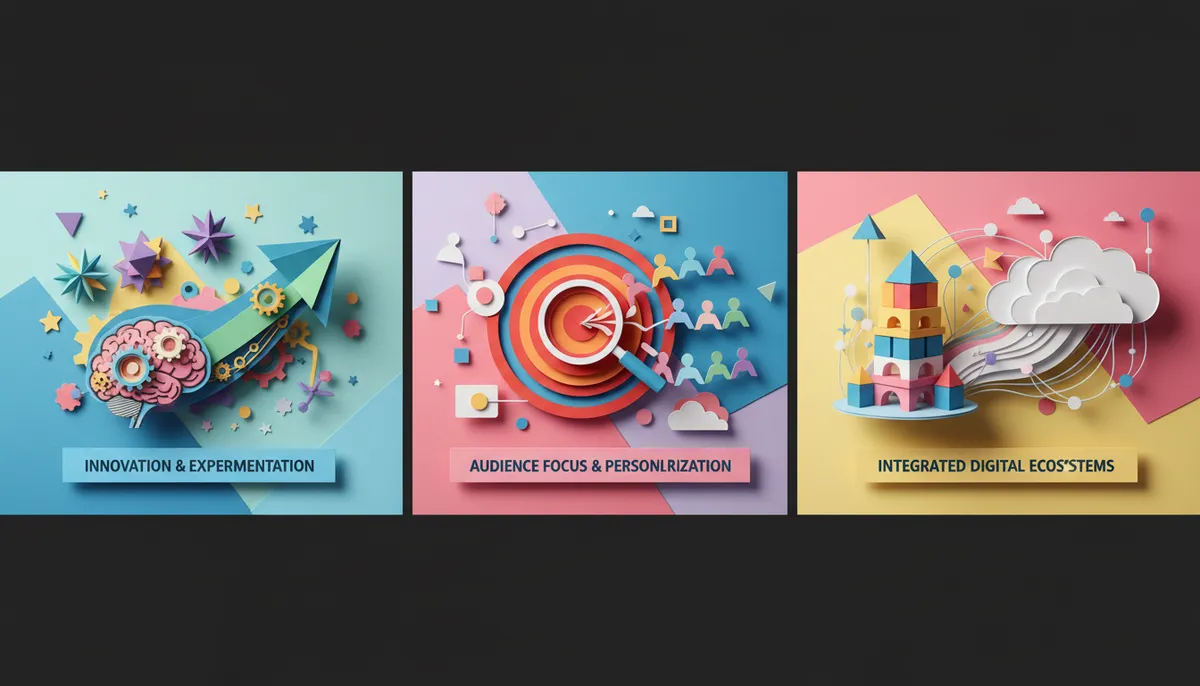
Understanding the shift is only half the work. Here are three concrete steps you can begin implementing this week to position your brand for the agent era in marketing 2026.
Step 1: Build for Citation, Not Just Ranking
The way you structure your content needs to change immediately. AI agents decide which sources to pull from based on specific signals. Follow these guidelines to improve citation potential:
-
Lead with direct answers. Place your most important insight in the first paragraph, not buried in paragraph fourteen.
-
Use structured data markup. Schema markup helps AI systems identify, categorize, and cite your content accurately.
-
Include clear attribution. Well-sourced, factual content with transparent references earns more AI citations.
-
Layer depth beneath the direct answer. Give the agent a clear answer first, then support it with detail below.
-
Make content machine-readable. Use descriptive headers, concise paragraphs, and organized lists throughout.
Track how often your content appears in AI-generated responses — not just where it ranks on Google. This is the new key performance indicator. Tools like Ubersuggest’s AI Visibility report can show you exactly which pages are being pulled into AI responses and which are invisible to agent systems. You can also explore how to optimize for AI search results in 2026 with a more detailed strategy guide.
Step 2: Own the Research Layer Across Platforms
Here is a fact that surprises many marketers: Google is no longer where most research happens. When you add up all platforms — YouTube, TikTok, ChatGPT, Perplexity, Claude, and others — the total daily volume of searches across the internet exceeds 50 billion queries per day. Google accounts for roughly 13.7 billion of those. That means over 70% of daily search happens outside of Google’s control.
Your brand needs to be present across these platforms through contributions, community engagement, and structured visibility. If your brand exists only as a ranked URL on Google and nowhere else, you are invisible to a growing share of the research that drives real purchasing decisions. Consider these platforms for brand presence:
-
YouTube — the second-largest search engine in the world
-
TikTok — increasingly used for product and service research
-
ChatGPT and other AI assistants — used by roughly 30% of people for answers
-
Perplexity and Claude — rapidly growing research platforms
-
Industry forums, review sites, and community platforms
A strong content writing strategy that distributes authoritative information across these surfaces is no longer optional — it is a core component of competitive visibility. See how content remains the backbone of SEO in 2026, even as the platforms evolve. Staying consistent across social channels, including Brain Buzz Marketing on Instagram, is one practical way to build that multi-platform presence.
Step 3: Build Systems, Not Just Tactics
This is the throughline from every CEO covered in this article. Satya Nadella said it most directly: models to systems. The marketers who win in the agent era are not the ones experimenting with AI tools one at a time. They are the ones building integrated pipelines with measurement loops and feedback systems.
-
Create a content strategy pipeline. Strategy feeds production, production gets published with structured data, and performance data flows back into the next content cycle.
-
Measure agent retrieval and citation frequency. Build this into your regular reporting alongside traditional SEO metrics.
-
Develop a feedback loop. Use citation and retrieval data to continuously improve the topics, structure, and format of your content.
-
Ensure your website is technically optimized. A fast, well-structured custom website design is the foundation that supports all content and AI visibility efforts.
This is what compounds over time. That is the competitive moat. Small, proactive steps taken now are worth significantly more than large reactive moves taken 18 months from now, when every competitor has already caught on. The fundamentals of Answer Engine Optimization provide a strong framework for building this kind of durable system. Understanding the difference between SEO vs. AEO and which strategy wins for your specific business will also help you prioritize effectively.
What This Means for Small and Mid-Sized Businesses
If you run a small business, manage marketing for a local service company, or operate an e-commerce store, this shift is not only for large enterprises. In fact, smaller and more agile businesses have a real opportunity to move faster than slower-moving competitors.
The brands that show up in AI-generated answers are not necessarily the biggest brands — they are the most structured, most authoritative, and most clearly organized sources. A local service provider with well-structured content, strong reviews, and consistent multi-platform visibility can absolutely outperform a large national brand that has not yet adapted. Learn more about how local SEO drives more customers in 2026 in the context of AI-driven search.
This is exactly the kind of strategic shift that Brain Buzz Marketing helps businesses navigate. As a Tampa-based digital marketing agency with decades of experience across SEO, GEO, AEO, Google Ads, and custom website design, the team understands both the technical and creative sides of adapting to AI-driven search. Visit Brain Buzz Marketing on Google to read real client results and see what is possible when your digital strategy is built for where search is actually heading.
Building authority that AI systems trust requires the same principles that have always driven quality content: accuracy, clarity, structure, and genuine expertise. The Google E-E-A-T framework — Experience, Expertise, Authoritativeness, and Trustworthiness — remains the foundation for content that earns both human trust and AI citations. Those principles are more important in 2026 than they have ever been.
The Window for Early Advantage Is Narrowing
Every major structural shift in digital marketing has rewarded early movers. Print gave way to the web. The web gave way to mobile. Organic search was joined by paid advertising. In every case, the businesses that adapted first compounded their advantage. The late movers scrambled to catch up.
The shift from AI models to AI systems and agents is one of those structural moments. The ROI data makes this clear: companies that adopted Answer Engine Optimization (AEO) strategies saw a negative 28% ROI in 2024 — when the infrastructure was not yet ready. In 2025, the same strategy returned a positive 144% ROI. That is not a coincidence. That is the timing of infrastructure reaching maturity. And 2026 is when it accelerates further.
You do not have to overhaul everything at once. Start with one piece of content restructured for citation. Add structured data markup to your highest-traffic pages. Check how your brand appears — or does not appear — in AI-generated answers for your most important keywords. Connect with us through Brain Buzz Marketing on Facebook for updates and practical tips on navigating this shift. Each small step taken now is worth significantly more than a large effort made after the window closes.
Conclusion
Five of the world’s most powerful AI CEOs delivered a consistent message in 2026: the era of AI models is ending, and the era of AI systems and agents has begun. For marketers and business owners, this means three fundamental changes — your content’s audience has changed, your metrics must evolve, and your competitive moat has shifted from volume to authority and machine-readability.
The practical response is not complicated, but it requires action. Build content for citation. Establish brand presence across all research platforms. And develop systems — not just tactics — that improve with every cycle. The businesses that take these steps now will have a meaningful advantage over those who wait. If you are ready to build a digital marketing strategy designed for where marketing 2026 is actually heading, reach out to our team at Brain Buzz Marketing and let us help you get there.
FAQs
Q: What is the most important marketing shift in 2026 according to AI CEOs?
A: The most significant shift is the transition from standalone AI models to AI systems and autonomous agents. This changes how content must be created — moving from optimizing for human readers to structuring content so that AI agents can extract, cite, and recommend it when completing tasks for users.
Q: What is Answer Engine Optimization (AEO) and why does it matter in 2026?
A: Answer Engine Optimization (AEO) is the practice of structuring content so that AI-powered answer engines and agents can accurately retrieve and cite it. It matters because AI-referred traffic, while small in volume, is generating a disproportionately high share of revenue — making citation frequency a more valuable metric than traditional keyword rankings.
Q: How should small businesses adapt their digital marketing strategy for the agent era?
A: Small businesses should focus on three priorities: restructuring content with clear, direct answers and structured data markup; building brand presence across multiple search platforms beyond Google; and developing integrated content systems with measurement loops that track AI citation frequency alongside traditional SEO metrics.
Q: Are traditional SEO rankings still relevant in marketing 2026?
A: Traditional SEO rankings remain relevant but are increasingly considered lagging indicators. The metrics that matter most now are citation frequency and agent retrieval — how often AI systems pull your content when answering user queries. A combined SEO, GEO, and AEO strategy is the most effective approach in 2026.
Q: What does ‘building for citation’ mean in a marketing context?
A: Building for citation means structuring your content so AI agents can easily identify, extract, and reference it in their responses. This includes leading with direct answers, using structured data markup, ensuring clear attribution, and organizing content with descriptive headers and concise paragraphs that are machine-readable as well as human-readable.